Home Service Marketing: The 2026 Playbook for Plumbers, Electricians, and Local Trades
A complete home service marketing playbook: the growth flywheel, owned vs rented channels, budgets by company size, the metrics that matter, and a 90-day plan.

Key takeaways
- 01 Home service marketing works as a flywheel: visibility starts conversations, conversations become booked jobs, jobs become reviews and referrals, and that proof becomes content that drives the next round of visibility.
- 02 Split every channel into owned (reviews, past customers, community presence, content) and rented (ads, lead marketplaces). Rented channels buy speed. Owned channels build a business that still gets calls when you stop paying.
- 03 Speed to lead decides more jobs than ad spend. A homeowner who reaches voicemail calls the next name, whether they found you on Google, in an ad, or in a neighborhood Facebook group.
- 04 Track cost per booked job, not cost per lead. Add speed to lead, close rate, review velocity, and share of local conversation, and most budget arguments settle themselves.
- 05 Most owners do not lack ideas. They lack hours. Otomizer Local runs the daily work for you (monitoring, responding, content, and posting) so the flywheel keeps turning while your crews stay on jobs.
Home service marketing is the system that gets a plumber, electrician, or other local trade found, chosen, and rehired by homeowners in a defined service area. The companies that win in 2026 run it as a flywheel: be visible where neighbors ask for help, answer in minutes, turn every job into a review and a referral, then use that proof to earn the next conversation.
That is the short answer. The long answer is this playbook.
It is written for owners and office managers running plumbing, electrical, HVAC, roofing, pest control, remodeling, solar, restoration, landscaping, and cleaning companies. Shops with one truck and shops with fifteen. It covers what to build, in what order, what it costs, what to measure, and when to stop doing it yourself.
No “revolutionize your brand” language. Just the parts of local service business marketing that reliably put jobs on the calendar.
What is home service marketing, really?
Most marketing advice is written for companies that sell online to anyone, anywhere. Home services are the opposite. You sell to a few thousand households inside a drive time. Your customer usually needs you because something broke, leaked, tripped, or failed. They want someone trustworthy, available, and close.
That changes the job of marketing in three ways.
Trust beats reach. A homeowner letting a stranger into their house cares more about a neighbor’s recommendation than a clever ad. Reviews, referrals, and local reputation do more work than impressions.
Timing beats targeting. The most valuable moment in home services is the hour after a problem appears. Whoever is visible and reachable in that hour gets the job. Being perfectly targeted three days later is worth nothing.
Repeat beats acquisition. A water heater customer becomes a drain cleaning customer, then a repipe, then a referral to their sister. The lifetime value of a happy household is several times the first ticket.
So marketing for home service businesses is less about campaigns and more about a machine that runs every day. Here is the shape of that machine.
The home service growth flywheel
Every healthy local trade business we look at runs some version of the same loop.
- Visibility. You are present where homeowners look or ask: neighborhood Facebook groups, Google, Maps, the yard sign on your last job, the truck parked in their street.
- Conversation. A homeowner calls, texts, books online, or asks a group “who do you use?” and someone mentions you.
- Booked job. Someone answers fast, books the visit, and shows up when promised.
- Review. The finished job turns into a public review because you asked for it in the right moment.
- Referral and repeat. The customer calls you again, recommends you in the next thread, and joins a maintenance plan.
- Content and proof. The job, the photos, the question the customer asked, and the review become posts, tips, and examples that make you more visible.
Then the loop starts again, a little faster each time.
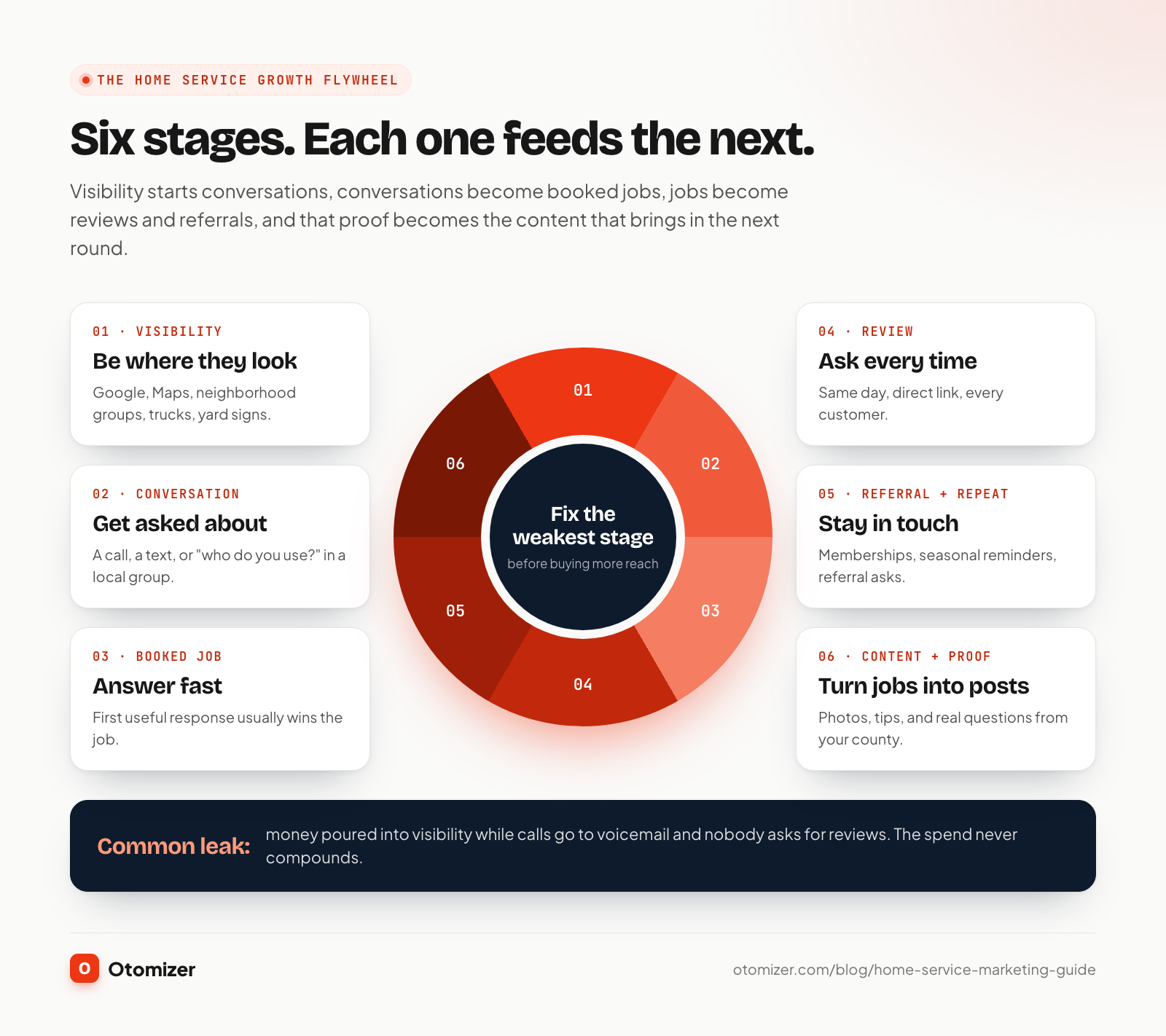
The flywheel explains why so much marketing spend gets wasted. Owners pour money into stage one (ads, listings, marketplaces) while stage three leaks. Calls go to voicemail. Estimates go out two days late. Nobody asks for reviews. The money buys visibility that never compounds.
Fix the weakest stage first. That rule alone will save most shops more money than any new channel.
Owned vs rented: the split that decides your margins
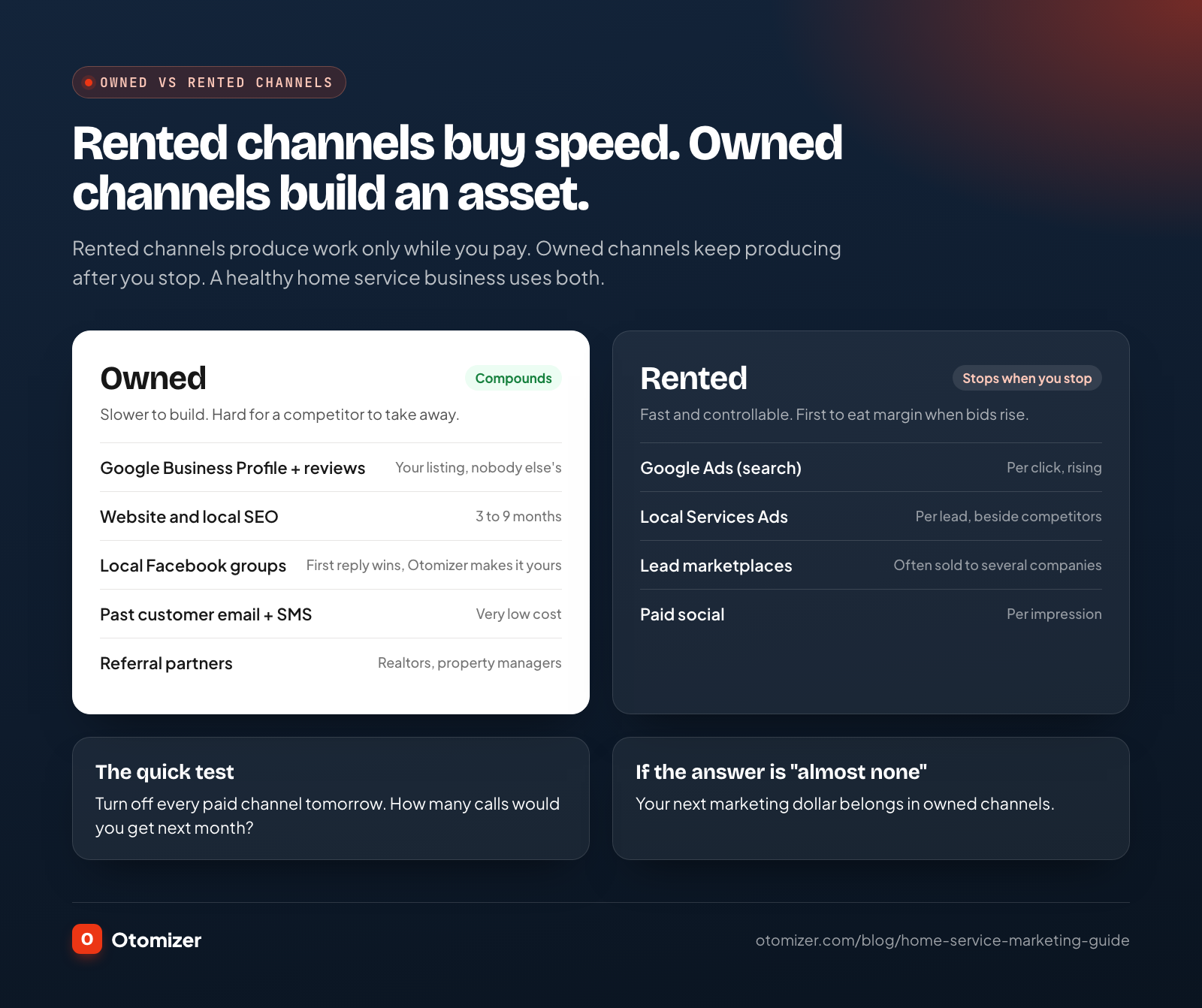
Every marketing channel you use falls into one of two buckets.
Rented channels produce work only while you pay. Google Ads, Local Services Ads, lead marketplaces like Angi and Thumbtack, paid social. They are fast and controllable. They are also the first line item that eats your margin when competitors bid up the same keywords.
Owned channels keep producing after you stop paying for them. Your reviews. Your past customer list. Your reputation in local groups. Your website’s organic rankings. Your relationships with realtors and property managers. They are slow to build and almost impossible for a competitor to take away.
| Channel | Owned or rented | Speed to first job | Cost behavior | Who else gets the lead |
|---|---|---|---|---|
| Google Business Profile and reviews | Owned | Weeks to months | Mostly time | Nobody, it is your listing |
| Website and local SEO | Owned | 3 to 9 months | Upfront build, then upkeep | Nobody |
| Local Facebook groups | Owned presence | Days | Otomizer from $89 a month, or done for you | Whoever replies first (with Otomizer, that is you) |
| Past customer email and SMS | Owned | Immediate | Very low | Nobody |
| Referral partners (realtors, property managers) | Owned | Weeks | Relationship time | Nobody |
| Google Ads (search) | Rented | Same day | Per click, rising | Competitors bid on the same terms |
| Local Services Ads | Rented | Days | Per lead | Shown alongside competitors |
| Lead marketplaces (Angi, Thumbtack) | Rented | Same day | Per lead or per contact | Often sold to several companies |
Rented channels never build anything you keep. The failure mode is running entirely on rented channels for years, then discovering that stopping is impossible because nothing else produces calls. Local group presence is the fastest owned channel to switch on, which is why it sits at the center of everything Otomizer does. We covered the marketplace side of this in detail in are Angi leads worth it and how to get contractor leads without Angi.
The local marketing stack, layer by layer
These are the layers that matter for local service business marketing, in roughly the order to build them. You do not need all of them on day one. You do need the first four before spending heavily on anything else.
1. Google Business Profile and reviews
Your Google Business Profile is the most important free asset a home service company has. When someone searches “plumber near me” or “electrician in [town],” the map results decide most of the clicks.
What moves it:
- Complete categories and services. Primary category matches your main trade. Add secondary categories and list every service you actually want, with short descriptions.
- Accurate service area. Match where you really go. Do not list a radius you will not drive.
- Fresh photos. Real trucks, real crews, real jobs. A few new photos every month signals an active business.
- Review velocity. A steady stream of recent reviews beats a big pile from three years ago. Ask every satisfied customer, every time, with a direct link.
- Owner responses. Reply to every review, good and bad, in a calm, specific voice. Future customers read the replies.
For the complete checklist, see how to rank higher on Google Maps. For request texts, reply templates and the 72-hour ask system, see how to get more Google reviews.
Never buy reviews, write them yourself, or only send the review link to customers you expect to be happy. Ask everyone the same way and let your work speak.
2. A website that converts calls, not just clicks
Your website’s job is simple: confirm you are legitimate, show you serve their area, and make it absurdly easy to call or book.
- Phone number clickable and visible at the top of every page on mobile.
- One page per core service (water heater repair, panel upgrades, drain cleaning) and one page per main town or area you serve, each with real content, not copy-paste.
- Reviews, license numbers, and photos above the fold.
- Online booking or a short form that actually gets answered.
- Fast load on a phone. Most of your visitors are standing in a wet basement.
3. Paid search and Local Services Ads
Google Ads and Local Services Ads are the fastest way to buy calls. They are also the easiest way to lose money if stage three of the flywheel leaks.
Run them with discipline: tight geographic targeting, negative keywords for jobs you do not want, call tracking per campaign, and a monthly review of cost per booked job, not cost per click. If a campaign cannot book jobs profitably after a fair test, cut it.
The problem with paid search is that every click gets more expensive as competitors bid on the same terms, and the homeowner still sees three other ads beside yours. A recommendation thread in a neighborhood group has none of that. One homeowner, one question, and the first helpful reply wins. That is where Otomizer puts you, and it is why shops that add group coverage usually find they can trim the ad budget instead of growing it.
4. Call handling and speed to lead
This is the least glamorous layer and the one with the highest return.
A homeowner with a leaking pipe calls three companies. The first one to answer usually books the job. Every other marketing dollar you spend depends on this moment.
- Answer live during business hours. If you cannot, use an answering service that can book, not just take messages.
- Return missed calls within minutes, not hours.
- Text back automatically when a call is missed so the homeowner knows someone is coming.
- Track how many calls go unanswered each week. Most owners are shocked by the number.
5. Local Facebook groups and social content
This is the highest-leverage layer in home service marketing, and the one where small companies beat big ones every day.
Every town has neighborhood groups, subdivision pages, community boards, and local buy-and-sell groups. Every day, homeowners post in them: “Anyone know a good electrician? Half the outlets in the kitchen stopped working.” “Who do you use for drain cleaning?” “Water heater is leaking, need someone today.”
Those posts are the highest intent leads in local marketing. Nobody filled out a form. Nobody is comparing twelve quotes yet. One person asked one question, and the first helpful, specific reply often gets the call.
The challenge is not finding the groups. It is watching them. Recommendation threads collect most of their useful replies in the first hour. A crew on a job cannot scroll Facebook all day. That is exactly the gap Otomizer closes: it lets you monitor facebook groups around the clock, scores every request Hot, Warm, or Cold by buyer intent, and drafts a reply in your voice so you are first in the thread. Our complete guide to monitoring Facebook groups for leads walks through keywords, scoring, and reply tone step by step.
It works. Edge Mechanical, an HVAC company outside Philadelphia, added $6,800 of extra booked work in three weeks by joining local groups and using Otomizer to surface AC, heating, and water heater requests while the crew was on other jobs.
Social content belongs in this layer too. Posting regularly on your business page and, where group rules allow it, sharing genuinely useful tips keeps your name familiar before anyone needs you. For a full content plan using HVAC as the example trade, see 75 HVAC social media post ideas with a 30-day calendar. The ideas adapt easily to plumbing and electrical.
6. Email and SMS to past customers
Your past customers are the cheapest jobs you will ever book. They already trust you, and they already have your number buried somewhere.
- Seasonal reminders: winterize outdoor spigots, test GFCI outlets, flush the water heater, schedule pest treatment before spring.
- Maintenance plan renewals and upgrade offers.
- A simple “we are in your neighborhood Thursday” message for route density.
- A referral ask once a year, with a small thank-you for referred jobs.
A few well-timed messages a year beat a weekly newsletter nobody reads.
7. Memberships and maintenance plans
Memberships turn one-time customers into recurring revenue and smooth out the slow months. Plumbers sell annual inspections and water heater flushes. Electricians sell safety checks and surge protection. Pest control is almost entirely recurring.
Members also leave more reviews, refer more neighbors, and forgive the occasional scheduling hiccup. Every membership sold makes the rest of your marketing cheaper.
8. Referral partnerships
Some businesses meet your future customers before you do:
- Realtors need inspection repairs fixed before closing.
- Property managers need reliable trades on call.
- Home inspectors flag problems that someone has to fix.
- Adjacent trades (a remodeler needs an electrician, a roofer needs a gutter company) refer constantly.
Pick five partners, deliver flawlessly on their first referral, and make it easy for them to send more. Our guide to real estate leads on Facebook shows how agents work local groups too, which makes them natural partners.
9. Community presence
Sponsor the Little League team. Show up at the town fall festival. Wrap your trucks properly and keep them clean. Leave yard signs with permission. Answer questions in local groups even when there is no job in it.
None of this shows up neatly in a spreadsheet. All of it shows up the next time a neighbor asks “who should I call?” and three people mention you.
Your next 10 clients are already posting in your groups.
Otomizer monitors your Facebook groups 24/7, scores every post Hot / Warm / Cold, and drafts replies in your voice. Live in under 5 minutes.
See plans and pricingTrade-specific notes: what changes by trade
The stack is the same across trades. The emphasis shifts.
Plumbing marketing. Emergencies dominate: leaks, backups, no hot water. Speed to lead and after-hours coverage decide everything. Local groups convert especially well because the need is urgent and the homeowner wants a name now, not a list of ads. Water heater replacements and repipes are the high-ticket jobs to aim content and reviews at. See Otomizer Local for plumbers.
Electrician marketing. Homeowners are nervous about electrical work and care deeply about licensing and safety. Lead with credentials, clear pricing for common jobs (panel upgrades, EV chargers, generator hookups), and educational content about warning signs. EV charger and generator installs are growing categories worth dedicated service pages. See Otomizer Local for electricians.
Pest control. Recurring plans are the business. Marketing focuses on seasonal triggers (ants in spring, mosquitoes in summer, rodents in fall) and converting one-time treatments into quarterly service. Local groups are full of “what are these bugs?” posts. See Otomizer Local for pest control.
Remodeling. Long sales cycles and big tickets. Portfolio content, before-and-after photos, and referrals matter most. Homeowners research for months, so staying visible over time beats any single ad. See Otomizer Local for remodelers.
Solar. Heavy competition from national installers and a lot of homeowner skepticism. Local trust, clear education on incentives and payback, and real local installs carry the most weight. See Otomizer Local for solar.
Restoration. Pure emergency demand after floods, fires, and storms. Twenty-four hour response, insurance knowledge, and partnerships with plumbers and adjusters drive the business. Storm events also flood local groups with requests. See Otomizer Local for restoration.
HVAC and roofing. Both are seasonal and high ticket. We cover them in depth in how to get HVAC leads and how to get roofing leads, with HVAC and roofing pages for done-for-you coverage.
Landscaping and cleaning. Lower ticket, high frequency, very local. Route density matters, so “we are already on your street” marketing and neighborhood group presence work especially well. Recurring service agreements are the goal.
How much should a home service business spend on marketing?
A common starting range is 5 to 10 percent of revenue. Newer companies or companies trying to grow fast often spend more for a period. Mature companies with strong referral bases often spend less.
That percentage is a sanity check, not a strategy. The real question is how much you can spend to book a job profitably, and which channels hit that number.
Here is how we would split the budget at each stage of growth. Shift money toward whatever channel books jobs at the best cost in your market.
| Company size | Owned channels | Rented channels | Notes |
|---|---|---|---|
| Owner-operator, 1 to 2 trucks | 70 percent (reviews, GBP, groups, past customers) | 30 percent (small LSA or search budget) | Time is the constraint. Build reviews and local presence before buying volume. |
| Growing shop, 3 to 8 trucks | 55 percent (add website, SEO, memberships, content) | 45 percent (search, LSA, selective marketplace) | Add a CSR or answering service before scaling ads. |
| Established company, 9+ trucks | 50 percent (brand, memberships, partnerships, content) | 50 percent (multi-campaign paid, seasonal pushes) | Measure by channel and season. Defend your reputation in local conversations. |
The metrics that matter
Most home service owners track too little or the wrong things. Leads and clicks feel good and mean little. These are the numbers that actually tell you whether marketing is working.
| Metric | What it tells you | How to measure it |
|---|---|---|
| Cost per booked job | The true price of a customer from each channel | Channel spend divided by jobs actually booked from it |
| Speed to lead | Whether you are winning the first-response race | Minutes from inquiry to first human contact |
| Booking rate | Whether your phones convert calls into appointments | Booked appointments divided by qualified calls |
| Close rate | Whether estimates turn into sold jobs | Sold estimates divided by estimates given |
| Average job value | Whether you are attracting the right work | Revenue divided by completed jobs, by channel |
| Review velocity | Whether the flywheel is compounding | New Google reviews per month |
| Share of local conversation | Whether neighbors think of you first | How often your name appears when people in local groups ask for your trade |
The last one is new for most owners, but it is the closest thing local marketing has to a brand score. If you never come up when neighbors ask “who do you use for electrical?”, no amount of ad spend fixes that. Our county demand report shows how many of those requests appear in local groups.
A 12-month home service marketing calendar
Demand in the trades is seasonal and predictable. Plan content, offers, and capacity around it instead of reacting.
| Month | Demand drivers | Marketing focus |
|---|---|---|
| January | Frozen pipes, heating failures, post-holiday budgets | Emergency response messaging, membership renewals |
| February | Cold snaps, tax refund planning | Water heater and panel upgrade content, financing offers |
| March | Spring thaw, sump pumps, pests emerging | Spring maintenance reminders to past customers |
| April | Storm season begins, outdoor projects | Restoration and roofing readiness, yard sign push |
| May | AC tune-ups, outdoor electrical, ants and termites | Seasonal tune-up campaigns, review push from spring jobs |
| June | Heat, irrigation, mosquitoes | Fast-response messaging, local group presence peaks |
| July | Peak cooling demand, vacation home checks | After-hours coverage, capacity planning |
| August | Back to school, end of summer repairs | Referral campaign, partner outreach to realtors |
| September | Fall maintenance, pre-winter prep | Heating and generator content, membership drive |
| October | Rodents, gutter and roof checks, leaf season | Fall checklist content, community events |
| November | Holiday hosting (drains, outlets, heat) | “Before the in-laws arrive” messaging, gift cards |
| December | Freezes, holiday lighting, year-end budgets | Review requests, thank-you messages, plan next year |
Adjust for your climate. A plumber in Minnesota and a plumber in Phoenix have very different Januaries.
Should you do it yourself, hire a marketer, use an agency, or go done-for-you?
This is the decision most owners avoid, and avoiding it is expensive. Most home service businesses do not lack marketing ideas. They lack the hours to execute them every day. Here is how the four options stack up.
| Option | What you get | Where it breaks down |
|---|---|---|
| Do it yourself | Cheapest in cash, you know the trade | Fades the moment busy season starts. Threads get answered hours late, if at all. |
| Hire an in-house marketer | One dedicated person | A full salary plus tools, hard to hire well, and nobody covers nights, weekends, or vacations |
| Marketing agency | Websites, SEO, and ad accounts | Not inside local conversations at all. You pay a retainer for reports while neighbors ask for your trade unanswered. |
| Otomizer Local (done for you) | Every local group watched 24/7, replies in about a minute, content and posting, review requests, monthly reporting, and an exclusive county | Nothing to manage. You answer the phone and book the job. |
For most growing home service companies, Otomizer Local is the clear choice. It is the only option that runs the daily work of the flywheel (being seen, answering first, posting, and collecting reviews) every single day, at a fraction of the cost of a hire, and it locks your competitors out of your county.
What Otomizer Local does
Otomizer Local is our done-for-you service for home service companies that want the local presence layer of the flywheel run for them. One trade per county, exclusive.
In practice that means our team:
- Monitors the neighborhood, town, and community groups across your county around the clock, nights and weekends included.
- Finds the leads by scoring every request for buyer intent so urgent jobs surface first.
- Responds in matching threads with a written recommendation that names your company, usually within about a minute, and logs every conversation with a link to the original post.
- Hands off each engaged homeowner to you by instant SMS and email so you can call and book.
- Creates and publishes content on the Local Presence plan: 20 designed posts and 4 short videos a month across your groups, Facebook Page, Instagram and Google Business Profile, seasonal campaign planning around storms, freezes, and incentive deadlines, and review request sequences to closed jobs.
- Reports weekly, with a monthly performance call on Local Presence.
Pricing is public: Local Leads is $1,197 a month with a $1,497 setup and Local Presence is $1,497 a month with a $1,797 setup, each on a three-month initial term. Local Dominance, at $1,997 a month, adds a complete website rebuild, local SEO and AI search. The guarantee is 20 qualified conversations in your first 90 days, or the team keeps working at no charge until you get them. The full breakdown of how it works is in what Otomizer Local actually does and on the how it works page. If you are comparing it to marketplaces, Otomizer Local vs Angi leads puts the two side by side.
We take one company per trade per county, and only shops that call homeowners back fast. If your trade is still open in your county, claim it before a competitor does.
The home service marketing self-audit
One point for each “yes.” Then fix the lowest-scoring section first.
Visibility (5 points)
- Google Business Profile is complete, with correct categories, services, and service area.
- You added new photos to your profile in the last 30 days.
- You have a dedicated page for each core service and main town.
- Your name comes up when neighbors ask for your trade in local groups.
- Your trucks, uniforms, and yard signs are consistent and clean.
Conversation and booking (5 points) 6. Calls are answered live during business hours. 7. Missed calls get a text back automatically. 8. Missed calls are returned within 15 minutes on average. 9. You know your booking rate on qualified calls. 10. Someone watches local group requests for your trade daily.
Reviews and repeat (5 points) 11. Every completed job gets a review request with a direct link. 12. You gained new Google reviews in each of the last three months. 13. You reply to every review. 14. You offer a membership or maintenance plan. 15. Past customers hear from you at least four times a year.
Measurement (5 points) 16. You know cost per booked job for every paid channel. 17. You track speed to lead. 18. You know average job value by channel. 19. You review marketing numbers monthly. 20. You know which channels you would keep if you could only keep two.
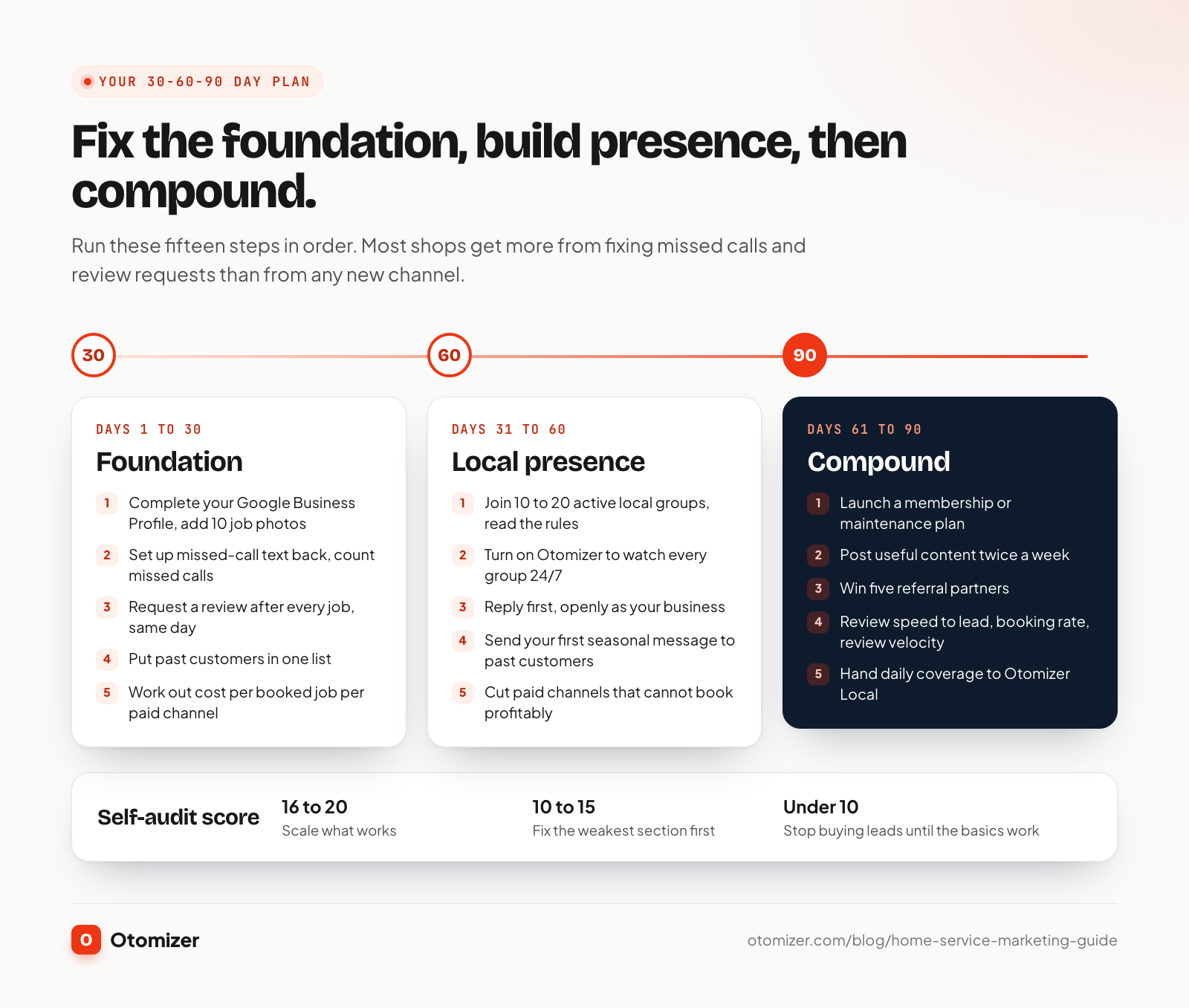
Scoring: 16 to 20 means focus on scaling what works. 10 to 15 means fix the weakest section before adding spend. Under 10 means stop buying new leads until the basics are in place, because you are paying for leads the system cannot convert.
Your 30-60-90 day action plan
If you take nothing else from this playbook, run this plan.
Days 1 to 30: fix the foundation
- Complete and correct your Google Business Profile. Add 10 real job photos.
- Set up missed-call text back and measure how many calls you miss for two weeks.
- Start asking every completed job for a review, with a direct link, the same day.
- Pull your past customer list into one place, even if it is a spreadsheet.
- Calculate cost per booked job for every paid channel you run today.
Days 31 to 60: build local presence
- Join 10 to 20 active neighborhood and community groups across your service area as a real local person, and read the rules.
- Turn on Otomizer so every group is watched around the clock and every request for your trade lands in one dashboard, scored by intent.
- Reply first to Hot requests, helpfully and openly as your business.
- Send your first seasonal message to past customers.
- Cut or reduce any paid channel that cannot book jobs at a cost you can live with.
Days 61 to 90: compound
- Launch or relaunch a membership or maintenance plan.
- Post useful content twice a week: tips, job stories, seasonal checklists.
- Reach out to five referral partners and deliver perfectly on their first job.
- Review your metrics: speed to lead, booking rate, review velocity, cost per booked job.
- Hand the daily work to Otomizer Local so the flywheel keeps turning without you running it.
The bottom line on home service marketing
Home service marketing is not a mystery, and it is rarely about finding a clever new channel. It is about running a simple flywheel every single day: be visible where neighbors ask, answer fast, do the work well, ask for the review, stay in touch, and turn the proof into the next conversation.
The companies that win are not always the biggest. They are the ones that show up first in the right local conversations and never let a call go cold.
If you want to run that loop yourself, Otomizer monitors the Facebook groups you are already in, scores every request by buyer intent, and drafts replies in your voice. If you want the whole local presence layer handled for you, with one exclusive trade per county, Otomizer Local is the fastest way to become the name your county recommends.

Stop racing for shared leads. Get recommended in your county.
Otomizer Local covers one trade in one county exclusively. Our team monitors neighborhood groups and posts a recommendation naming your company when homeowners ask who to hire.
Apply for Otomizer LocalOne company per trade per county · Three-month initial term
FAQ
Frequently asked questions
01What is home service marketing?
02What is the best marketing channel for home service businesses?
03How much should a home service business spend on marketing?
04How do plumbers and electricians get more local customers?
05Are lead marketplaces like Angi worth it for home service companies?
06How long does home service marketing take to work?
07Should I hire a marketing agency or a done-for-you service?
08What marketing metrics should a home service business track?
Keep reading
Related articles
How to Get More Google Reviews: 22 Templates and a 72-Hour System
November 13, 2026
MarketingWhat Is AEO? How Local Businesses Get Named by ChatGPT and Google AI
November 1, 2026
Marketing75 HVAC Social Media Post Ideas (Plus a Ready-to-Use 30-Day Content Calendar)
October 30, 2026
Otomizer LocalDone-For-You Marketing for Contractors: Inside Otomizer Local
October 30, 2026