Case Study: How Edge Mechanical Added $6,800 of HVAC Work in 3 Weeks From Facebook Groups
A case study on how Evan's team at Edge Mechanical joined neighborhood groups across Philadelphia, Eastern Montgomery County, and Bucks County. Otomizer watched them for AC, heating, and water heater requests. In three weeks the extra work came to $6,800 and the calendar roughly doubled.
Key takeaways
- 01 Edge Mechanical added $6,800 of booked HVAC work in three weeks by monitoring local Facebook groups with Otomizer, not by buying shared marketplace leads.
- 02 The work was already being asked for in neighborhood and township groups across Philadelphia, Eastern Montgomery County, and Bucks County. The gap was coverage, not demand.
- 03 Air conditioning emergencies, furnace failures, and water heater requests showed up at night and on weekends, when nobody on a small crew can scroll groups from a job site.
- 04 Otomizer scored posts Hot, Warm, and Cold so Evan could reply to real buyer intent first instead of wading through noise.
- 05 Within three weeks the calendar had roughly doubled. The channel kept running without adding headcount or marketplace spend.
Three weeks. $6,800 in extra booked work. A calendar that had been steady for months suddenly had twice the load.
That is what happened when Edge Mechanical, a family-owned HVAC company serving Philadelphia, Eastern Montgomery County, and Bucks County, stopped hoping homeowners would find them on a marketplace and started showing up inside the Facebook groups where those homeowners already ask for help.
Evan, who founded the company in 2014, did not change his pricing, hire a sales team, or buy a stack of shared leads. He joined the local groups his customers were already in, pointed Otomizer at the conversations that mattered, and answered fast when a real request came through.
This is how it worked, what showed up in the dashboard, and what any HVAC shop with a local presence can take from it.
Results at a glance
3 weeks
From setup to a calendar that roughly doubled
$6,800
Extra booked work attributed to Otomizer
24/7
Group monitoring while the crew was on jobs
Who Edge Mechanical is
Edge Mechanical is the kind of HVAC company homeowners describe when they say they want somebody local, not a big chain.
Evan built it around a straightforward promise: fix it first, sell second. Show up on time. Give the price before the work starts. Answer the phone yourself instead of routing people through a call center three states away. The site calls it “the anti-big-box HVAC company,” and the reviews back that up. Same-day and next-day service on emergencies. Honest second opinions when another company pushed a full replacement. Maintenance plans that turn one summer AC call into years of repeat work.
They cover the full residential stack: central air, furnaces, heat pumps, water heaters, mini-splits, and indoor air quality. Emergency service runs 24/7, which matters because the posts that convert fastest in local groups are rarely polite weekday enquiries.
Their service area spans Philadelphia, Eastern Montgomery County, and Bucks County. Towns like Doylestown, Warminster, Richboro, Newtown, and Warrington show up on the map, but the practical coverage is county-shaped: wherever a homeowner in a neighborhood group is asking who fixed their AC last summer, Edge Mechanical wants to be in that thread.
That positioning lines up almost perfectly with how people buy HVAC in groups. They are not comparing twelve tabs of Google results. They want one name from somebody who lives nearby and has actually used the company.
The problem: the work was already there
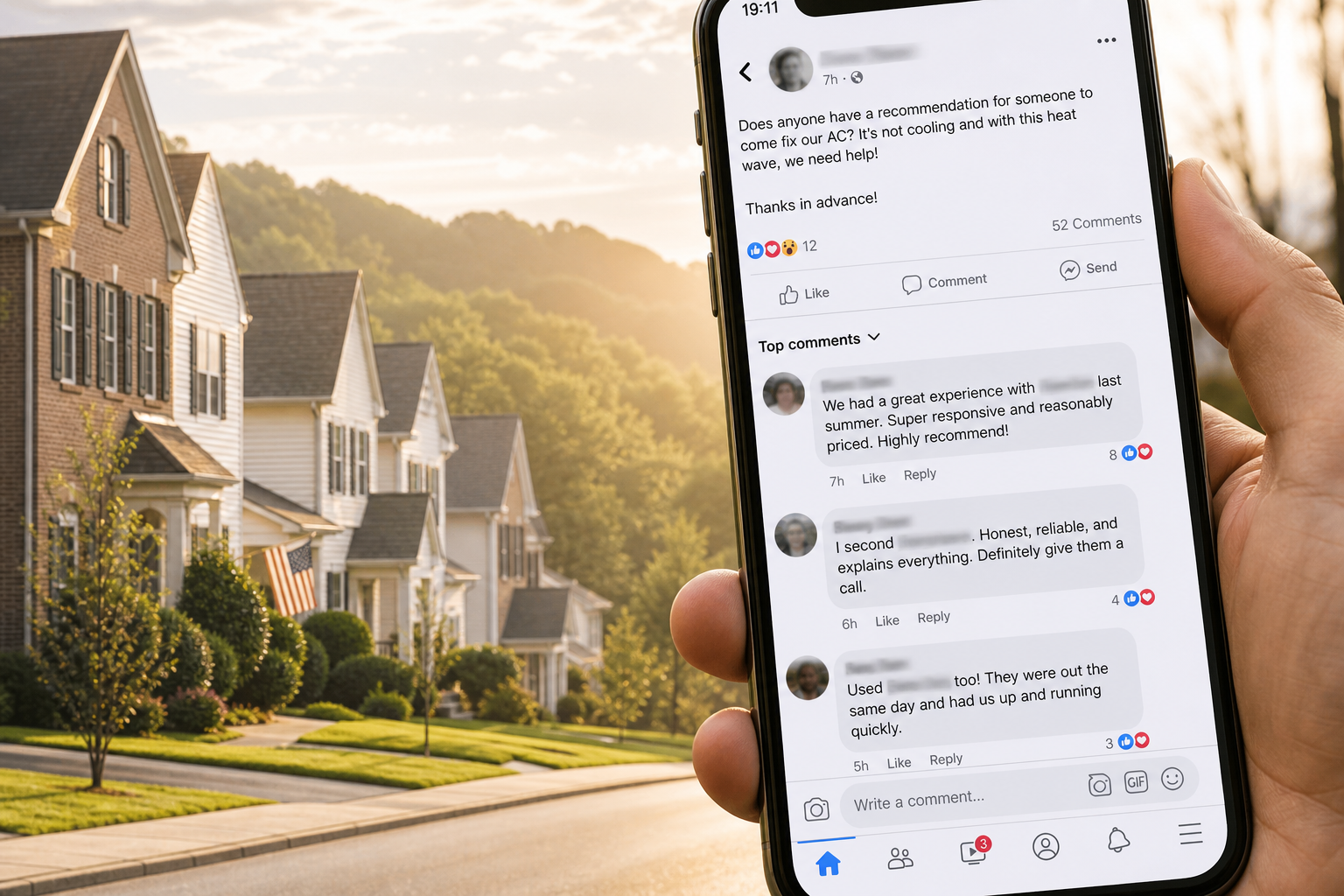
Before Otomizer, Evan knew the demand existed. He had seen the posts. A neighbor asking who to call when the AC quit in July. Somebody whose water heater started leaking at ten on a Tuesday night. A new homeowner looking for a maintenance company before the first winter in the house.
Those threads live in neighborhood groups, subdivision pages, township boards, and local community pages. They are high intent by definition. The person is not researching for fun. Something in the house is uncomfortable or broken, and they want a name they can trust.
The structural problem is not finding the groups. Bucks County and the surrounding markets have dozens of active ones. The problem is watching them.
A four-person crew cannot scroll Facebook from a crawlspace. Evan cannot pause a furnace diagnostic to check whether somebody in Langhorne just posted about a dead compressor. And the window is short. Recommendation threads collect most of their useful replies in the first hour. Check at nine PM and you are reading the outcome. Check at nine AM and you missed the whole conversation.
Marketplace leads have a different failure mode. They arrive fast, but they arrive to four companies at once. You are racing strangers for a contact who already expects a barrage of calls. Group threads are the opposite moment. One homeowner, one question, zero form submission. Whoever shows up first with a helpful, specific answer is often the only company they call.
Edge Mechanical was already strong on reviews, callbacks, and the kind of work that generates referrals. What they did not have was a way to be present in dozens of group feeds at once without hiring somebody whose entire job was Facebook.
What they set up
Evan’s approach was deliberate and boring in the best way. No promotions. No business-page spam. No “call us today” comments that get flagged and removed.
Join groups as a local person. Edge Mechanical joined neighborhood, subdivision, and community groups across their service area using personal accounts with real local history. Private groups with admin approval take time, which is normal. You apply, you wait, you participate like a neighbor before you ever mention your company.
Describe the business once in Otomizer. Air conditioning repair and installation. Heating and furnace work. Water heaters, tank and tankless. Heat pumps and emergency service. That description drives keyword suggestions and helps the intent scorer understand what counts as a match.
Track the language homeowners actually use. Positive signals included recommendation phrasing (“anyone recommend,” “who do you use,” “need help with”) plus trade terms: AC, air conditioning, furnace, heat pump, water heater, HVAC, no heat, no cool, emergency. Negative keywords filtered out job posts, giveaways, and unrelated noise.
Connect the groups through the Chrome extension. Otomizer synced the groups Edge Mechanical was already in and let them choose which communities to watch. From there, monitoring ran continuously inside Facebook as a logged-in user, not as an external scrape.
Work Hot posts first. Every matching post landed in the dashboard with a Hot, Warm, or Cold score. Hot meant explicit buyer intent: an emergency, a specific broken system, a clear ask for a company name. Warm meant exploring or comparing. Cold got skipped. That ordering mattered because Evan was still running jobs. He needed the dashboard to tell him where to spend the next ten minutes, not dump fifty keyword hits on him at lunch.
If you want the full mechanics of keyword lists, scoring, and reply tone, the complete guide to monitoring Facebook groups for leads walks through the same setup step by step.
Three weeks: what changed
Week 1: coverage and first signals. Most of the week was group approvals, keyword tuning, and learning which communities actually produce requests versus which ones are mostly event posts and lost pets. The first Hot posts confirmed the thesis quickly. AC trouble in summer heat. A furnace question ahead of a cold snap. A water heater post with urgency in the wording. Evan replied as himself: specific, helpful, no brochure language. Several turned into phone calls the same day.
Week 2: jobs stacking on a full calendar. This is where the operational shift showed up. Otomizer kept flagging posts while the crew was on other calls. Evan or somebody on the team could see a Hot lead on a phone between jobs and call back within minutes instead of discovering the thread hours later. Service tickets mixed with one larger diagnostic that turned into a repair rather than a premature replacement pitch. That matches how Edge Mechanical already sells: fix what is actually wrong, earn the trust, keep the customer for maintenance and the eventual system swap.
Week 3: roughly double the workload. By the end of the third week, the extra booked work had reached $6,800 attributed to Otomizer-surfaced conversations, and the schedule felt like a different company. Not because they changed who they were. Because they were finally present in the channel where their ideal customers ask for help, at the hour those customers ask.
The compounding part is easy to miss. One emergency AC job in a group thread can become a maintenance plan, then a replacement three years later, then a referral to a sister across town. None of that shows up in a cost-per-lead spreadsheet on day twenty-one. What does show up is $6,800 of work that was sitting in public conversations they previously walked past.
Your next 10 clients are already posting in your groups.
Otomizer monitors your Facebook groups 24/7, scores every post Hot / Warm / Cold, and drafts replies in your voice. Live in under 5 minutes.
See plans and pricingWhy it converted
Three things stacked in Edge Mechanical’s favor, and only one of them was the software.
They were already built for the moment groups create. Group buyers want speed, honesty, and a local name with a reason attached. Edge Mechanical’s whole brand is anti-upsell and pro-second-opinion. When Evan replies in a thread, it sounds like a neighbor recommending a company that fixed their system without pushing a five-figure replacement on the first visit. That is not a script. It is how they already work.
Speed beat size. The big chains have marketing budgets Edge Mechanical will never match. They do not need to. In a recommendation thread, the winner is often whoever responds in five minutes with something useful, not whoever has the largest radio presence. Otomizer did not replace Evan’s voice. It made sure he saw the post while it still mattered.
After-hours coverage matched the trade. A large share of HVAC posts go up in the evening or on a weekend because that is when people notice the house is not cooling or the water heater is failing. Edge Mechanical already runs emergency service. Otomizer made sure the enquiry side kept up with the dispatch side. A recommendation that reaches voicemail is worse than no recommendation, because the homeowner tells the group you never called back.
Evan put it plainly when we checked in after the third week:
“We knew the posts were in those groups. We just never had somebody watching all of them. Otomizer kept putting real jobs in front of us while we were already on a call somewhere else. Three weeks in, we had basically doubled what we were carrying.”
That is the whole case in one sentence. Not a new brand. Not a new market. A coverage problem solved.
What other HVAC companies can copy
You do not need Edge Mechanical’s exact county mix to run the same play. You need the same ingredients.
Join before you sell. Apply to neighborhood and subdivision groups as a person, not a logo. Participate normally. The groups that matter most are often private and quick to remove promoters.
Cover your whole service map. If you run Philadelphia and two counties, join groups across all three, not just the town where your shop sits. Homeowners post where they live, not where your office is pinned on Google Maps.
Monitor the trades that show up in writing. At minimum: AC, air conditioning, furnace, heat, no heat, water heater, HVAC, heat pump, emergency, plus recommendation phrasing. Tune negatives so you are not replying to hiring threads and giveaways.
Reply like a peer. One specific reason beats a paragraph of credentials. “They came out same night during the July heat wave and did not push a full replacement” wins more calls than a link to your website.
Protect the phone process. Groups produce evening and weekend enquiries. If nobody returns a missed call within an hour, the channel wastes itself no matter how good the monitoring is.
Give it three weeks before you judge it. Week one is setup. Week two is rhythm. Week three is when you can compare calendar load honestly. That matches what we see in the broader contractor guidance on getting leads without Angi: group coverage takes a few weeks to spin up, then runs continuously if you keep the groups active.
Contractors comparing this to marketplace math should read the other side of the ledger too. Shared leads charge you for speed races you often lose. Group threads charge you attention and response time instead. The Angi cost breakdown is worth running on your own numbers if you are still splitting budget between the two models.
What Evan did not do
Worth stating because case studies get misread.
He did not buy Otomizer Local or hand the channel to a done-for-you team. He joined the groups himself and used the self-serve extension plus dashboard. That is the product this story is about.
He did not inflate the result with invented job counts or a fake invoice breakdown. The number we are using is $6,800 of extra booked work over three weeks, full stop.
He did not spam groups with business-page posts. That path gets you removed and teaches the admins to filter everything you say. The workable version is monitor, reply personally, call fast.
He did not stop every other channel on day one. This added workload on top of what was already running. The smart move for most contractors is still to build the exclusive channel first, prove it produces, then let marketplace spend fall to whatever level actually earns its keep.
If you run an HVAC company in a similar market
The playbook is unglamorous and it works.
Join the groups. Describe your services. Let Otomizer watch for AC, heating, and water heater language around the clock. Reply to Hot posts like a neighbor. Call back fast. Give it three weeks before you decide whether the calendar changed.
Edge Mechanical went from knowing the posts existed to booking an extra $6,800 inside twenty-one days, with roughly double the workload they were carrying before. The demand was never missing. It was just posting while they were on a job somewhere else.
If you want to run the same setup yourself, Otomizer monitors the groups you are already in, scores every post Hot, Warm, or Cold, and drafts replies in your voice. Live in under five minutes with the extension connected.
If you would rather not join groups personally, Otomizer Local is the done-for-you path for HVAC companies that want exclusive county coverage handled by our team. This case study is not that product, but it is the same underlying channel.

Stop scrolling. Start closing leads in your voice.
Otomizer monitors your Facebook groups 24/7 and replies like a peer, not a pitch deck.
Get startedCancel anytime · 7-day money-back guarantee
FAQ
Frequently asked questions
01How did Edge Mechanical get HVAC leads from Facebook groups?
02How much revenue did Edge Mechanical add in three weeks?
03Did Edge Mechanical use Otomizer Local or the self-serve extension?
04What Facebook groups work best for HVAC contractors?
05How long does it take to see results from Facebook group monitoring?
06Can other HVAC companies copy what Edge Mechanical did?
Keep reading