Facebook Group Lead Generation for Agencies: The 2026 Playbook
A complete playbook for agencies to generate leads from Facebook groups at scale: niche selection, intent scoring, automation safety, and turning replies into discovery calls.
Key takeaways
- 01 Facebook groups give agencies a repeatable inbound channel, as long as you pick the right niches and respond fast.
- 02 Agencies should monitor 15 to 30 niche groups per vertical, not one generic 'business owners' group.
- 03 Hot / Warm / Cold intent scoring lets your team triage leads instead of reviewing every keyword match.
- 04 Account safety controls (rate limits, auto-pause, comment caps) are non-negotiable when running Autopilot at agency scale.
- 05 Agencies can resell group monitoring as a service through Otomizer's white label program.
Referrals are great until they are not. Outbound works until reply rates drop. Paid ads scale until CPAs climb.
Agencies need a third pipeline channel, one that produces inbound, high-intent leads without ad spend or cold outreach. For many agency types, that channel is Facebook groups.
This playbook covers how agencies can build Facebook group lead generation as a repeatable system: picking niches, monitoring at scale, triaging with intent scoring, staying safe with automation, and turning group conversations into discovery calls.
Why should agencies care about Facebook group leads?
Agencies live and die by pipeline. Most rely on some combination of referrals, outbound, content, and paid ads. Facebook groups add something different: buyers raising their hand in public.
Consider what happens in a typical group post:
“We’re a DTC skincare brand doing about $80K/mo. Looking for someone to take over our Facebook ads, our current agency isn’t delivering. Anyone recommend?”
That is not a cold lead. That is a qualified prospect with budget, pain, and urgency, posted in a group where 5,000 other e-commerce owners can see the recommendation thread. If your agency shows up first with a helpful reply, you are on the shortlist before a single email is sent.
Groups work for agencies because:
- Intent is explicit. Recommendation threads are pre-qualification.
- Social proof is built in. A helpful public reply plus group member endorsements equals a warm intro.
- It scales across verticals. E-commerce, local services, SaaS, coaching, every niche has active groups.
- Cost is near zero. No ad spend, no list buying, no SDR salaries for cold outreach.
The challenge is operational: monitoring 20+ groups per vertical, responding fast, and doing it without burning out your team or risking client Facebook accounts.
This channel is also getting more valuable over time. As we cover in Facebook Groups are the new Reddit, community knowledge and buying conversations are shifting into Groups, and Meta is now surfacing that content directly in search and AI answers.
How do agencies pick the right Facebook groups?
Group selection is the highest-leverage decision in this playbook. Wrong groups mean wasted replies. Right groups mean pipeline.
The niche group matrix
Build a matrix of groups by client vertical:
| Vertical | Group types to target | Example group themes |
|---|---|---|
| E-commerce | Brand owner groups, platform-specific (Shopify, Amazon) | “Shopify Entrepreneurs,” “DTC Brand Owners” |
| Local services | City business groups, industry associations | ”[City] Small Business Network,” “Home Service Professionals” |
| SaaS / B2B | Founder groups, industry verticals | ”SaaS Founders,” “B2B Marketing Leaders” |
| Coaches / consultants | Niche coaching communities | ”Online Business Coaches,” “Fitness Business Owners” |
| Real estate | Agent groups, investor groups | ”Real Estate Marketing,” “[Region] Realtors” |
For each vertical your agency serves, identify 15 to 30 active groups. Prioritize groups where:
- Recommendation threads appear weekly (minimum)
- Members match your ideal client profile
- Admin moderation keeps content on-topic
- Group size is 2K to 50K (large enough for volume, small enough for relevance)
Groups to avoid
- Link-dump groups where every post is self-promotion
- Inactive groups with fewer than one post per week
- Mega-groups (500K+) where your reply gets buried instantly
- Groups with no recommendation culture, because if nobody asks for help, nobody needs your services
How do agencies monitor groups at scale?
Manual monitoring breaks down fast at agency scale. One account manager scrolling 25 groups for one client is manageable. Doing that for ten clients is not.
The agency monitoring stack
| Layer | What it does | Manual vs tool |
|---|---|---|
| Group selection | Pick 15 to 30 niche groups per vertical | Manual (strategic) |
| Keyword filtering | Match “looking for,” industry terms, pain language | Tool (automated) |
| Intent scoring | Rate posts Hot / Warm / Cold | Tool (automated) |
| Reply drafting | Write peer-like, post-specific responses | Tool + human review |
| Reply posting | Comment in the group thread | Monitor or Autopilot |
| Lead handoff | Move qualified conversations to CRM / discovery call | Manual (strategic) |
The manual parts, namely group selection, lead handoff, and closing, require human judgment. Everything else should be automated.
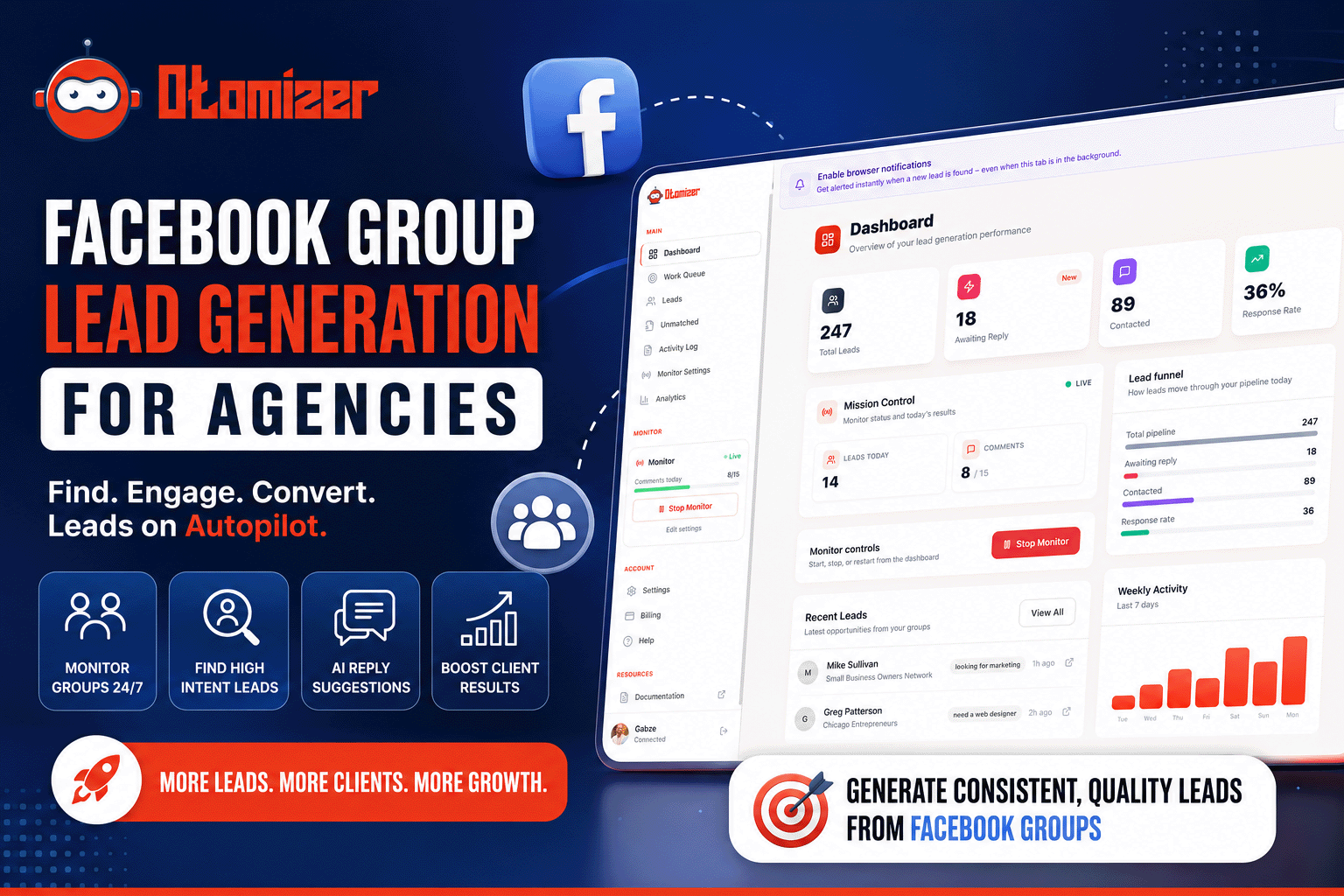
Otomizer handles the automated layers: continuous monitoring via Chrome extension, keyword matching with positive and negative filters, Hot / Warm / Cold intent scoring, and AI-drafted replies through a 4-stage pipeline (Decode, Frame, Draft, Critique).
Monitoring multiple groups across clients
Agencies running group lead gen for multiple clients should:
- Separate keyword sets per client so there is no cross-contamination of brand voice or keywords
- Use distinct persona templates, such as agency voice for one client and local service voice for another
- Set per-account rate limits so you do not run all clients at maximum comment volume simultaneously
- Review Hot leads daily and assign team members to triage and follow up
For agencies reselling group monitoring as a service, Otomizer’s white label program provides a rebrandable platform with per-client dashboards and your own pricing.
How does intent scoring help agencies triage leads?
At agency scale, keyword matching alone creates too much noise. Your team cannot review 40 keyword hits per day across five clients.
Intent scoring solves this by rating every matched post:
| Score | Label | Agency action |
|---|---|---|
| 9-10 | Hot | Reply within minutes. Assign senior team member. Move to discovery call if engaged. |
| 7-8 | Warm | Reply with value + question. Add to weekly follow-up queue. |
| 5-6 | Cool | Optional clarifying question. Low priority. |
| 0-4 | Cold | Skip. Do not reply. |
For an agency managing Facebook ads for e-commerce brands, a Hot post looks like:
“Our ROAS dropped from 3x to 1.2x after iOS updates. Looking for an agency that specializes in Facebook ads for Shopify stores doing $50K+/mo. Budget is $3K/mo for management.”
That post has specificity, pain, budget signal, and an explicit ask. It scores Hot. Your team replies first.
A Cold post in the same group:
“What’s everyone’s favorite podcast for entrepreneurs?”
It might match a keyword accidentally. It scores Cold. Skip it.
This triage layer is what makes group lead gen viable at agency scale. Without it, your team drowns in false positives.
How should agencies reply in Facebook groups?
Agency replies follow the same peer-like principles as freelancers, but with higher stakes. A bad reply in a 10,000-member group is visible to your entire target market.
The agency reply framework
- Acknowledge the specific problem mentioned in the post
- Share a relevant insight, such as a data point, a framework, or a “what we have seen work”
- Ask one calibrated question to qualify fit
- Never drop your agency name or link unless the poster asks
Example for an e-commerce ads post:
iOS attribution changes hit a lot of Shopify stores in that revenue range. We typically see ROAS recover once retargeting audiences are rebuilt with first-party data. Are you running any post-purchase survey flows to capture source attribution?
Notice what this reply does:
- Demonstrates expertise without pitching
- References their specific situation ($50K+/mo Shopify)
- Asks a question that qualifies whether they are sophisticated enough to be a good client
- No link, no “DM us,” no agency name
Otomizer’s Marketing Intelligence Layer applies frameworks from Cialdini, Hormozi, SPIN, and Voss to every drafted reply, so your team starts with a strong draft instead of a blank text box.
When to mention your agency
Only when:
- The poster asks “who do you recommend?” or “does anyone know an agency that can help?”
- Someone in the thread tags you or asks for your contact info
- You are moving the conversation to DMs and the prospect asks who you are
Otherwise, let the quality of your reply speak for itself. Group members who see a helpful answer will click your profile.
Your next 10 clients are already posting in your groups.
Otomizer monitors your Facebook groups 24/7, scores every post Hot / Warm / Cold, and drafts replies in your voice. Live in under 5 minutes.
See plans and pricingHow do agencies stay safe when automating group replies?
Automation at agency scale requires safety controls. One flagged account can damage a client relationship.
Non-negotiable safety settings
| Control | Recommended starting point | Why |
|---|---|---|
| Daily comment cap | 5 to 10 per account | Prevents burst activity that triggers throttling |
| Wait between comments | 3 to 5 minutes (randomized) | Mimics natural browsing behavior |
| Comment uniqueness | Enabled | Never post the same reply twice |
| Auto-pause | Enabled | Stops activity if Facebook throttles |
| Account safety score | Monitor daily | Early warning before restrictions |
The recommended ramp schedule
- Week 1: Monitor mode only. Approve every reply manually. Tune voice and keywords.
- Week 2: Autopilot at 5 comments/day. Review all posted replies daily.
- Week 3: Increase to 10 comments/day if safety score stays green.
- Week 4+: Scale gradually based on account health and lead quality.
Otomizer includes all of these controls plus a real-time account safety score visible in the dashboard. Smart auto-pause stops activity if Facebook signals throttling, before damage happens.
How do agencies turn group replies into discovery calls?
The group comment starts the conversation. The discovery call closes the deal. Here is the handoff workflow:
Step 1: Reply in the thread (public)
Peer-like value reply. No pitch. Wait for engagement.
Step 2: Move to DMs (when they respond)
“Happy to dig into this more, what’s the best way to reach you?”
Or if they liked your comment but did not reply:
“Saw your post about [specific problem]. Happy to share a few things that have worked for similar [vertical] brands if useful.”
Step 3: Qualify in DMs (two or three messages)
Ask about budget, timeline, current situation, and decision process. Use Mom Test-style questions that ask about their past experience, not hypothetical interest.
Step 4: Offer a discovery call
“Sounds like a good fit. Want to jump on a 20-minute call this week to see if we can help?”
Step 5: Log in CRM and track
Tag the lead source as “Facebook Group: [group name].” Track group to DM to call to client conversion rates by vertical. Double down on groups that produce clients, not just conversations.
What results can agencies expect?
Results depend on vertical, group activity, and reply quality. Based on data from 800+ businesses using Otomizer:
- First scored lead: within an hour of going live for most accounts
- Hot leads per week: 18+ for active users in engaged niches
- Time to reply: under 90 seconds from post to drafted reply
- Setup time: under 5 minutes per account
For agencies, the math gets interesting at scale. If one client account produces 5 Hot leads per week, and your close rate from group leads is 20%, that is one new client every week from a single account, with near-zero acquisition cost.
Multiply that across five client verticals, and Facebook group lead gen becomes a meaningful pipeline channel.
Can agencies resell group monitoring as a service?
Yes. Some agencies treat group lead gen as an internal tactic. Others productize it.
Otomizer’s white label program lets agencies:
- Rebrand the platform with their logo and domain
- Set their own client pricing (example: $99/client/month)
- Deliver group monitoring, intent scoring, and AI replies as a managed service
- Add a recurring revenue line without building the technology
This turns a lead gen tactic into a productized service, which is how agencies scale beyond trading hours for dollars.
Platform fee starts at $549/month with a one-time setup fee. For agencies with 6+ clients on the service, the unit economics work quickly.
How does Otomizer compare for agency use?
| Capability | Otomizer | Devi AI | Manual process |
|---|---|---|---|
| Monitoring frequency | Continuous, 24/7 | Every ~2 hours | When someone remembers |
| Intent scoring | Hot / Warm / Cold | Basic keyword match | Team judgment |
| AI reply pipeline | 4-stage (Decode, Frame, Draft, Critique) | Generic AI replies | Written from scratch |
| Account safety | Rate limits, auto-pause, safety score | Limited | Depends on discipline |
| White label option | Yes | No | N/A |
| Facebook-only focus | Yes | Multi-platform | Yes |
| Setup time | Under 5 minutes | Varies | Ongoing labor |
For a detailed comparison, see Otomizer vs Devi AI.

Stop scrolling. Start closing leads in your voice.
Otomizer monitors your Facebook groups 24/7 and replies like a peer, not a pitch deck.
Get startedCancel anytime · 7-day money-back guarantee
What is your agency’s 30-day action plan?
Week 1: Foundation
- Pick one client vertical to pilot
- Identify 15 active groups for that vertical
- Set keywords, persona, and negative filters in Otomizer
- Run Monitor mode and approve every reply manually
Week 2: Optimize
- Review Hot vs Warm vs Cold distribution
- Refine keywords based on Unmatched queue
- Turn on Autopilot at 5 comments/day
- Start tracking group to DM to call conversions
Week 3: Scale
- Add a second vertical or client account
- Increase Autopilot to 10 comments/day if safety score is green
- Assign team member to daily Hot lead triage
- Document reply templates that convert
Week 4: Evaluate
- Calculate cost per lead vs other channels
- Identify top-performing groups and cut underperformers
- Decide whether to expand internally or productize via white label
For the monitoring fundamentals, read the complete guide to monitoring Facebook groups for leads. For freelancer-level tactics your team can use, see 7 strategies to find clients in Facebook groups.
See Otomizer pricing and go live in under 5 minutes.
Your agency’s next retainer client might be posting in a group right now. Build the system to find them first.
FAQ
Frequently asked questions
01Is Facebook group lead generation worth it for agencies?
02How many Facebook groups should an agency monitor?
03Can agencies automate Facebook group replies safely?
04How do agencies turn Facebook group replies into discovery calls?
05Can agencies resell Facebook group monitoring to clients?
06How is Otomizer different from other Facebook group tools for agencies?
Keep reading