Facebook Groups Are the New Reddit, and Almost Nobody Has Noticed Yet
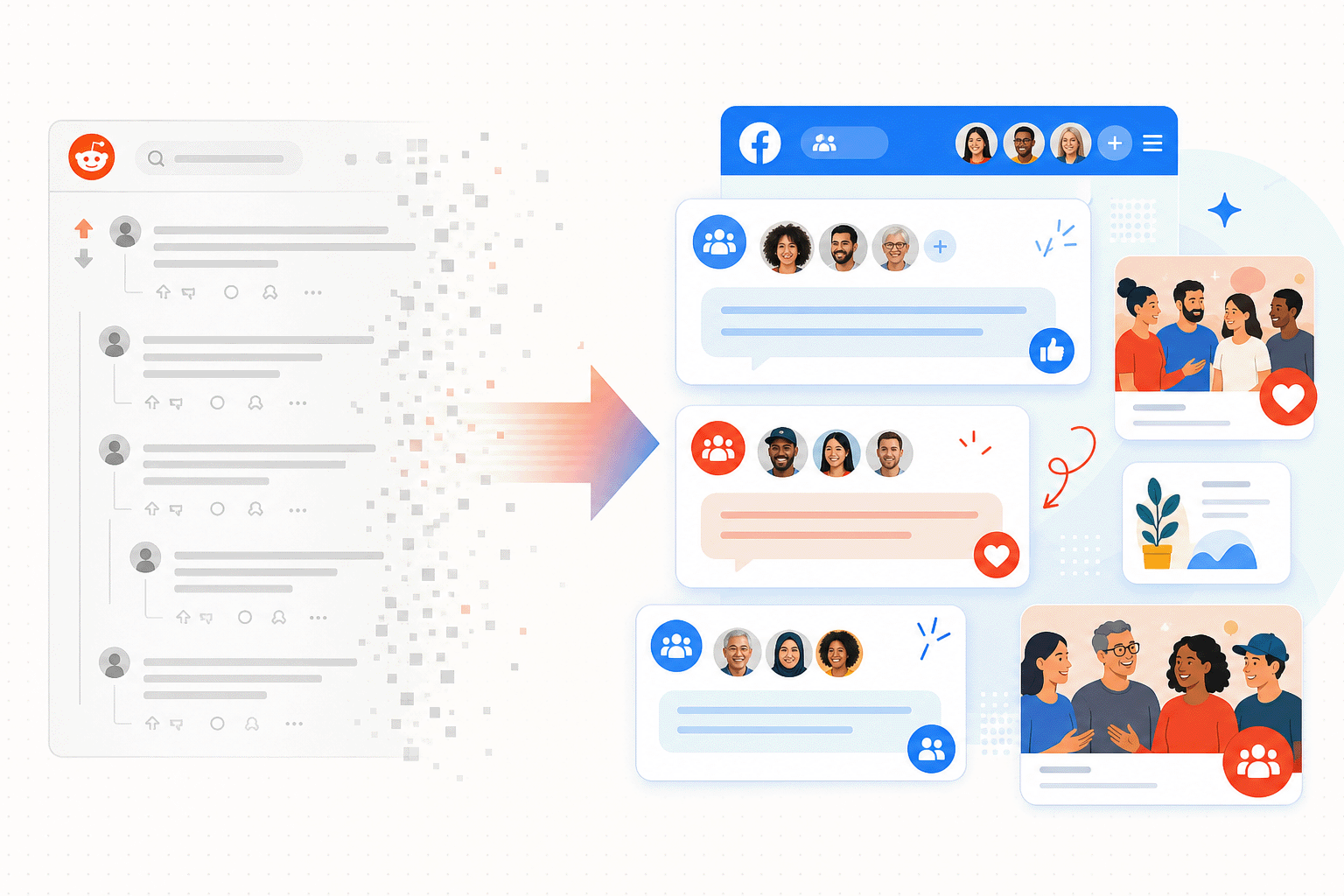
Reddit shaped a decade of online research. But in 2026, the real answers are moving to Facebook Groups: broader demographics, real identities, and a knowledge layer Meta is now mining directly. Here is why the shift is happening and what it means.
Key takeaways
- 01 Reddit won the last decade because pseudonymity and voting surfaced honest answers, but the same design now concentrates one demographic talking to itself.
- 02 In 2026, Reddit is 40%+ of AI chatbot citations, which made it a target. Researchers showed about 13 words of planted text can bias AI answers, and survivorship bias skews its recommendations.
- 03 Facebook Groups attach real identities and lived context to answers, and span demographics Reddit barely reaches: retirees, parents, locals, and non-English speakers.
- 04 Meta is betting on this shift. It launched a Reddit-style app (Forum), rolled out AI Mode that answers questions from Group discussions, and rebuilt Groups search with semantic retrieval, all in 2026.
- 05 For businesses, the recommendation threads that used to live in subreddits now happen in Groups with real buyer intent. Tools like Otomizer can monitor every group you have joined for your keywords and notify you or auto-reply, while tools like PilotPoster help you show up organically.
This summer, I planned a trip to Europe. Three weeks, no fixed itinerary, a loose plan to start in Paris and end somewhere in the Alps. So I did what I have done for a decade when I want real answers instead of marketing: I searched Reddit.
And for the first time, it let me down.
The trip that changed how I research
Every travel thread I opened said the same things. Skip Venice, it is a tourist trap. Do not bother with the Eiffel Tower, go to a rooftop bar instead. Ljubljana is underrated. Get the rail pass. The same ten opinions, upvoted into consensus, repeated across a hundred threads.
It took me a while to notice why it all sounded the same: it was mostly the same kind of person answering. Twenty-to-thirty-something, tech-adjacent, traveling solo or as a couple, optimizing for the same aesthetic. Great advice, if that is exactly who you are. I was trying to plan something with a wider range of needs, and the hive mind only had one shape.
On a whim, I searched Facebook Groups instead. “Europe travel.” “France for families.” “Slow travel over 50.” What I found was a different planet.
A retired couple who spent a full month in Alsace posted a day-by-day breakdown with photos, the name of the village baker they loved, and which trains actually had elevators. A mother of three explained how she handled Paris with a stroller and a toddler who refused to nap. A woman who had lived in Lyon for thirty years answered a stranger’s question by name, with her real face next to it, correcting three things the guidebooks get wrong.
None of it was optimized for upvotes. All of it was useful. The research that actually shaped my trip did not come from Reddit. It came from Facebook Groups, and I could not stop thinking about what that meant.
The best answer to my travel question came from a 63-year-old grandmother in Alsace, posting under her real name. Reddit could not have surfaced her if it tried.
Why Reddit won the last decade
I want to be fair, because Reddit earned its reputation honestly.
For most of the 2010s, Reddit was the best place on the internet to get a real answer. The reasons were structural:
- Pseudonymity enabled candor. People said things under a throwaway username they would never attach to their real name: honest reviews, embarrassing questions, unfiltered experience.
- Voting surfaced quality. The best answer floated to the top, and bad answers got buried. It was crowd-sourced editing at scale.
- Threading preserved nuance. A good Reddit thread is not one answer. It is a debate: half agreeing, a quarter pushing back with specifics, a quarter recommending alternatives.
That combination was so reliable that “append reddit to your Google search” became folk wisdom. It worked so well that AI companies noticed. By 2026, Reddit accounts for more than 40% of citations across AI chatbots like ChatGPT, Perplexity, and Google’s AI tools, more than Wikipedia and YouTube combined.
Which is exactly where the problem starts.
How Reddit got hollowed out
Three things happened at once.
One demographic talking to itself
Reddit’s audience skews young, male, English-speaking, US-centric, and tech-adjacent. That is not a criticism of the people. It is a description of the pool. When one demographic dominates a platform, its worldview gets amplified through the same voting mechanic that once surfaced quality. Consensus stops meaning “this is true” and starts meaning “this is what people like us believe.”
Add survivorship bias to that. As one analysis of Reddit’s role in AI put it, Reddit recommendations skew toward users motivated enough to post. The quietly satisfied majority stays silent, so threads overrepresent enthusiasts, outliers, and contrarians. The loudest experience wins, not the most common one.
Confidence mistaken for accuracy
There is a specific kind of Reddit reply that states something completely wrong with total conviction and collects a hundred upvotes before anyone notices. The person is not lying. They genuinely believe it. They just have the confidence dial turned all the way up regardless of how much they actually know. Threading is supposed to catch this, but on fast-moving topics, the confident wrong answer often wins the race.
The platform became a target
Once Reddit became the fuel for AI answers, it became worth manipulating. In June 2026, Cornell researchers demonstrated that roughly 13 words of planted text was enough to get a fictional product mentioned in 38% to 51% of AI responses that pulled from the poisoned content. A single seeded comment could bias an entire cluster of related queries. When a source becomes the answer layer for the whole internet, gaming that source becomes a business, and it did.
The quiet shift to Facebook Groups
While everyone kept watching Reddit, the center of gravity for real community knowledge started moving. Here is what Facebook Groups have that Reddit structurally cannot.
Identity is attached to the answer. When that grandmother in Alsace answers your question, you see her name, her face, her town, her life. You can tell in two seconds whether she is a real person with real experience or a burner account with an agenda. Pseudonymity was Reddit’s superpower a decade ago; in an era of AI-generated everything, verifiable identity is becoming the more valuable currency.
The demographics are the whole world. Facebook Groups reach the people Reddit barely touches: retirees, parents, tradespeople, local residents, non-English speakers, and hobbyists over 50. When you ask a question in a Group, you are not sampling one worldview. You are sampling the actual population.
There is a group for everything, and they are dense. In 2026 there are nearly 30 million active public Facebook Groups, up almost 19% year over year, with well over a billion people using Groups every month. Whatever you are researching, whether a neighborhood, a medical condition, a camera, or a school district, there is a group where people live that topic daily.
And then there are the receipts, because Meta is not being subtle about where this is going:
- In May 2026, Meta quietly launched Forum, a Reddit-style standalone app, with its own AI “Ask” tab that pulls answers from Facebook Groups discussions. Reddit’s stock reportedly dropped about 6% on the news.
- In June 2026, Meta launched AI Mode, a search experience that answers questions by mining what real users have written in public posts and Groups: “answers rooted in the culture, opinions, and recommendations people share,” not a list of links.
- Earlier in 2026, Meta’s engineering team rebuilt Facebook Groups search around hybrid semantic retrieval specifically to “unlock the power of community knowledge.”
Read those three moves together. Meta is turning Facebook Groups into the web’s next answer layer, and building multiple front doors into it, while most of the internet is still arguing about Reddit.
In five years, “check the Facebook group” will be what “append reddit” was in 2020. The difference is that this time, the answers come with a face attached.
What this actually means for you
The shift plays out differently depending on which side of the conversation you are on.
If you are researching something
Add Groups to your process. For anything where lived experience and demographic breadth matter, like travel, parenting, local services, health, or big purchases, search Facebook Groups the way you used to append “reddit.” Read who is answering, not just what they say. The name and profile next to an answer is signal Reddit never gave you.
If you run a business
This is the part most people are going to be late to. For a decade, the recommendation threads that mattered lived in subreddits where you could not really participate without getting flamed for self-promotion. Now those same threads (“anyone recommend a good bookkeeper?”, “looking for a wedding photographer in Austin”, “who do you use for Shopify help?”) happen in Facebook Groups, in public, with real buyer intent attached and a real person you can actually talk to.
Attention is migrating. The businesses that show up helpfully in Groups now will own the same advantage that early Reddit-savvy brands had a decade ago, except this time the platform is actively rewarding genuine community participation by feeding it into AI answers.
How to actually operate in Facebook Groups
There are two motions, and you need both. Think of it as listening and speaking.
Listen: catch the buying signals (Otomizer)
People post intent in Groups constantly, but the signal is buried in noise and it moves fast. The first helpful reply usually wins, and you cannot manually watch 30 groups around the clock.
That is exactly what we built Otomizer for. Most people who join dozens of groups over the years eventually stop checking most of them, which means the good posts scroll by unseen. Otomizer monitors every Facebook group you have joined, not just a handful you remember to check, 24/7 through a Chrome extension that runs alongside your normal browsing.
Here is how it actually works. You tell Otomizer the keywords that signal a real opportunity for you (things like “looking for a photographer” or “need help with bookkeeping,” plus negative keywords to filter out noise). It scans every post across your joined groups for those keywords, then scores each match Hot / Warm / Cold based on buyer intent, tone, and specificity. From there, you choose how hands-on you want to be: get notified so you can review and reply yourself, or let Otomizer draft a peer-like reply in your voice and post it for you within safety limits you control. Either way, you stop missing the conversations that matter just because you were not scrolling that group at the right moment. If you want the full mechanics, we broke it down in our guide to monitoring Facebook groups for leads.
Speak: maintain an organic presence
Listening is half of it. The other half is consistently showing up with valuable content across the groups you belong to, without spending three hours a day copy-pasting.
Worth a mention here: PilotPoster is a solid option for that side of things. It is one of the only tools that can post to the Facebook groups you have joined, not just ones you admin, and it does it organically, right from your browser, one group at a time with natural delays, so the activity looks and behaves like a real person browsing. If you are trying to maintain presence across a large number of groups without burning hours on copy-paste, it is worth a look.
The emphasis on organic matters. Meta is rewarding authentic, helpful participation, and AI Mode is unlikely to surface low-value spam. The goal is not to blast groups. It is to be genuinely present and genuinely useful, at a scale that a human doing it by hand cannot sustain.

Stop scrolling. Start closing leads in your voice.
Otomizer monitors your Facebook groups 24/7 and replies like a peer, not a pitch deck.
Get startedCancel anytime · 7-day money-back guarantee
The bet
Here is my prediction. The next few years will make it obvious that community knowledge did not disappear. It moved. It moved from a platform where a username shouts into the void to one where a real person answers with their name attached. It moved from one demographic to the whole world. And it moved to exactly the place Meta is now wiring directly into search and AI.
Reddit had a remarkable decade. But the internet is quietly turning the page, and Facebook Groups are where the next chapter is being written. The people who notice first, especially travelers, researchers, and businesses, will have a head start that is hard to buy later.
If you want that head start, start by monitoring every group you have joined with Otomizer. The conversations are already happening. The only question is whether you are in the room.
Want the practical playbook? Read how to find clients in Facebook groups or, if you run an agency, the Facebook group lead generation playbook for agencies.
FAQ
Frequently asked questions
01Are Facebook Groups better than Reddit for research and recommendations?
02Why is Reddit less reliable than it used to be?
03What is Meta AI Mode and why does it matter?
04Is Facebook still relevant in 2026?
05How do businesses find customers in Facebook Groups?
06Can you automate Facebook Group activity safely?
Keep reading