Are Angi Leads Worth It? A Contractor Cost Breakdown for 2026
Are Angi leads worth it? Run the cost-per-booked-job math on shared marketplace leads, when they still make sense, and what exclusive alternatives exist.
Key takeaways
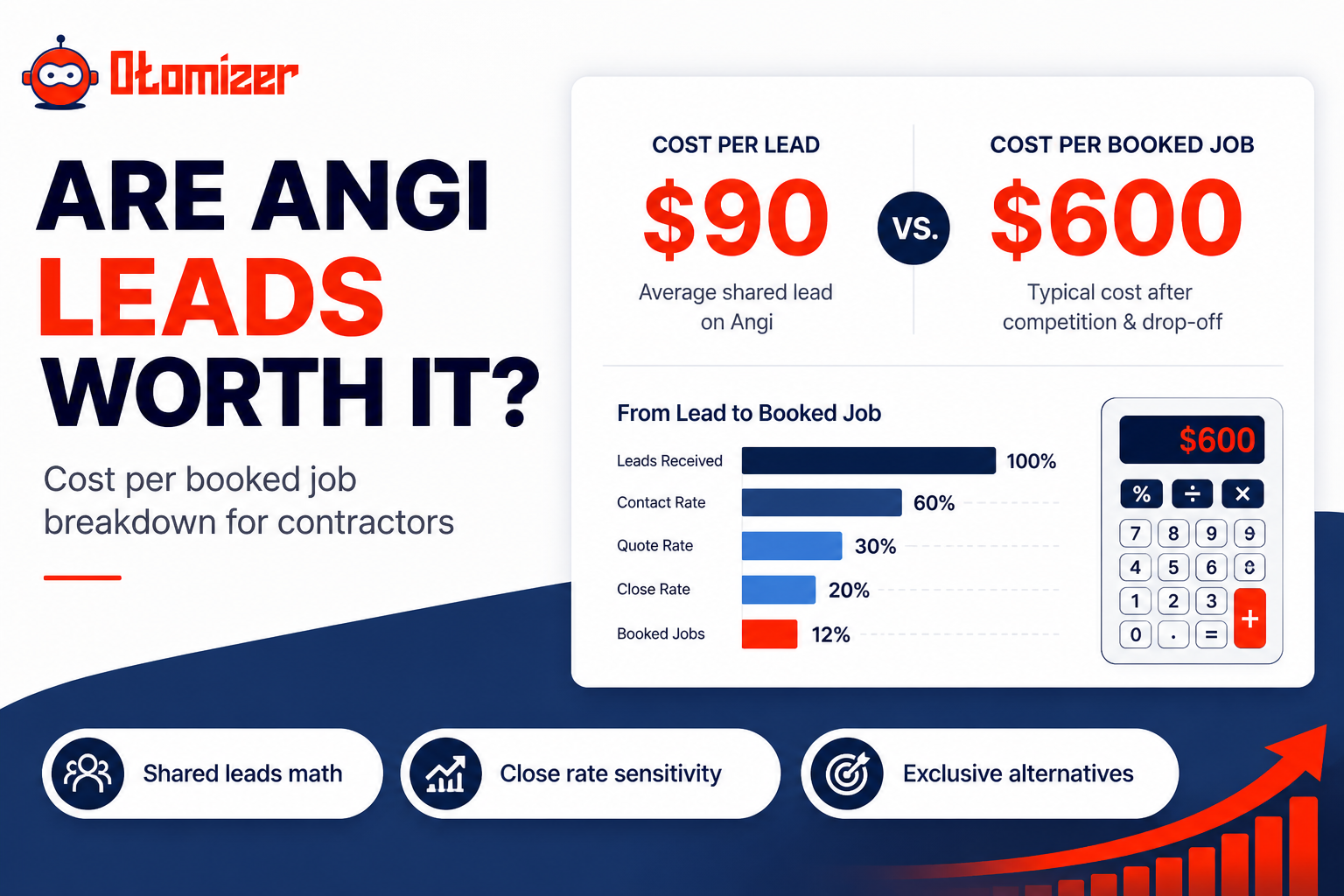
- 01 The number that matters is cost per booked job, not cost per lead. A $90 lead at a 15 percent close rate is a $600 acquisition cost.
- 02 Shared distribution is structural, not a setting. A marketplace earns more by selling the same request to several contractors, so it always will.
- 03 Speed of response drives close rate on shared leads more than price, reviews or presentation.
- 04 Marketplaces work well for filling gaps at lower ticket sizes and badly as a primary channel for high-ticket trades.
- 05 Exclusive channels cost more up front and less per booked job, but only if you can absorb a steady flow of enquiries.
Ask ten contractors whether Angi leads are worth it and you will get ten different answers, mostly delivered with feeling. The reason is that both camps are right about their own business and wrong to generalise from it. A handyman filling gaps between jobs and a roofing company trying to keep three crews busy are running completely different arithmetic, even though they are buying from the same platform.
So rather than argue the point, here is the arithmetic itself, plus the structural reason the experience is so consistent across trades and markets.
What Angi leads actually cost you per booked job
The advertised price per lead is close to irrelevant. The number that decides whether a channel works is what you spend to book one job.
Take a roofing company spending $3,000 a month. At $100 a lead that is thirty enquiries. Suppose you reach twenty of them, quote eight, and close three. Your cost per booked job is $1,000. On an $11,000 average roof that is fine, and you would take that trade all day.
Now change one variable. Your office is busy and calls back in four hours instead of four minutes. You reach fifteen, quote five, close one. Same $3,000, one job, and your acquisition cost tripled without anything else about your business changing.
That sensitivity is the whole story of shared leads. Everything hinges on speed of response, because the homeowner receives several calls and the first credible one anchors the entire decision. It is why contractors who succeed on these platforms almost always have somebody whose actual job is answering within minutes.
Why the leads are shared, and why that will not change
It is tempting to read shared distribution as a platform being greedy, but it is simpler than that. A marketplace earns revenue per contact it distributes. Selling one homeowner request to four contractors earns roughly four times what selling it once does, at zero additional cost. No amount of product improvement changes that equation, and no competitor entering the space changes it either, because they face the same economics.
Which means the experience you are having is the intended one. The request arrives, three other companies get it at the same moment, and the outcome is decided largely by who happened to be holding their phone. Contractors respond by hiring somebody to dial faster, which raises everybody’s cost and shifts nobody’s share.
The second-order effect is worse. Homeowners on these platforms have learned to expect a barrage of calls, so they answer fewer of them and treat all of you as interchangeable before anybody has said a word. You are not just competing on speed, you are competing while the customer is already slightly irritated.
When it stops working
The pattern is consistent and it usually arrives with growth.
Your close rate drifts down as more pros join your market. Your cost per booked job climbs past what the job can carry. You start declining the enquiries that look thin, which reduces your volume without reducing your spend. Somebody in the office spends an increasing amount of their week disputing bad contacts.
At that point contractors typically try to fix it by working harder on the same channel, which is the natural response and rarely the right one. The constraint is not your effort. It is that you bought a position in a race four other companies also entered.
What the alternatives actually are
Google Local Services Ads. Still the strongest paid intent channel for most trades. Also pay per lead, also competitive, but the homeowner searched for exactly your service, which shows in close rates. Worth running alongside almost anything else.
Referral partnerships. Realtors, property managers, insurance adjusters, and complementary trades. Slow to build, largely free once built, and the trust transfers. Every established contractor we know has some version of this and wishes they had started it years earlier.
Your own reviews and local search presence. Unglamorous, compounding, and the only asset in this list you fully own. It will not fill a schedule next week.
Facebook group recommendation threads. Every county has neighborhood and subdivision groups where homeowners ask each other who to hire. These people have not filled in a form and are not being called by anybody. They want one name from somebody they trust. Whoever gets named first, with a specific reason attached, usually gets the call.
That last one is the closest thing to the opposite of a marketplace, because you arrive before the comparison starts rather than in the middle of it. For a full comparison of shared marketplace leads against exclusive county coverage, see our Angi Leads alternative page.
Homeowners in your county are already asking who to hire.
Otomizer Local joins your local groups, monitors them around the clock, and posts a recommendation naming your company when a matching request appears. No bidding, no shared leads.
See Otomizer LocalThe catch with group threads
They are genuinely effective and they are genuinely hard to work yourself.
The window is short. A recommendation thread collects most of its replies within the first hour, usually while you are on a roof. Checking Facebook in the evening means reading the results rather than competing in them.
The good groups are closed. Subdivision and neighborhood groups have admin approval and rules against promotion. Getting in takes an account with real local history, and posting from your business page tends to get you removed.
And it never stops. Requests appear at nine at night and on Sunday mornings, which is exactly when nobody at your company is watching.
This is why done-for-you services exist for this channel. Otomizer Local covers one trade in one county: our team joins the local groups with our own aged accounts, monitors them around the clock, and posts a recommendation naming your company when a matching request goes up. We will not sign another company in your trade in your county, so there is no race to be first because there is nobody to race.
So, are they worth it?
If your close rate on shared leads is above twenty percent and your cost per booked job leaves comfortable margin, keep buying them and stop reading articles like this one.
If it is below that, the honest diagnosis is usually not that you are bad at sales. It is that you bought a shared request and lost the speed contest, which is the outcome the model is built to produce for most participants most of the time.
The move is not to quit in a huff. It is to build one channel where you are not sharing, get it producing, and then let your marketplace spend fall to whatever level actually earns its keep. For a broader channel mix and a ninety-day rollout plan, read how to get contractor leads without Angi.

Stop racing for shared leads. Get recommended in your county.
Otomizer Local covers one trade in one county exclusively. Our team monitors neighborhood groups and posts a recommendation naming your company when homeowners ask who to hire.
Apply for Otomizer LocalOne company per trade per county · Three-month initial term
FAQ
Frequently asked questions
01Are Angi leads worth it for contractors in 2026?
02How much do Angi leads actually cost?
03How many contractors get the same Angi lead?
04What is the best alternative to Angi for contractors?
05Should I stop using Angi entirely?
06Should I use Otomizer or Otomizer Local for Facebook group leads?
Keep reading