Thumbtack Alternatives for Contractors: How to Stop Bidding for Shared Work
Looking for a Thumbtack alternative for contractors? Why bidding platforms trend toward zero return, and how exclusive county coverage compares.
Key takeaways
- 01 Any marketplace where position is bought will bid up to the point where nobody makes excess return. That is the design working, not failing.
- 02 Compare channels on cost per booked job across a full quarter, not cost per lead in a good month.
- 03 Flat-fee exclusive channels lose to pay per lead at low volume and win at steady volume.
- 04 The homeowner in a Facebook group thread has not contacted anybody yet, which is a materially different conversation to a submitted request.
- 05 Management attention is a real cost. Tuning bids and chasing bad-contact credits is unpaid labour that never shows on the invoice.
The frustration contractors describe with Thumbtack is remarkably consistent. It worked well for a while, then it worked less well, and the effort required to keep it working kept climbing. Most people read that as the platform changing something. Usually it is just an auction doing what auctions do.
If you are searching for a Thumbtack alternative for contractors, the useful question is not which platform has the lowest per-lead price. It is whether you want another auction or a structurally different channel. Understanding that mechanism is the difference between switching to another version of the same problem and switching to something that actually changes the economics.
Why bidding platforms trend toward zero excess return
In any marketplace where position is bought, your competitors can always respond to your success by paying more.
Suppose you find a setting that produces jobs at a comfortable margin. That is a real edge, and for a while you enjoy it. But the other two serious companies in your market are looking for the same thing, and when they find it they bid into it. The price of that position rises until it stops being comfortable for anybody.
This is not a bug and it is not the platform being unfair. It is what competitive bidding is designed to produce. The platform captures most of the value created by the demand, because it controls access to it and you do not.
The practical consequence is that your effort on these platforms is spent maintaining position rather than building anything. Stop tuning for a month and you slide. There is nothing accumulating underneath the spend.
The cost that never appears on the invoice
There is also a cost most contractors do not count, which is the management attention.
Somebody at your company watches spend, adjusts targeting, chases reviews, disputes bad contacts, and worries about response times. For a shop running three crews, that is a real fraction of somebody’s week, and it is the person you can least afford to have doing it.
When you compare channels, include it. A channel that costs slightly more per job and requires no ongoing management is frequently the cheaper option once you price the attention honestly.
What a genuinely different model looks like
The alternative to competing better is not competing at all.
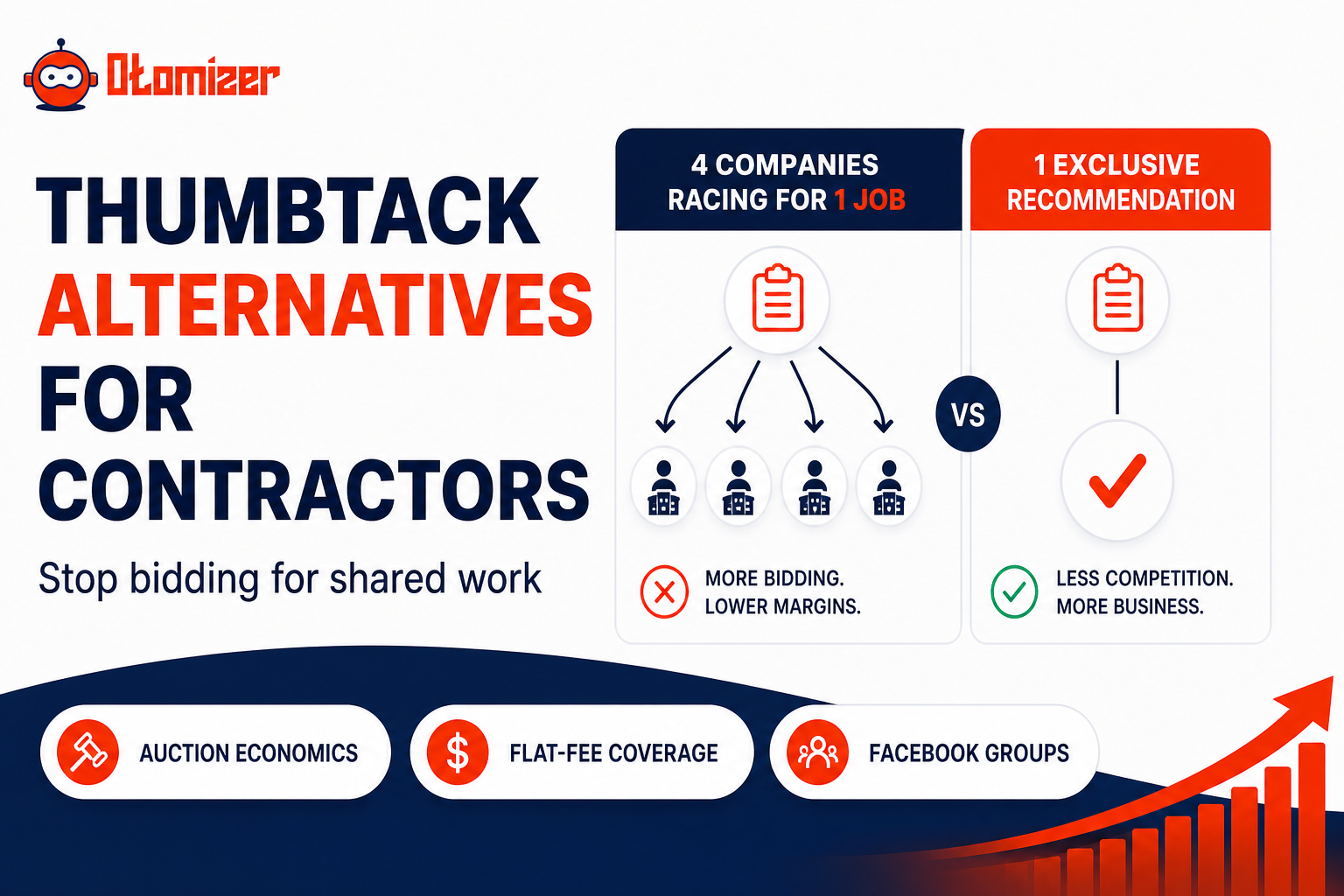
Exclusive territory means one company in your trade in your county, full stop. There is no bid to lose because there is nobody to lose it to. Your competitor cannot buy the same county while you are a client.
That only works if the provider’s capacity is genuinely constrained, which is worth checking before you believe anybody’s exclusivity claim. In our case it is constrained by the obvious thing: our people write comments in your county’s Facebook groups, and they cannot recommend two roofing companies in the same thread without both looking absurd. The exclusivity is a consequence of how the work is done rather than a promise stapled onto a database.
For a side-by-side breakdown of bidding marketplaces against exclusive county coverage, see our Thumbtack alternative comparison page.
Where the demand comes from instead
Every county has neighborhood groups, subdivision groups and town pages where homeowners ask each other who to hire. It happens constantly and it looks nothing like a marketplace request.
“Our AC just quit and the house is already 84 degrees. Who do y’all use? Please no big chains.”
That person has not filled in a form. They are not being called by four companies. They want one name from somebody nearby who has actually used them. If your company is the first name in that thread, with a specific reason attached, you are frequently the only company they contact.
The difference in the conversation is hard to overstate. A homeowner who submitted to a platform has already decided to shop around and has their guard up before your phone rings. A homeowner who asked their neighborhood group is at an earlier point entirely, and a recommendation from within the group carries trust that no advertisement transfers.
It is also durable. Platform mechanics change and reset everybody’s position overnight. Neighborhood groups have worked the same way for a decade, because they are just people asking each other questions.
The honest difficulty
If this were easy, everybody would do it and the advantage would be gone.
The window is about an hour. A recommendation thread collects most of its replies quickly and the homeowner usually contacts somebody before it stops moving. Checking Facebook in the evening means reading the outcome rather than affecting it.
The best groups are closed. Subdivision and neighborhood groups have admin approval and explicit rules against promotion, and a business page posting into them gets removed. Getting in requires an account with genuine local history, which takes months to build and cannot be bought credibly.
And it runs continuously. The requests that matter appear at nine at night, on Sunday morning, and during the storm when your whole crew is already out.
Homeowners in your county are already asking who to hire.
Otomizer Local joins your local groups, monitors them around the clock, and posts a recommendation naming your company when a matching request appears. No bidding, no shared leads.
See Otomizer LocalWhat we do about it
Otomizer Local covers one trade in one county for $1,200 a month plus a one-time $1,500 setup fee.
Our team finds the local groups in your county by hand, joins them using our own aged Facebook accounts rather than anything of yours, and monitors them around the clock. When a matching request appears, a person writes and posts a recommendation naming your company, usually within about a minute. You get a text with the thread link, and every post found and comment posted sits in a dashboard you can audit against the original Facebook thread whenever you like.
There is no bidding, no auction, and no second company in your trade in your county. We do not sign a second company in your trade in the same county while you are a client.
Setup takes two to three weeks while our accounts get approved into your county’s groups, then it runs continuously. That ramp is why the initial term is three months, so you see a full cycle before judging results. For a contractor who wants a steady flow of work rather than an occasional contact, the flat fee is built to be the better deal.
Running the numbers on your own business
Take your average job value and divide it by $1,200. That is how many months of coverage one job pays for.
At an $11,000 average roof, one job covers roughly nine months. At a $6,500 HVAC system, five. At a $450 plumbing service call, you need three jobs a month before the channel breaks even, which most counties support comfortably but not all of them do.
Then look at what you currently spend on the platform across a busy month and a quiet one, and what fraction of that produced work. If the flat figure is close to your current spend and removes the competition and the management overhead, it is worth a quarter to find out. If it is far above, stay where you are and revisit when your volume changes.
We would genuinely rather tell you the arithmetic does not work than take a fee for coverage you cannot convert, which is why we review applications carefully before onboarding anyone. For the shared-lead cost math that makes this comparison meaningful, read are Angi leads worth it.

Stop racing for shared leads. Get recommended in your county.
Otomizer Local covers one trade in one county exclusively. Our team monitors neighborhood groups and posts a recommendation naming your company when homeowners ask who to hire.
Apply for Otomizer LocalOne company per trade per county · Three-month initial term
FAQ
Frequently asked questions
01What is the best Thumbtack alternative for contractors?
02Why does Thumbtack feel more expensive over time?
03Are exclusive leads actually better than shared leads?
04How much does exclusive county coverage cost?
05Do I need lots of reviews for this to work?
06Should I use Otomizer or Otomizer Local for Facebook group leads?
Keep reading