How to Get Real Estate Leads on Facebook in 2026: Groups, Content, and Follow-Up
Get real estate leads on Facebook: which groups to join, buyer and seller intent signals, replies that are not pushy, 30 post ideas, and a follow-up system.

Key takeaways
- 01 The best real estate leads on Facebook are not ad clicks. They are people asking their town, neighborhood, and moving-to groups for an agent, a neighborhood, or advice on selling.
- 02 Buyer and seller intent shows up as timelines, relocations, life changes, and FSBO frustration. Learn the phrasings and answer the Hot ones first.
- 03 Reply like a neighbor who happens to be a licensed agent: one useful local answer, clear disclosure, and an offer to DM. Keep neighborhood answers factual to stay on the right side of Fair Housing.
- 04 Content and group replies work together. Five posts a week build recognition, and twenty minutes a day in groups captures the people who are ready now.
- 05 Speed to lead decides who gets the consultation. Otomizer monitors your groups around the clock, scores posts Hot, Warm, or Cold, and drafts replies in your voice so you see the right threads while they are still open.
The fastest way to get real estate leads on Facebook is to answer the people who are already asking. Join the local groups where movers, sellers, and first-time buyers post questions, watch for buyer and seller intent, reply with one genuinely useful local answer while disclosing you are an agent, then follow up fast in Messenger and your CRM.
That sounds simple, and it is. The hard parts are knowing which groups matter, recognizing intent when nobody says “I want to hire an agent,” replying without sounding like the pushy agent everybody warns each other about, and being there in the first hour instead of the next morning.
This guide covers all of it: why Facebook still matters for agents in 2026, the exact phrasings that signal a buyer or seller, which groups to join, how to reply, 30 realtor Facebook post ideas, how Facebook ads compare with organic and group work, and the follow-up system that turns a comment into a consultation.
Why Facebook still matters for real estate leads in 2026
Every year somebody declares Facebook dead for real estate. And every year the same thing happens in every town: somebody posts in the community group asking who to use.
Portals are where people browse listings. Facebook groups are where people ask each other for advice. Those are different moments, and the second one is far more valuable to an agent.
Think about what actually gets posted in a typical town or neighborhood group:
- “We are moving here from out of state this spring. What areas should we look at?”
- “Can anyone recommend a realtor who knows the new builds?”
- “Thinking of selling. Who did you list with and would you use them again?”
- “Trying to sell by owner and getting nowhere. Any tips?”
- “Does anybody know a good property manager? We might rent the house out instead of selling.”
Every one of those posts is a person in the early or middle stage of a transaction, asking strangers for help in public. They have not filled out a Zillow form. They have not been sold to six agents already. They are open to a recommendation and, crucially, open to whoever gives them the most useful answer.
This is the same shift we wrote about in why Facebook groups are the new Reddit: people trust local, peer conversations more than ads or search results. For agents, that matters even more, because real estate is a referral business at its core. A group thread is a referral conversation happening live.
Three reasons groups beat portals for many agents:
- No shared lead race. A portal lead often goes to several agents at once. A group post goes to whoever shows up with something useful.
- Earlier in the journey. People ask groups months before they are ready to tour. Being the agent who helped early is how you become the agent they call.
- Built-in social proof. When you answer well in public, everybody reading the thread sees it, including the neighbors who will sell next year.
This channel rewards presence and speed. A thread that gets twenty helpful replies in the first hour is decided before you check Facebook at lunch. That is the problem the rest of this guide solves.
What does a real estate lead look like in a Facebook group?
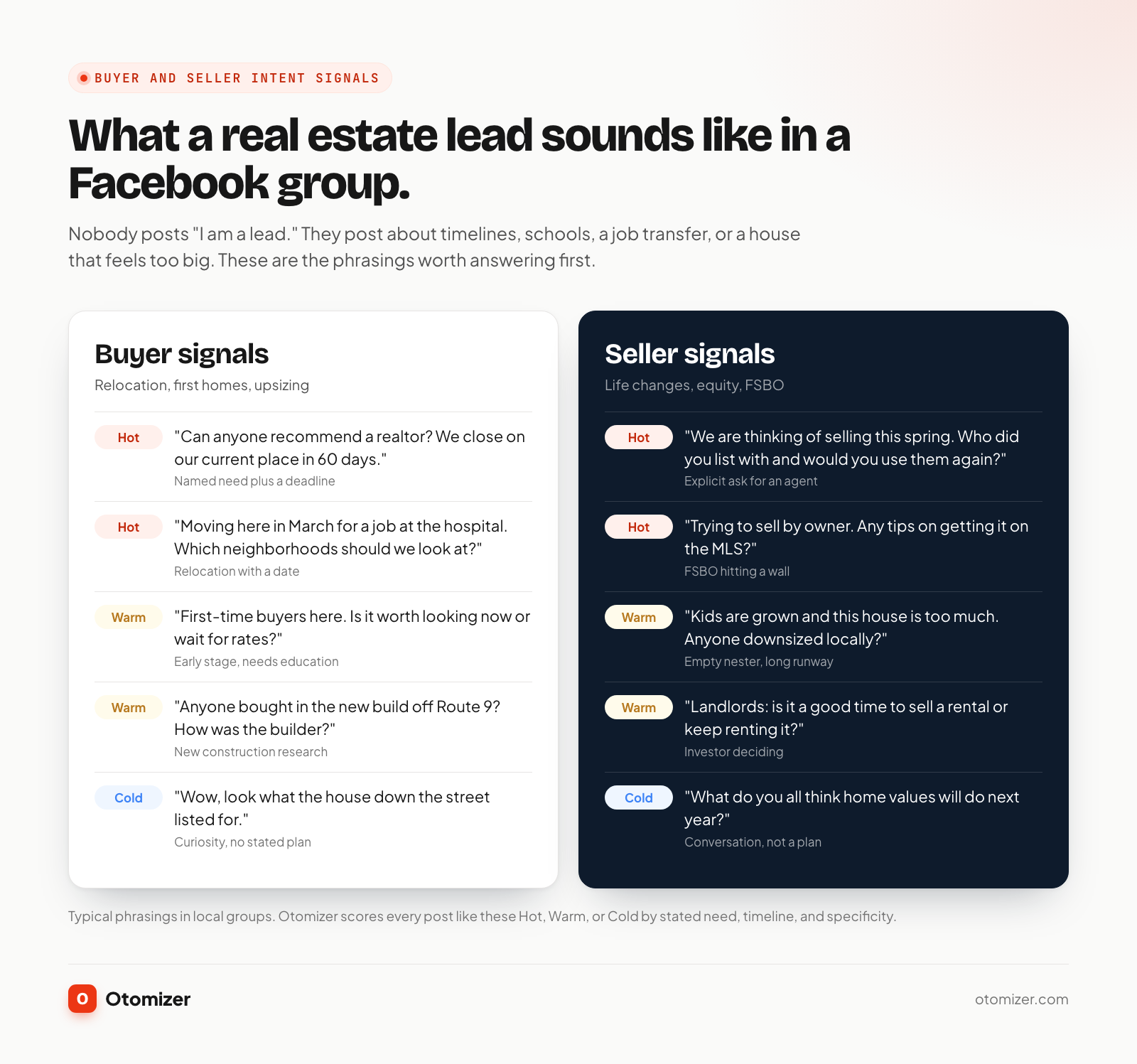
Nobody writes “I am a lead.” They write about timelines, schools, a job transfer, a divorce, kids leaving home, or a house that has become too much. Learning to read those signals is the core skill of Facebook real estate lead generation.
We sort them the same way Otomizer scores them: Hot, Warm, and Cold.
Buyer intent signals
Hot (answer now):
- A direct ask for an agent: “Can anyone recommend a realtor?”
- A relocation with a date: “Moving here in March for a job at the hospital.”
- A deadline: “We close on our current place in 60 days and need somewhere to land.”
- A specific search: “Looking for a 3 bed under $400k near the middle school, any advice?”
Warm (answer helpfully, nurture):
- First-time buyer questions: “Is it worth looking now or should we wait for rates?”
- New construction research: “Anyone bought in the new build off Route 9? How was the builder?”
- Renters thinking about buying: “Our lease is up next year. Is buying here realistic?”
- Neighborhood comparisons: “Which side of town has the shorter commute to downtown?”
Cold (engage lightly or skip):
- Price gossip: “Wow, look what the house down the street listed for.”
- General market opinions with no personal plan attached.
Seller intent signals
Hot:
- “We are thinking of selling this spring. Who did you list with and would you use them again?”
- FSBO frustration: “Trying to sell by owner. Any tips on getting it on the MLS?”
- Life changes with a timeline: “We are relocating for work in August and need to sell.”
Warm:
- Downsizing: “Kids are grown and this house is too much. Anyone downsized locally?”
- Investors deciding: “Landlords, is it a good time to sell a rental or keep renting it?”
- Value curiosity tied to a plan: “Curious what homes in our subdivision go for. We might move next year.”
Cold:
- “What do you all think home values will do next year?”
Adjacent signals that turn into deals
Some of the best real estate conversations do not mention real estate at all:
- “Recommend a moving company?” often means a move is planned.
- “Anyone know a good contractor to get our house ready to list?” is a seller in prep mode.
- “Need a property manager” is an owner who may sell instead.
- “Estate sale company recommendations?” can signal an inherited property.
- “Which school district is better?” from a renter is often a future buyer.
You do not pitch on these. You help, and you remember the name.
Which real estate Facebook groups should you join?
Not all groups are equal. The best real estate Facebook groups for lead generation are the ones where your future clients are, not where other agents are.
| Group type | Why it produces leads | What to watch for | Typical rules |
|---|---|---|---|
| Town and city community groups | The default place locals ask for recommendations | ”Recommend a realtor,” selling plans, moving questions | Often ban self-promotion, allow helpful answers |
| Neighborhood, subdivision, and HOA groups | Small, high-trust, and full of future sellers | ”Thinking of selling,” value questions, contractor asks | Usually residents only. Join where you actually live or own |
| ”Moving to [city]” and “New to [city]” groups | Relocating buyers asking about areas and agents | Relocation dates, school questions, rental vs buy | Often welcome local experts who answer well |
| Parents and school groups | Families planning moves around school calendars | School boundary questions, “we need more space” | Strict on promotion. Be a parent first |
| Military and relocation groups near bases | PCS moves on fixed timelines, frequent buyers and renters | PCS dates, VA loan questions, rent vs buy | Value VA loan knowledge and fast, accurate answers |
| New construction community groups | Buyers comparing builders and lots | Builder questions, agent representation questions | Builders may moderate. Stay factual |
| Local buy and sell groups | High volume, movers selling furniture | ”Moving sale,” “must go by the 30th” | Commercial posts restricted |
| Local business networking groups | Referral partners: lenders, contractors, movers | Vendor recommendations, partnership asks | Promotion often allowed on set days |
How many groups? Start with 10 to 15 active groups across your farm area and the metro’s relocation groups. More groups only help if you can actually watch them. Coverage without monitoring is just a longer list of threads you missed.
Join as a person. Use your personal profile with your real name, and make sure your profile clearly lists your brokerage and that you are a licensed agent. Many groups do not let business pages comment at all, and people trust people. Answer the membership questions accurately.
Read the rules before your first comment. Most community groups ban listing posts and direct advertising. Many still allow, and appreciate, an agent who answers a question well. A few allow a weekly promotion thread. Learn which is which and stick to it.
For a deeper walkthrough on finding and vetting groups, our guide to finding clients in Facebook groups covers the search operators and the red flags that mean a group is not worth your time.
How to reply without being the pushy agent
Every group has seen it: somebody asks a simple question and three agents reply with “DM me!” and a link to their website. Admins hate it, members hate it, and the original poster rarely calls any of them.
The agents who win group threads do the opposite. They answer the question.
The four-part reply
- Answer the actual question. If they asked about neighborhoods near the hospital, name the commute times and the areas people commonly consider. If they asked about selling FSBO, give one useful tip.
- Show local knowledge in one specific detail. A school assignment lookup tool, a builder’s current incentive, the fact that a certain road floods. Specificity is credibility.
- Disclose that you are an agent. “[Your Name] with [Brokerage]” builds trust and is required by most brokerage and state advertising rules.
- Offer, do not push. “Happy to send you the list if it helps, just message me.” One invitation. No follow-up comment begging for a DM.
Replies that win the thread
Relocation post: “Welcome early! [Your Name] with [Brokerage] here. The county has a school assignment lookup by address, which is the first thing I would check before falling in love with a house. Commute to the hospital is [X to Y] minutes from most of the areas people consider. Happy to send you a short list of neighborhoods that match your budget if you message me.”
FSBO post: “Good on you for trying it. One tip: most buyers search the MLS-fed sites, so getting on the MLS is the usual next step if you want real exposure. [Your Name] with [Brokerage], I list homes in [town] and am happy to answer questions either way.”
“Recommend a realtor” post: “[Your Name] with [Brokerage] here. Whoever you choose, ask for their last three sales in your neighborhood and how they priced them. That tells you more than any ad. I would love to be one of the agents you interview.”
Notice what those replies do not do. They do not claim to be a past client. They do not stack praise for themselves. They do not paste a link. They are useful even if the person never calls.
Brokerage and MLS compliance
Three quick checks keep every reply clean: include your brokerage name as your brokerage and state advertising rules require, keep your license status visible on your profile, and follow your MLS rules before sharing anything about a specific listing. Otomizer’s Monitor mode lets you approve every reply, so compliance review takes seconds.
Why speed decides who gets the consultation
The single biggest variable in Facebook real estate lead generation is not your reply copy. It is when you show up.
A recommendation thread usually collects most of its replies in the first hour. After that, the original poster has already messaged two or three people and the thread drifts down the feed. Show up in minute 12 and you are part of the decision. Show up at hour 9 and you are reading it.
That is a problem for working agents. You are at showings, inspections, closings, and listing appointments. You cannot refresh twenty group feeds between appointments, and the posts that matter often land in the evening when families sit down to talk about the move.
It is the same pattern behind Edge Mechanical’s $6,800 in HVAC jobs from Facebook groups in three weeks: the demand was already posting, and Otomizer put them in the thread while it was still open. The same works for agents.
Your next 10 clients are already posting in your groups.
Otomizer monitors your Facebook groups 24/7, scores every post Hot / Warm / Cold, and drafts replies in your voice. Live in under 5 minutes.
See plans and pricingHow Otomizer finds real estate leads in your groups
Otomizer is built for exactly this gap. It is an AI Chrome extension and web dashboard that monitors the Facebook groups you are already in, around the clock, and puts the posts worth answering in front of you.
Here is how agents typically set it up:
- Describe your business once. “Residential buyer and listing agent in [metro], focused on relocation, first-time buyers, and new construction.” That description teaches the intent scorer what counts as a match.
- Sync your groups. One click pulls your group list. Pick the town, neighborhood, moving-to, and relocation groups you want covered. No admin access needed.
- Set keywords and negatives. Positive: realtor, agent, relocating, moving to, selling, listing, by owner, FSBO, new build, first home, lease is up. Negative: rentals wanted (unless you do leasing), job posts, giveaways, other agents’ listing posts.
- Let it score. Every matching post is scored 0 to 100 and labeled Hot, Warm, or Cold. A relocating family with a March date is Hot. A “should we wait for rates” question is Warm. Price gossip is Cold and stays out of your way.
- Review drafted replies in your voice. Otomizer’s four-stage reply pipeline (Decode, Frame, Draft, Critique) writes a peer-like reply specific to the post, then checks it for pitchiness and banned phrases. You edit, approve, and post as yourself.
- Choose Monitor or Autopilot. Most agents keep Monitor mode on so they approve every reply, which also makes compliance review simple. Autopilot is available with rate limits and account-safety checks if your brokerage is comfortable with it.
You keep the relationships. Otomizer makes sure you see the relocating family’s post at 8:40 pm, not the next afternoon. For the full mechanics of keyword lists and scoring, see the complete guide to monitoring Facebook groups for leads, or monitor Facebook groups with Otomizer and see what is already being posted in your area.
Content strategy: what realtors should post on Facebook
Group replies capture intent. Content builds the recognition that makes people say “oh, I have seen her posts” when your name shows up in a thread. You want both.
The rule for agent content is simple: every post should either prove local expertise, educate, or show real results. Motivational quotes and “Just listed!” graphics with no context do none of those.
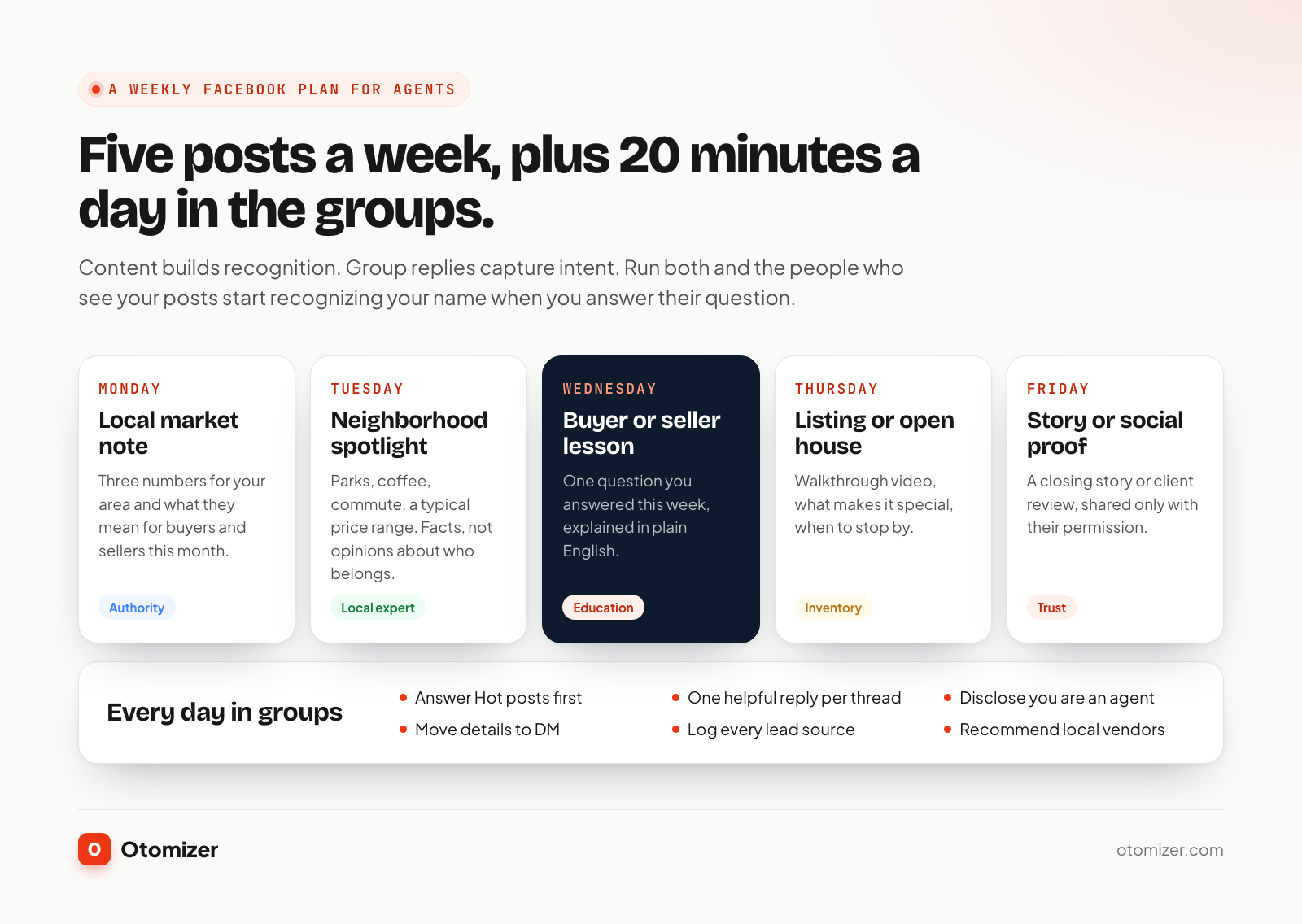
A weekly rhythm that is easy to sustain
- Monday: local market note. Three numbers for your area (median price, days on market, inventory) and what they mean for buyers and sellers in plain English.
- Tuesday: neighborhood spotlight. Parks, coffee, commute, a typical price range. Facts, not opinions about who belongs there.
- Wednesday: buyer or seller lesson. Take one question you answered this week and explain it for everyone.
- Thursday: listing or open house. A walkthrough video beats a photo carousel. Say what makes the home special and when to stop by.
- Friday: story or social proof. A closing story or client review, shared only with the client’s written permission.
Post these to your personal profile (where your friends and sphere actually see them) and your business page. Share to groups only where the rules allow it.
30 realtor Facebook post ideas
Market and data
- “What $400k buys in [town] right now” with three real examples from the MLS.
- Monthly market recap in three numbers, with one sentence on what it means.
- “Days on market by neighborhood” comparison for your farm area.
- Rent vs buy math for a typical home in your area, with assumptions stated.
- “What changed this quarter” for sellers: pricing, concessions, inspection trends.
Neighborhood and local expertise 6. Neighborhood spotlight with commute times, parks, and price ranges. 7. “New to [city]? Here is how trash pickup, utilities, and permits work.” 8. How to look up school assignments by address (link the official tool). 9. Upcoming roads, developments, or zoning changes and what they mean. 10. Local business shoutout: your favorite coffee shop, bakery, or hardware store. 11. Seasonal event guide: farmers markets, festivals, holiday lights. 12. A map of new construction communities with builder names and price bands.
First-time buyer education 13. “The real costs of buying a home, beyond the down payment.” 14. Down payment assistance programs available in your state. 15. Pre-qualification vs pre-approval, explained in 60 seconds. 16. What happens at inspection, and what is worth negotiating. 17. “Five questions to ask before you make an offer.” 18. Myth-busting post: “You do not need 20% down.”
Seller education 19. “Ten things to fix before listing, and five not to bother with.” 20. How pricing strategy affects days on market, with a local example. 21. Staging before and after, with permission from the seller. 22. What FSBO sellers usually miss, explained without trash talk. 23. “How long does it take to sell in [town] right now?”
Listings and open houses 24. Walkthrough video with your take on the best feature. 25. Open house invitation with what to expect and nearby spots to check out. 26. “Coming up this weekend” roundup of open houses in your area (yours and others, where allowed).
Stories, proof, and personality 27. Closing day story with the client’s permission and photo. 28. Client review shared with permission, plus what you did to earn it. 29. “A day in the life” of a listing appointment or a multiple-offer week. 30. Your trusted vendor list: lenders, inspectors, roofers, HVAC techs, movers.
That last one deserves its own section.
Build a local vendor network that refers back
Agents who win on Facebook tend to be the people who know everybody. When someone in a group asks for a roofer, an HVAC company, or a plumber before closing, the agent who recommends a good one earns goodwill from both sides.
Home service companies are working the same groups you are. Roofers, HVAC contractors, and plumbers who are serious about local marketing will be in the neighborhood threads every day, and they talk to homeowners months before those homeowners call an agent. A roofer who replaced a roof before a sale, or an HVAC tech who hears “we are probably moving next year,” is one of the best referral sources you can have.
If you want to understand how those trades approach the same channel, our guides on how to get roofing leads, how to get HVAC leads, and home service marketing show how the other side of the referral relationship works. Introduce yourself to the best ones, send them work, and ask them to keep you in mind.
Facebook ads vs organic content vs groups for real estate
Here is how the three main Facebook channels compare for agents. Group monitoring with Otomizer comes out ahead on the things that close deals: intent, cost, and speed.
| Facebook and Instagram ads | Organic content alone | Groups with Otomizer | |
|---|---|---|---|
| What you get | Form fills from people who were scrolling | Recognition with your sphere | Conversations with people who asked for an agent |
| Intent level | Mostly early stage | Mostly passive | High and time-bound |
| Cost | Ad spend plus creative, every month | Your time | A flat monthly plan |
| Speed to results | Fast clicks, slow closings | Slow, months to build | First Hot posts usually within days |
| Exclusivity | Leads often shopping several agents | Not applicable | You reply first, often before anyone else |
| Follow-up needed | Heavy, long nurture | Light | Fast first touch, warm from the start |
| Winner | Best cost per conversation |
The strongest setup for most agents and teams: Otomizer watching your groups around the clock for high-intent conversations, backed by the weekly content rhythm above so your name is familiar when you reply. Add ads later if you want extra volume, once group conversations are already feeding your pipeline.
The follow-up system: from comment to consultation
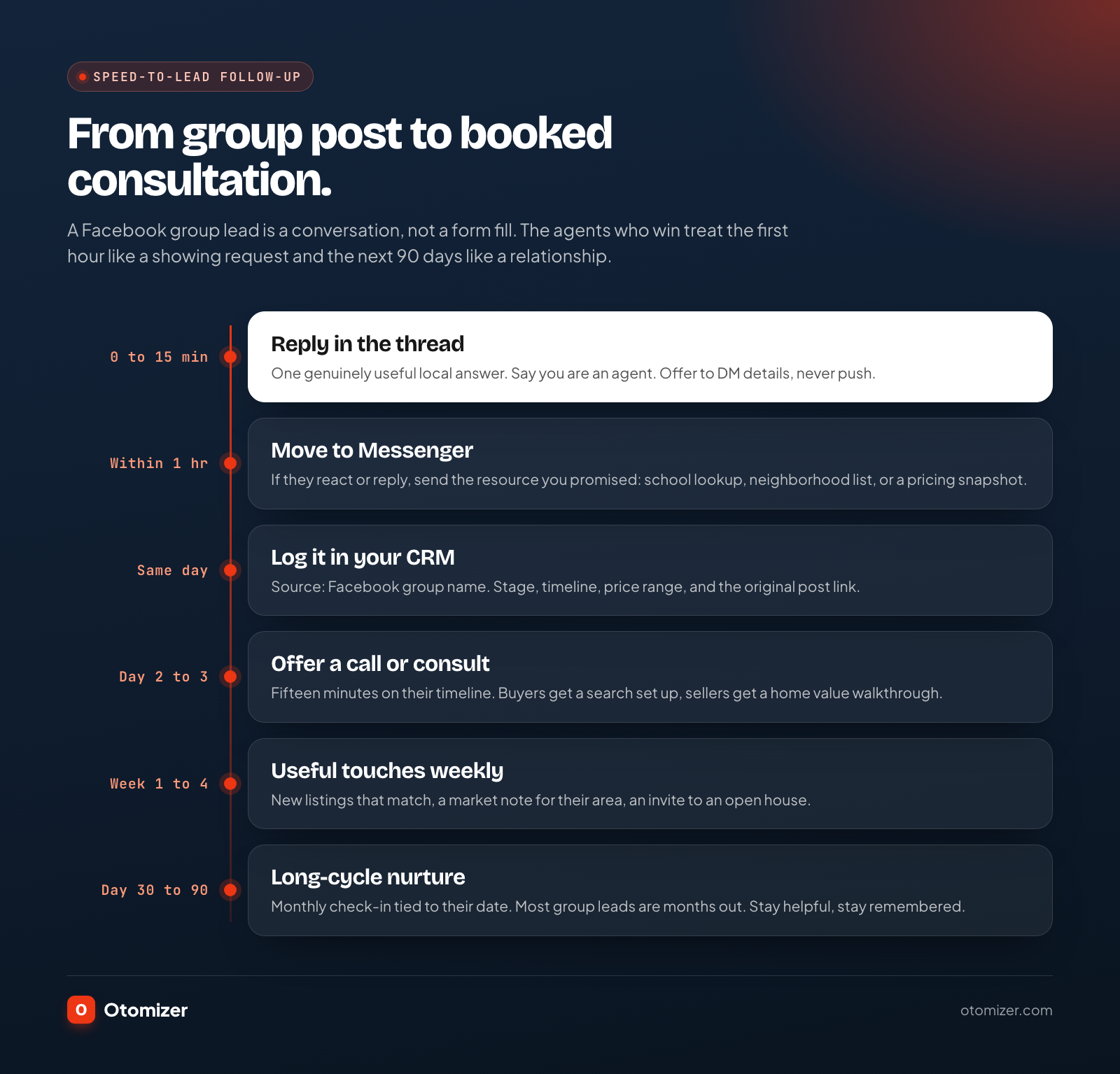
A Facebook group lead is a conversation, not a form fill. Treat the first hour like a showing request and the next 90 days like a relationship.
Step by step
- 0 to 15 minutes: reply in the thread. One genuinely useful answer, disclosure, and an offer to DM.
- Within an hour: move to Messenger. If they react or reply, send the resource you promised. A school lookup link, a short neighborhood list, a pricing snapshot for their street. Deliver before you ask for anything.
- Same day: log it in your CRM. Source as “Facebook group: [group name].” Record stage, timeline, price range, and the link to the original post. Source tracking is how you find out which groups actually produce clients.
- Day 2 to 3: offer a short call. Fifteen minutes on their timeline. Buyers get a search set up. Sellers get a home value walkthrough.
- Weeks 1 to 4: useful touches weekly. New listings that match, a market note for their area, an invite to a relevant open house.
- Day 30 to 90: long-cycle nurture. A monthly check-in tied to their date. Many group leads are months away from transacting. The agent who stays helpful and present is usually the one they call.
What to track
Keep it simple. For each group, track conversations started, consultations booked, and closings. After 90 days you will know which groups deserve more of your time and which ones are mostly event flyers and lost dogs.
Also track reply time. If your median time to first reply is measured in hours, fixing that will likely do more for your Facebook results than any copywriting change.
What your week looks like with Otomizer
Say you are a buyer and listing agent covering two suburbs and your metro’s relocation market, with about 14 groups connected: town groups, the subdivisions you live in or near, two “moving to” groups, a military relocation group, parents groups, a new construction community, and a local business network.
- Morning (10 minutes): You open your Otomizer dashboard. Overnight posts are already scored: a family relocating in March asking about neighborhoods and a homeowner asking who people listed with are Hot. A couple of first-time buyer questions and a landlord deciding whether to sell are Warm. You tweak two drafted replies, post them as yourself, and save the Warm ones for later.
- Midday: The relocating family reacts to your reply. You send the school lookup link and three neighborhoods that fit their budget in Messenger, then log them in your CRM.
- Evening (10 minutes): A Hot post lands at 8:15 pm from a FSBO seller tired of showings. Otomizer alerts you, you reply with a useful tip and your brokerage, and the seller messages you the next morning.
- Content: Your Monday market note and Wednesday “five questions before you make an offer” post go out on schedule, and a member shares the Wednesday post into a parents group.
Twenty minutes a day, five posts a week, and a clean follow-up process. Otomizer handles the watching, so you spend your time on the conversations that turn into clients.
Want it done for you? Otomizer Local for teams and brokerages
The self-serve setup above is built for agents who like to stay hands-on. Teams and brokerages that want the whole channel run for them use Otomizer Local, our done-for-you service.
Our team handles the full loop across your market: finding and joining the right groups, monitoring them around the clock, responding to buyer and seller requests within minutes, alerting your agents the moment someone engages, and creating and publishing local content that keeps your brand in front of every town you serve. We take on a limited number of teams per market, so the earlier you apply, the better your chance of locking in your area. You can see exactly how it works in our breakdown of done-for-you local marketing.
Otomizer Local is a strong fit when:
- You have several agents and nobody owns Facebook consistently.
- Your market spans multiple towns and dozens of active groups.
- You have an ISA, a lead coordinator, or agents who call back within the hour, and you want more conversations feeding them.
Territories are limited. Apply for Otomizer Local and tell us about your market.
Common mistakes that kill Facebook real estate leads
- Posting listings in groups that ban promotion. You get removed, and the admin remembers your name.
- Replying with “DM me” and nothing else. It reads as a sales grab. Give the answer first.
- Hiding that you are an agent. It is a compliance problem and a trust problem. People find out, and screenshots travel.
- Using steering language. “Great area for young families” can create Fair Housing exposure. Stick to facts.
- Checking groups once a day. By then most threads are decided.
- No source tracking. Without it you cannot tell which groups are worth your time.
- Treating every lead as ready now. Most are months out. Nurture beats pressure.
- Joining 60 groups and watching none of them. Fewer groups, watched properly, beat a long list you never read.
Your 30-day starting plan
- Week 1: Join 10 to 15 groups across town, neighborhood, moving-to, parents, and relocation categories. Update your profile with your brokerage and license disclosure. Read every group’s rules.
- Week 2: Read and collect real posts. Build your keyword list from actual phrasing. Start answering two or three questions a day with genuinely useful replies.
- Week 3: Start the five-post weekly content rhythm on your profile and page. Set up CRM source tracking for “Facebook group: [name].”
- Week 4: Turn on monitoring so you see Hot posts within minutes, including evenings. Review which groups produced conversations and drop the dead ones.
By day 30 you should know which groups produce real conversations, how fast you are actually responding, and which content your sphere engages with. Everything after that is doing more of what works.
Real estate leads on Facebook are not hidden. They are posting in your town’s groups every week, asking for exactly what you do. The agents who win are the ones who show up first, answer well, and follow up like professionals. Otomizer makes sure that is you.
If you want to be there in the first hour without living in your Facebook feed, Otomizer monitors your groups 24/7, scores every post Hot, Warm, or Cold, and drafts replies in your voice for you to approve. See plans and pricing and connect your groups in under five minutes.

Stop scrolling. Start closing leads in your voice.
Otomizer monitors your Facebook groups 24/7 and replies like a peer, not a pitch deck.
Get startedCancel anytime · 7-day money-back guarantee
FAQ
Frequently asked questions
01How do I get real estate leads on Facebook without paying for ads?
02What Facebook groups should real estate agents join?
03Is it allowed for realtors to comment in Facebook groups?
04How fast should a realtor respond to a Facebook lead?
05What should realtors post on Facebook to get leads?
06How does Fair Housing apply to answering questions in Facebook groups?
07Can software find real estate leads in Facebook groups for me?
08Are Facebook ads or Facebook groups better for real estate leads?
Keep reading
Related articles
How to Get Plumbing Leads in 2026: 12 Channels Ranked by Cost
November 13, 2026
Otomizer LocalDone-For-You Marketing Pricing: Local Leads vs Presence vs Dominance
November 1, 2026
MarketingHome Service Marketing: The 2026 Playbook for Plumbers, Electricians, and Local Trades
October 30, 2026
ContractorsHow to Get HVAC Leads in 2026: Every Channel Ranked by Cost Per Booked Job
October 30, 2026