How to Get Roofing Leads in 2026 (Without Paying for Shared Leads)
How to get roofing leads you do not have to share: 11 channels ranked by cost per signed roof, a 72-hour storm playbook, winning group replies, and a 90-day plan.

Key takeaways
- 01 The cheapest roofing leads are the ones you do not share. Local Facebook group threads, worked with Otomizer, deliver the lowest cost per signed roof of any channel, because the homeowner asks once and calls the first trusted name.
- 02 Roofing demand is event driven. A hail or wind event can produce more requests in a few days than the previous two months, and Otomizer watches every group in your county through the whole surge.
- 03 Speed decides group threads. A recommendation thread is usually settled within the first hour, and the first two credible names get the calls. Otomizer puts you in the thread in minutes.
- 04 Storm work rewards trust. A local address, a license number, a written warranty, and no pressure tactics separate you from the storm chasers homeowners are warned about.
- 05 Shared marketplace leads are the most expensive way to sign a roof. Track cost per signed roof, and move budget to exclusive channels like Otomizer Local.
The short answer: the best way to get roofing leads in 2026 is to win the local Facebook group threads where homeowners ask neighbors who to hire, then stack referrals and neighbor marketing on top. Those roofing leads are exclusive and arrive with trust attached. Otomizer monitors every group in your area 24/7 so you are first in each thread. Measure everything by cost per signed roof.
The rest of this guide shows you how to run it: which roofing lead generation channels sign the most roofs, what to do in the 72 hours after a hail storm, how to answer a “who do you recommend for roof damage” post so the homeowner calls you, and a 90-day plan you can start on Monday.
If you have ever paid for a lead, called within five minutes, and heard “three other roofers already called me,” this is for you.
Why are roofing leads so expensive?
Roofing leads are expensive for three structural reasons.
The ticket is big. A full replacement is often a five-figure job. When one signed roof can pay for months of marketing, every lead platform and ad network prices accordingly. You are bidding against every roofer in your market who has done the same math.
Demand is lumpy. Most homeowners do not think about their roof until something happens: a storm, a leak, a failed inspection during a sale. Demand spikes hard after weather events and goes quiet in between. Platforms charge the most exactly when you want leads the most.
Most paid leads are shared. Marketplace leads are commonly sold to several contractors at once. The homeowner fills out one form and gets four calls in ten minutes. You are now in a speed race and a price fight with strangers, for a homeowner who is already tired of the phone ringing. Your close rate drops, so your real cost per signed roof is several times the sticker price of the lead.
There is a fourth reason specific to roofing: storm chasers have trained homeowners to be suspicious. After every major hail event, out-of-town crews knock doors, push contingency agreements, and disappear before the warranty matters. So even a legitimate local roofer starts every conversation with a trust deficit.
The way out is not to outbid everyone for the same shared lead. It is to get into the conversations where trust is already attached, and that is exactly where Otomizer puts you.
Retail roofing vs storm and insurance work
Before you pick channels, decide what kind of roofing work you want more of.
Retail work is a homeowner paying out of pocket. Age-related replacements, leaks, repairs, inspection flags during a home sale, upgrades to metal or architectural shingles. Price matters more, and financing often decides the deal. Retail requests show up all year in neighborhood groups, search, and referrals.
Storm and insurance work is driven by hail or wind and funded by a claim. The homeowner often already has an adjuster visit scheduled and wants someone who has worked with insurance before. Volume is concentrated in short windows after weather events. Speed and trust decide who gets the job.
Most roofing companies need both. Storm work produces bursts of revenue. Retail work keeps crews busy between storms. Local Facebook groups are the one channel that delivers both: steady retail asks all year, and a flood of storm threads the night the hail hits.
11 roofing lead generation channels, ranked
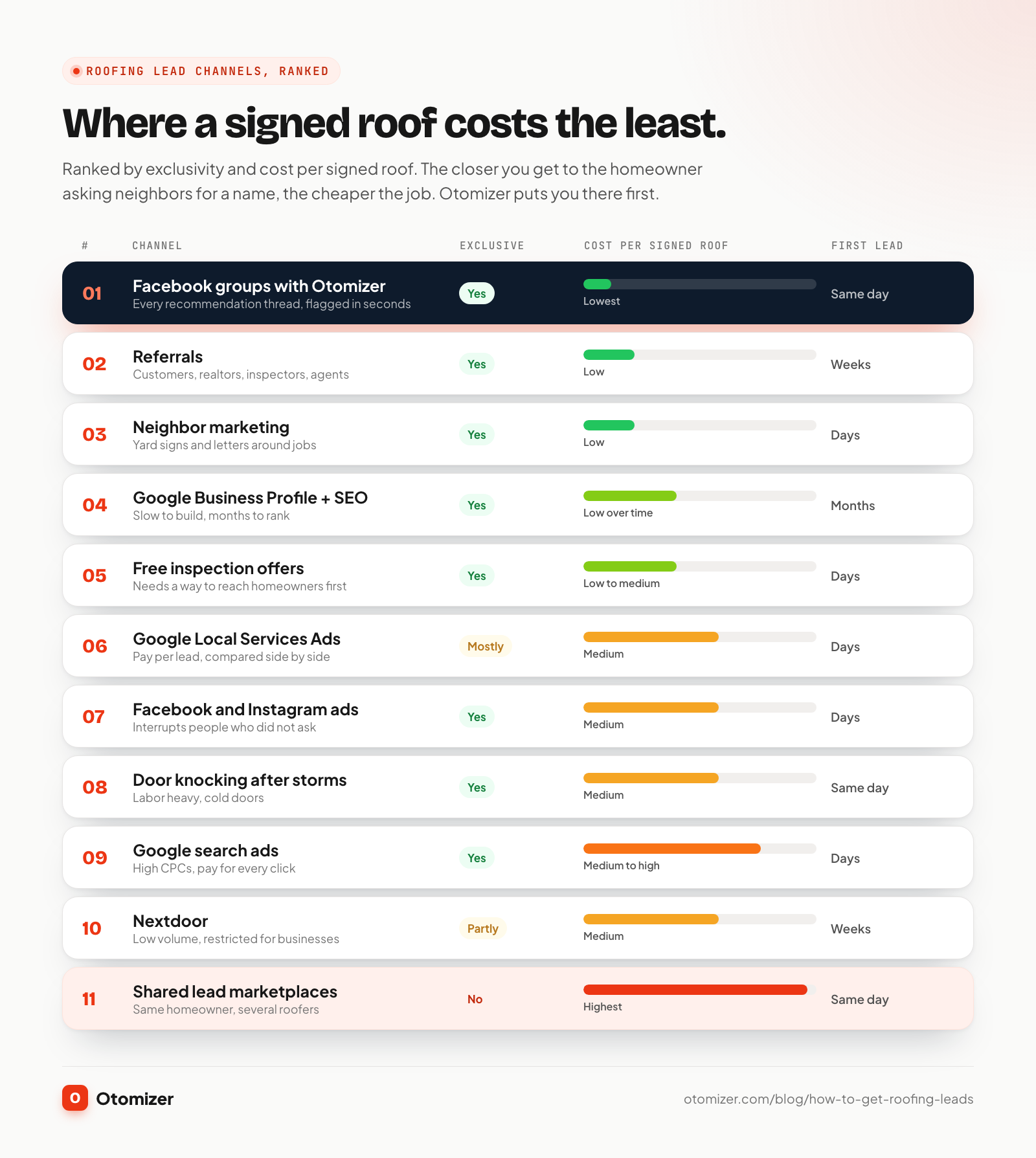
Here is how the main roofing lead sources compare on the four things that matter: whether the lead is exclusive, what it costs per signed roof, how fast it starts working, and whether it compounds.
| Rank | Channel | Exclusive? | Cost per signed roof | Speed to first lead | Compounds? |
|---|---|---|---|---|---|
| 1 | Local Facebook groups with Otomizer | Yes | Lowest | Same day | Yes |
| 2 | Past customer and partner referrals | Yes | Low | Weeks | Yes |
| 3 | Neighbor marketing around active jobs | Yes | Low | Days | Yes |
| 4 | Google Business Profile and local SEO | Yes | Low over time | Months | Yes |
| 5 | Free inspection offers | Yes | Low to medium | Days | Somewhat |
| 6 | Google Local Services Ads | Mostly | Medium | Days | No |
| 7 | Facebook and Instagram ads | Yes | Medium | Days | No |
| 8 | Door knocking after storms | Yes | Medium (labor heavy) | Same day | No |
| 9 | Google search ads (PPC) | Yes | Medium to high | Days | No |
| 10 | Nextdoor | Partly | Medium | Weeks | No |
| 11 | Shared lead marketplaces | No | Highest | Same day | No |
Exclusive, trust-carrying channels sit at the top. Shared leads sit at the bottom. And group threads worked with Otomizer win on every column at once: exclusive, cheapest per signed roof, live the same day, and compounding as your name keeps coming up in the same neighborhoods.
Now each channel in practice.
1. Local Facebook groups with Otomizer
Every town, subdivision, and county has neighborhood groups where homeowners ask each other for recommendations. Roofing requests show up in a few predictable patterns:
- The storm follow-up: posted within days of hail or wind, often mentioning an adjuster.
- The leak: a ceiling stain or a drip during the last rain. Urgent, and usually awarded to whoever can get on the roof soonest.
- The inspection flag: a sale is under contract and the roof needs to be handled before closing.
- The financing question: “does anyone know a roofer who does payment plans?”
These are the highest intent roofing leads that exist, and nobody is charged for them. One person asks, a handful of people answer, and the homeowner calls the first couple of names that got a positive reply. In most groups, that is settled within the first hour.
That timing is why this channel belongs to whoever is watching. You cannot scroll thirty groups from a roof. Otomizer can. It is built to monitor Facebook groups for buyer intent around the clock, scores every roofing request Hot, Warm, or Cold, and drafts a reply in your voice the moment a post goes up, so you are one of the first two names in the thread every time. Our complete guide to monitoring Facebook groups for leads covers the keyword setup in detail.
We cover exactly how to reply below, because a great reply is what turns the thread into a signed roof.
2. Referrals from past customers, realtors, inspectors, and insurance agents
Referrals close well because the trust transfers with the name. Turn them into a system:
- Ask at the right moment. The best time is the day the crew cleans up and the homeowner sees the finished roof, not three weeks later in an email.
- Make it easy to pass on. Leave two or three cards or a simple door hanger with your name, license number, and a direct number.
- Build partner relationships. Realtors deal with inspection flags constantly. Home inspectors are asked “who would you call?” every week. Independent insurance agents hear about claims before anyone. Visit them, explain how fast you can turn around a written estimate, and follow up when you do a job for one of their clients.
- Close the loop. When a referral signs, tell the person who sent it. People refer again when they hear it went well.
Referrals have one ceiling: you cannot control when they arrive. Group threads give you a steady stream of the same kind of trusted recommendation, every week, on demand. Run both and every finished roof feeds the next thread.
3. Neighbor marketing around every active job
When you have a crew on a roof, the neighbors are watching. Their roofs are likely the same age, from the same builder, hit by the same storm. Use that:
- Yard sign on the job for the duration of the work (with the homeowner’s permission).
- A short neighbor letter to the five to ten houses on either side: “We are replacing the roof at 412 Maple this week. Sorry for the noise. If you want us to look at yours while we are on the street, here is a direct number.” Local, useful, and low key.
- Offer a no-pressure look while the crew is already there. Same street, no extra drive time.
- Photograph the finished job for your Google Business Profile and social posts.
Neighbor marketing pairs perfectly with group monitoring. The letter reaches the street. The group thread reaches the whole subdivision when one of those neighbors asks, “who is the roofer working on Maple?“
4. Google Business Profile and local SEO
Your Google Business Profile is where homeowners look you up after a neighbor recommends you. Treat it like a storefront:
- Correct service area, hours, and a phone number someone actually answers.
- Real photos of real jobs, added weekly. Before and after, crews on roofs, finished ridgelines.
- A steady stream of reviews from actual customers. Ask every customer, every time.
- Posts about seasonal topics: storm season prep, what an inspection covers, how insurance claims work.
- Service pages on your website for each core service and each town you serve.
The step-by-step version is in our guide on how to rank higher on Google Maps, and the review system (with copy-paste request texts) is in how to get more Google reviews.
Local SEO takes months to build. Every recommendation you win in a group thread sends a homeowner to your profile already primed to call, which is why the two channels work best together.
5. Free inspection offers
A free roof inspection is the standard entry point for storm work, and it works for retail too. The offer has to be genuinely free and genuinely no-pressure. Homeowners have been warned about “free inspections” that end in a contract on the kitchen table.
Make the inspection valuable on its own: photos of every slope, a written summary of what you found, and a clear statement of whether a claim is worth filing. When the roof is fine, say so. That homeowner will remember you, and they will name you the next time a neighbor asks in the group.
6. Google Local Services Ads
Local Services Ads (the “Google Verified” listings at the top of search, formerly Google Guaranteed) charge per lead rather than per click. Placement leans heavily on review count and responsiveness, and you pay for every call, including the ones that are not roofing work.
The weakness: the homeowner who searches is still comparing three listings side by side. The homeowner in a group thread has asked neighbors for one name. Otomizer puts you in front of the second homeowner, who is closer to signing and costs you nothing per lead.
7. Facebook and Instagram ads
Paid social can work for roofing when it is tied to something concrete: a storm that just went through, a seasonal inspection offer, or a financing promotion. Generic “best roofer in town” ads underperform.
The weakness: ads interrupt people who did not ask. Group threads are people actively asking for a roofer in your town today. Otomizer finds them for you, so the spend goes into replies that convert instead of impressions that scroll past.
8. Door knocking after storms
Canvassing still produces work after a hail event. It is also exactly what storm chasers do, so the trust bar is high and the labor cost is real. If you canvass, wear branded gear, carry your license and local address, leave something useful, and never pressure anyone to sign on the doorstep. Some towns require solicitor permits.
The weakness: a crew can knock a few dozen doors an hour. Otomizer watches every neighborhood group in the hail swath at once and tells you which homeowners are already asking for help, so your canvassers go to warm doors instead of cold ones.
9. Google search ads
Pay-per-click on terms like “roof repair near me” and “roof replacement [city]” puts you in the auction with every roofer in your metro. Costs per click are high, and without tight tracking it is easy to spend a lot and learn nothing.
The weakness: you pay for every click whether it signs or not. A group thread costs nothing to answer, and the homeowner already trusts the neighbor who passed your name along.
10. Nextdoor
Nextdoor recommendation threads look like Facebook group threads, but volume is much lower in most markets and business participation is restricted. Most of the recommendation activity in a typical town happens in Facebook groups, which is where Otomizer focuses.
11. Shared lead marketplaces
Angi, HomeAdvisor, and similar platforms produce leads on demand, which is why roofers keep paying for them. Because those leads are sold to several contractors, close rates are low and the cost per signed roof rises fast. Our breakdown of whether Angi leads are worth it walks through the audit, and the Otomizer Local vs Angi comparison shows why exclusive coverage signs more roofs.
What a signed roof costs by channel
Here’s the math for a typical roofing company, using a $12,000 average replacement contract:
- Shared marketplace lead: $80 per lead, sold to multiple roofers, close rate 1 in 12
- Exclusive paid lead (LSA or PPC): $150 per lead, close rate 1 in 4
- Self-serve Otomizer: $289 a month all in (Otomizer Pro at $89, plus about four hours of your time replying, valued at $50 an hour), 10 qualified threads replied to per month, close rate 1 in 4
- Otomizer Local: $1,197 a month, 15 conversations per month handled by our team, close rate 1 in 4, zero hours of your time
Cost per signed roof:
| Channel | Cost per signed roof |
|---|---|
| Shared marketplace | $960 |
| Exclusive paid lead | $600 |
| Otomizer Local (done for you) | $319 |
| Self-serve Otomizer | about $116 |
When you stop racing other roofers for the same homeowner, your close rate rises and your cost per signed roof falls. Both Otomizer options beat every paid channel, and on a $12,000 roof either one pays for itself many times over with a single signed job.
The 72-hour storm response playbook
A hail or wind event is the biggest roofing lead opportunity of the year in most markets, and it is where reputations are made. One storm can produce more requests in four days than the two months before it.
Here is how a local roofer should run the first 72 hours.
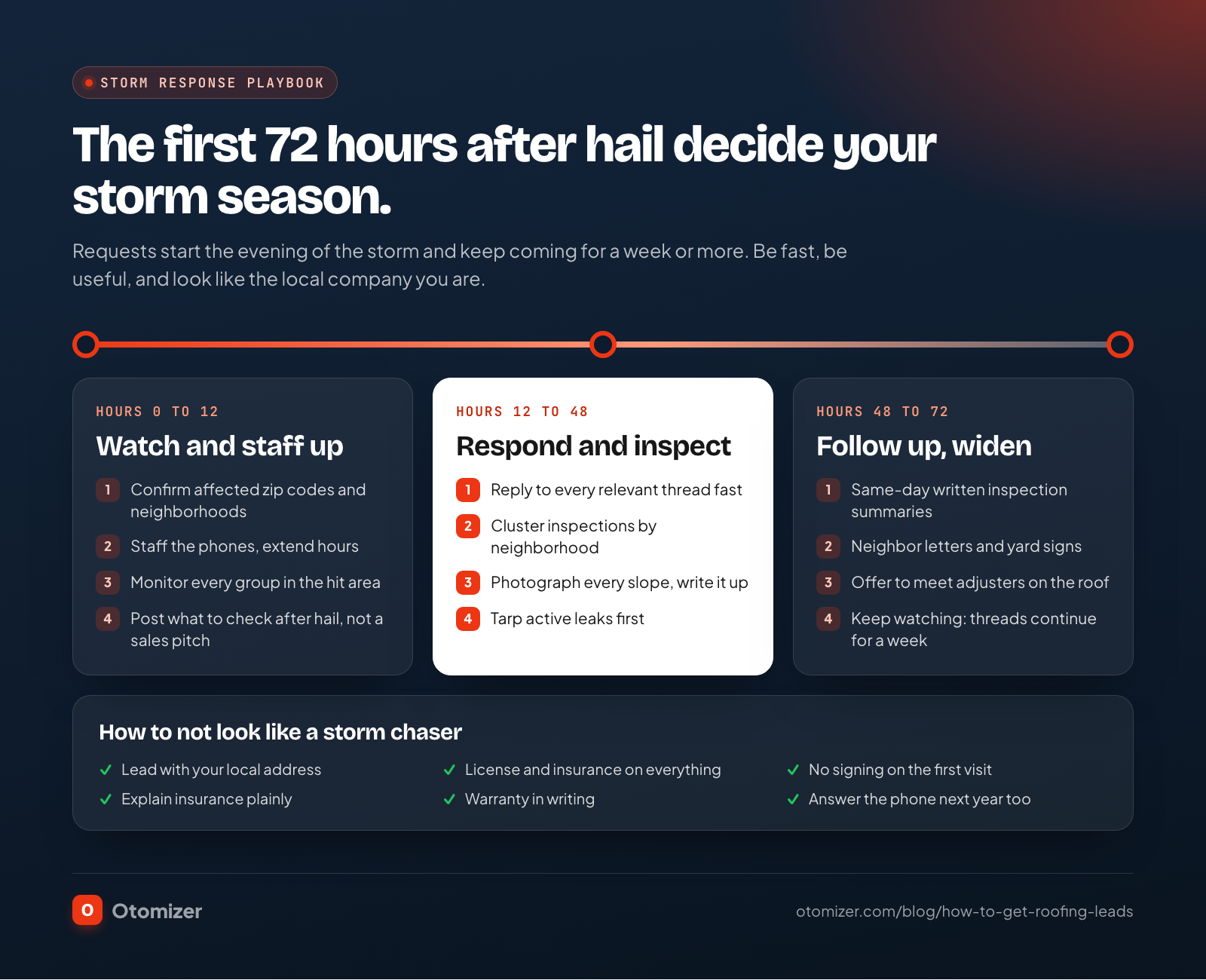
Hours 0 to 12: watch and staff up
- Confirm where it hit. Use hail maps and local weather reports to identify the affected zip codes and neighborhoods.
- Staff the phones. Every missed call in the first two days is a lost job. Extend office hours or set up a call forwarding rotation.
- Watch the groups. Recommendation threads start the evening of the storm and peak over the next few days. Otomizer monitors every neighborhood and town group in the affected area and flags each request as it lands. This is the night it pays for itself.
- Post something helpful. On your Facebook page and Google Business Profile: what to check after hail, how to photograph damage, when to call your insurer. Useful information builds trust before anyone calls.
Hours 12 to 48: respond and inspect
- Reply to every relevant thread fast. Use the reply framework below. Lead with what the homeowner needs to know, name your company clearly, and offer a no-pressure inspection.
- Schedule inspections in tight geographic clusters. Group appointments by neighborhood so crews spend time on roofs, not in traffic.
- Document everything. Photos of every slope, written findings, a clear yes or no on whether a claim makes sense.
- Tarp active leaks first. Emergency work builds the most loyalty and the most word of mouth.
Hours 48 to 72: follow up and widen the circle
- Follow up on every inspection with a written summary, the same day if possible.
- Start neighbor marketing around every inspected or contracted house: a short letter, a yard sign where permitted.
- Coordinate with adjusters. Homeowners with open claims want someone who has done this before. Offer to meet the adjuster on the roof.
- Keep watching. Group threads keep coming for a week or more as homeowners notice damage, hear from neighbors, or get adjuster visits. Otomizer keeps catching them long after your competitors stop looking.
How to not look like a storm chaser
Homeowners after a storm are being warned, by neighbors and by local news, about out-of-town crews. Look like the opposite.
- Lead with your local address and how long you have worked in the area.
- Show your license number and proof of insurance on every estimate, door hanger, and truck.
- Never ask anyone to sign on the first visit. No contingency agreements on the doorstep.
- Explain the insurance process plainly.
- Put the warranty in writing, both manufacturer and workmanship.
- Answer the phone next year. Storm chasers cannot promise that. You can.
How to reply to roofing requests in Facebook groups
Finding the thread gets you in the room. The reply decides whether the homeowner calls you.
A recommendation thread is a neighbor asking a question. The replies that win are short, specific, and helpful. The replies that lose are pasted brochures with a phone number in capital letters.
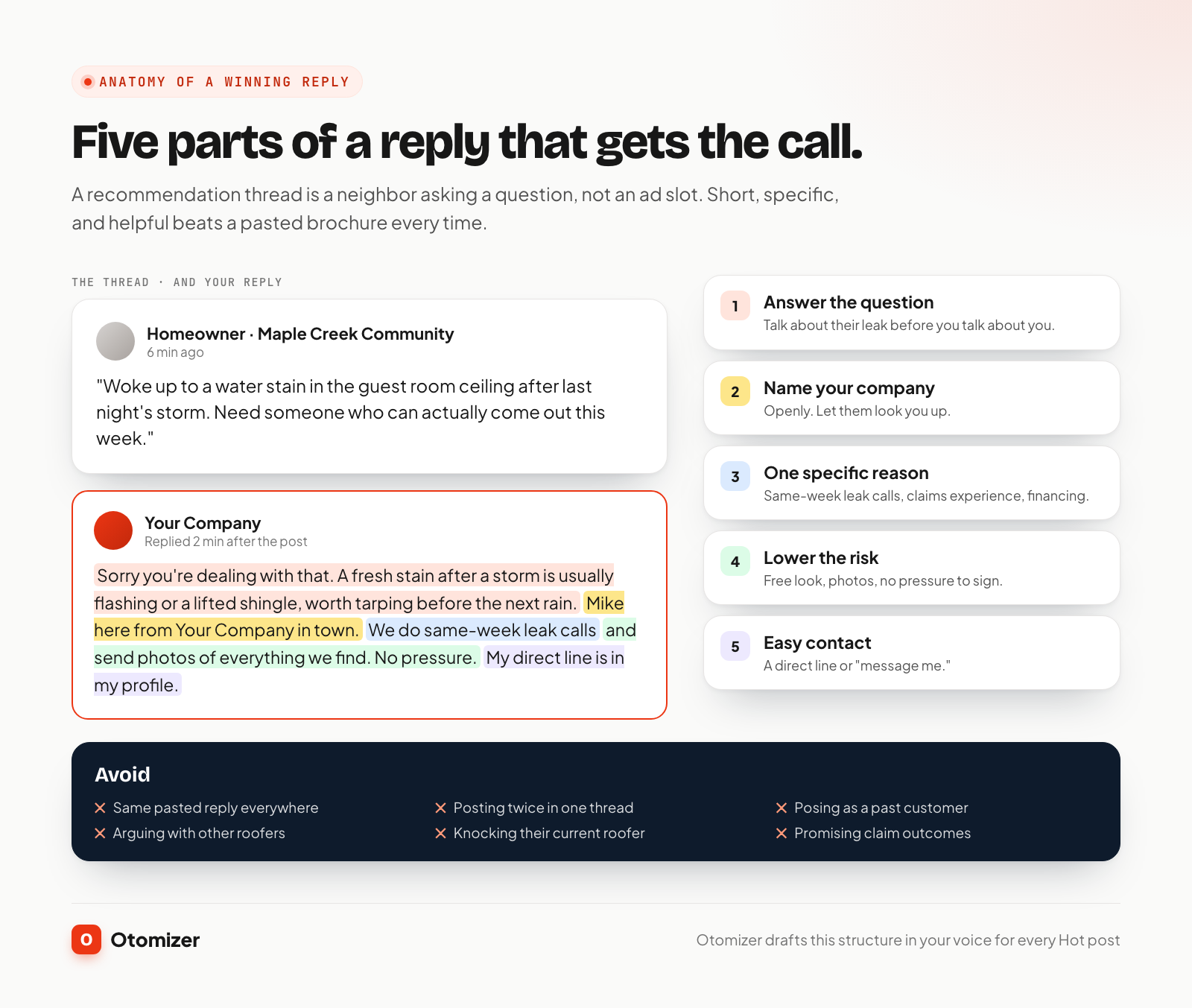
The five parts of a reply that gets the call
- Answer the actual question first. If they asked about a leak, talk about the leak.
- Name your company clearly. “Mike here from [Your Company]” lets them look you up in seconds.
- Give one specific, relevant reason. Same-week leak calls. Experience with adjusters. Financing available. Written completion dates for closings.
- Lower the risk. Free inspection, photos of every slope, no pressure to sign.
- Make contact easy. A direct number or “send me a message and I will get you on the schedule.”
Otomizer drafts replies in exactly this structure, in your voice, for every Hot post it finds. You approve and post, or let Autopilot handle it within safe limits.
Reply templates for the four roofing threads
Copy these, put your company name in the brackets, and adjust the details to how you work.
The leak
Homeowner: “Woke up to a water stain in the guest room ceiling after last night’s storm. Need someone who can actually come out this week.”
Your reply: “Sorry you’re dealing with that. Mike here from [Your Company] in town. A fresh stain after a storm is usually flashing or a lifted shingle, and it’s worth tarping before the next rain. We do same-week leak calls and send photos of everything we find. Happy to take a look, no pressure. My direct line is in my profile.”
The storm follow-up
Homeowner: “Adjuster is coming Thursday for hail damage. Should I have a roofer there? Who has done insurance work in this area?”
Your reply: “Yes, it helps to have a roofer on the roof with the adjuster so nothing gets missed. [Your Company] here, we’re local and handle claims regularly. We can inspect before Thursday so you have photos of every slope going in. Free, and if the damage doesn’t justify a claim we’ll tell you.”
The inspection flag
Homeowner: “Buyer’s inspection says the roof has about five years left and they want it replaced before closing on the 18th. Who can do this fast?”
Your reply: “Closing deadlines are doable. [Your Company] here. We can get an estimator out this week and give your agent and the title company a written completion date. Send me the address and closing date and I’ll confirm whether the 18th works.”
The financing question
Homeowner: “Does anyone know a roofer who does payment plans? Ours is due but we can’t do it all at once.”
Your reply: “[Your Company] here. We offer financing on replacements, and we’ll also tell you if a repair can buy you a few years instead. Free estimate either way.”
What to avoid in roofing replies
- Copy-pasting the same reply into every thread. Admins notice and members notice.
- Posting more than once in the same thread.
- Arguing with other contractors in the comments.
- Disparaging the homeowner’s current roofer.
- Promising an insurance outcome you do not control.
Done well, a group reply looks like what it is: a local business being useful in its own community.
How Otomizer gets roofing companies leads from Facebook groups
You can run this channel yourself, or have our team run it for you.
Run it yourself with Otomizer. Join the neighborhood and town groups across your service area, connect them through the Otomizer Chrome extension, and Otomizer monitors them continuously. Every roofing request is scored Hot, Warm, or Cold by buyer intent, so a “ceiling is leaking right now” post rises above “anyone thinking about metal roofs?” Otomizer drafts replies in your voice, and you approve them or let Autopilot post within safe limits. HVAC company Edge Mechanical used Otomizer to add $6,800 of booked work in three weeks, and the playbook carries straight over to roofing.
Have it done for you with Otomizer Local. Otomizer Local for roofers is the done-for-you version. Our team finds and joins the groups in your county, watches them around the clock (nights and weekends included), and posts a recommendation naming your company in matching threads, usually inside 60 seconds. Every conversation is logged with a link to the original post, and you get an SMS and email the moment a homeowner engages.
The key detail for roofers: one roofing company per county. We do not sign a second roofer in your territory at any price, so storm volume in your county goes to you, not to a bidding war. Plans start at $1,197 a month plus a $1,497 setup fee, and every plan is backed by our guarantee: 20 qualified conversations in your first 90 days, or we keep working at no charge until you get them. The Local Presence plan adds daily value posts, seasonal campaign planning around storms, and review request sequences.
If your average roof is around $12,000, one signed job covers roughly ten months of exclusive coverage. See exactly how Otomizer Local works, or the bigger picture in our guide to done-for-you marketing for local service businesses.
Otomizer Local is built for roofers who move fast: an estimator out within days and a phone answered during business hours. Pair that speed with an exclusive county and every recommendation turns into a signed roof. Claim your county before a competitor does.
Trust signals that turn roofing leads into signed roofs
Lead generation gets the call. Trust gets the signature. Every channel above performs better when these are in place:
- License and insurance, visible. On your website, trucks, estimates, and Google profile.
- A real local address. Not a P.O. box, not a hotel room during storm season.
- Written warranties. Both manufacturer and workmanship, explained in plain language.
- Photo documentation. Every inspection comes with photos the homeowner keeps, whether they hire you or not.
- Reviews that mention specifics. “Showed up the day after the storm and tarped our roof” beats five stars with no words.
- Financing options for retail replacements.
- No pressure tactics. No “this price is only good today.” No signing on the first visit.
- Clear communication on timelines. Especially for closing deadlines and insurance work.
These are the things homeowners check in their heads while they decide which of two names to call.
Your 90-day roofing lead generation plan
You do not need to launch eleven channels at once. Build in this order.
Days 1 to 30: fix the foundation and turn on monitoring
- Set up tracking. Every lead gets a source. Every signed roof gets traced back to a channel. A spreadsheet is fine.
- Turn on group monitoring. Join the active neighborhood groups across your service area and connect them to Otomizer, or apply for exclusive coverage through Otomizer Local. Check the Otomizer demand report to see how many roofing requests your county produces.
- Clean up your Google Business Profile. Service area, photos, hours, and a review request process.
- Start the referral system. A finish-day ask, cards to leave behind, and a list of five realtors, three inspectors, and three insurance agents to visit.
- Audit paid and marketplace spend. Calculate cost per signed roof for the last 90 days. Pause anything you cannot justify.
Days 31 to 60: build the exclusive engine
- Start neighbor marketing on every active job: yard signs, neighbor letters, a no-pressure look.
- Lock in your reply templates for the four thread types (leak, storm, inspection flag, financing) and load them into Otomizer so every draft sounds like you.
- Write your storm playbook using the 72-hour plan above, before the next storm hits.
Days 61 to 90: measure and reallocate
- Compare cost per signed roof across every channel.
- Move budget from shared marketplaces and expensive clicks into the exclusive channels that sign the most roofs.
- Publish proof. Job photos, short customer stories (with permission), and seasonal tips on your page and profile. Our HVAC social media post ideas translate well to roofing.
- Set a quarterly review. Recheck the numbers every 90 days and keep scaling what works.
How roofing compares to other trades
Roofing is the most event-driven trade in home services, which is why speed and exclusivity matter more here than almost anywhere else. HVAC sees a similar pattern around heat waves and cold snaps; our guide on how to get HVAC leads covers that side. If you run a broader home services company, the home service marketing guide lays out the full channel mix. For contractors cutting marketplace dependence entirely, how to get contractor leads without Angi and our Thumbtack alternatives are the companion reads.
The bottom line
Roofing leads are expensive when you buy them from someone else and share them with everyone. They get cheaper the closer you get to the original conversation: the homeowner asking a neighbor, the realtor asking an inspector, the family down the street watching your crew work.
Otomizer puts you in that conversation first, in every group in your county, every hour of the day. Answer fast. Look local, because you are. Track cost per signed roof. And when the next storm comes through, be the company that already shows up in every neighborhood thread, with a real address and a phone that gets answered.

Stop racing for shared leads. Get recommended in your county.
Otomizer Local covers one trade in one county exclusively. Our team monitors neighborhood groups and posts a recommendation naming your company when homeowners ask who to hire.
Apply for Otomizer LocalOne company per trade per county · Three-month initial term
FAQ
Frequently asked questions
01What is the best way to get roofing leads?
02How much does a roofing lead cost?
03How do roofers get storm damage leads without looking like storm chasers?
04Are Facebook groups good for roofing leads?
05What are exclusive roofing leads?
06How long does it take to build a steady roofing lead flow?
07Should roofers buy leads from Angi or HomeAdvisor?
Keep reading
Related articles
How to Get Plumbing Leads in 2026: 12 Channels Ranked by Cost
November 13, 2026
ContractorsHow to Get HVAC Leads in 2026: Every Channel Ranked by Cost Per Booked Job
October 30, 2026
ContractorsHow to Get Contractor Leads Without Angi or HomeAdvisor in 2026
August 26, 2026
ContractorsThumbtack Alternatives for Contractors That End the Bidding War
August 26, 2026