How to Get Plumbing Leads in 2026: 12 Channels Ranked by Cost
How to get plumbing leads in 2026: 12 channels ranked by cost per booked job, a freeze-night playbook, Facebook reply templates, and a 90-day plan.

Key takeaways
- 01 Judge every plumbing lead source by cost per booked job, and track emergency and planned work separately. A cheap shared lead that four plumbers call back is the most expensive job on your board.
- 02 Emergency plumbing is decided in minutes. Water is still running while the homeowner types, so the first credible name with an arrival time gets the call and the thread stops mattering.
- 03 Local Facebook group threads are the best source of exclusive plumbing leads in 2026. Otomizer Local covers every group in your county around the clock, one plumbing company per county, and posts your name usually inside 60 seconds.
- 04 Freeze nights and the weeks around the holidays carry a disproportionate share of the year. The plumbers who win them stocked parts, set an on-call rotation, and turned monitoring on before the forecast dropped.
- 05 Water heaters and sewer lines are the high-ticket tail, and a membership plan turns a one-time emergency into years of booked work, referrals, and the next neighbor recommendation.
The short answer: the best way to get plumbing leads in 2026 is to be the first trusted name in the local Facebook group threads where homeowners ask “who do you use for a plumber?”, then turn every emergency into a membership and a referral. Those requests are exclusive and decided in minutes. Otomizer Local covers every group in your county for you, around the clock.
This guide is for plumbing company owners who want more booked jobs this month. You get twelve plumbing lead generation channels ranked by cost per booked job, speed and exclusivity, cost math you can run with your own numbers, the reply that wins a “who do you recommend for a plumber” thread, four reply templates, an hour-by-hour freeze-night playbook, and a 90-day plan that starts this week.
Start in November and your next 90 days cover holiday drain season, the first hard freeze and the January run on water heaters. Everything below is built to win those weeks.
Why plumbing leads behave differently from every other trade
Plumbing has two businesses inside one company, and they get won in completely different ways.
Emergency work is water where it should not be, or no water where it should be. A burst pipe, a sewer backup into the basement, a water heater dumping forty gallons across the garage floor. The homeowner is standing in it while they type. An emergency plumbing lead is a request where damage is happening right now, so the first credible plumber with an arrival time gets the job.
Planned work is a decision the homeowner can sleep on. A water heater replacement before the old tank fails, a repipe of polybutylene or galvanized lines, a sewer line replacement after a camera inspection, a fixture upgrade during a remodel. A planned plumbing lead is a request where the homeowner compares options, so trust, a clear written quote and financing decide it.
Most plumbing marketing lumps them together. Here is how each job type actually gets decided.
| Job type | Typical trigger | Decision window | What wins it | Ticket |
|---|---|---|---|---|
| Burst or frozen pipe | Freeze night, thaw morning | Minutes | First name with an arrival time, shutoff help | Mid, plus repair follow-on |
| Sewer backup | Roots, holiday load, heavy rain | Minutes to hours | Same-day clearing, camera footage shown on site | Mid now, high if the line is replaced |
| No hot water | Tank failure, often in cold months | Hours, same day | Tanks on the truck, flat-rate price on the phone | High |
| Drain or disposal clog | Holidays, guests, grease | Hours | Same-day slot, upfront price | Low, membership hook |
| Hidden leak | A water bill that doubled | Days | Electronic leak detection, no guesswork demolition | Mid |
| Inspection flag | Home sale under contract | Days, set by the closing date | Written quote in 48 hours for the agent | Mid to high |
| Repipe or sewer replacement | Old pipe material, repeat failures | Weeks | Itemized scope, camera proof, financing | Highest |
Two conclusions fall out of that table. First, speed decides the emergency half of your revenue, and speed only works if you see the request the moment it is posted. Second, the high-ticket half is won by trust built earlier, often during the emergency. The plumber who showed up at 11 p.m. for the burst pipe is the first call for the repipe three months later.
What are the best ways to get plumbing leads? 12 channels, ranked
“Exclusive” means the homeowner contacted you and only you. “Covers 2 a.m.” asks the plumbing question nobody else asks: does this channel still produce booked work when the emergency happens overnight?
| Rank | Channel | Exclusive? | Cost per booked job | Speed to first job | Covers 2 a.m. emergencies? |
|---|---|---|---|---|---|
| 1 | Otomizer Local (done for you) | Yes, one plumber per county | Lowest | 2 to 3 weeks | Yes, monitored 24/7 |
| 2 | Facebook group monitoring with Otomizer | Yes | Lowest | Days | Yes, alerts to your phone |
| 3 | Membership plans | Yes | Low | Slow to build | Yes, members call you first |
| 4 | Realtor, inspector and property manager partners | Yes | Low | 1 to 3 months | Property managers, yes |
| 5 | Google Business Profile and reviews | Mostly | Low | 1 to 3 months | Only if you answer |
| 6 | Referrals and on-equipment stickers | Yes | Low | Weeks | Yes |
| 7 | Neighbor marketing around sewer and repipe jobs | Yes | Low to medium | Weeks | No |
| 8 | Google Local Services Ads | No, homeowners call several | Medium to high | Days | Only if you answer |
| 9 | SEO and website | Yes | High until it ranks | 4 to 12 months | Only if you answer |
| 10 | Google search ads | Yes | High | Days | Only while budget lasts |
| 11 | Facebook and Instagram ads | Yes, low intent | High | Days | No |
| 12 | Shared marketplaces (Angi, HomeAdvisor, Thumbtack) | No, shared | Highest | Days | A race to the phone |
Group coverage tops the table because it is the only channel that wins on all four columns at once: exclusive, lowest cost per booked job, fast, and working at 2 a.m. when the pipe actually bursts.
1. Otomizer Local: done-for-you group coverage for plumbers
Homeowners ask neighborhood, town and subdivision groups who to call. Otomizer Local for plumbers covers every one of those groups in your county, private ones included, around the clock, and posts a recommendation naming your company in every matching thread, usually inside 60 seconds. One plumbing company per county. The full operation is on how Otomizer Local works, and plans and the guarantee are covered below.
2. Facebook group monitoring with Otomizer (self-serve)
If you want to reply yourself, the Otomizer software watches the groups you join, scores every post Hot, Warm or Cold by buyer intent, and drafts a reply in your voice. A “pipe burst, water everywhere” post rises above “thinking about a tankless someday.” Pro is $89 a month. Our guide to monitoring Facebook groups for leads covers keyword setup, and HVAC company Edge Mechanical used the same workflow to add $6,800 of booked work in three weeks.
3. Membership plans
A plumbing membership is an annual plan that gives a homeowner a yearly inspection, a water heater flush, priority dispatch and a repair discount in exchange for a monthly or yearly fee. Members call you first, so every membership is a future emergency that never reaches a lead seller. More on building one below.
4. Realtor, home inspector and property manager partners
Inspectors flag old water heaters, polybutylene, galvanized lines and sewer issues every week, and someone has to fix them before closing. Property managers need a plumber who answers at 2 a.m. These partners send repeat, exclusive work. The partner playbook is further down.
5. Google Business Profile and reviews
Your profile is where a homeowner looks you up after a neighbor names you. Google says local results are based mainly on relevance, distance and how well known a business is, and that more reviews and positive ratings can help your local ranking. For plumbers that means:
- Primary category “Plumber”, with every service you want listed: water heater installation, drain cleaning, sewer line repair, leak detection, repiping.
- Hours that match reality. List 24/7 only if a person answers 24/7. An unanswered emergency call trains Google and the homeowner to try the next listing.
- Photos of real trucks, real tanks, real crews, added weekly.
- Reviews that name the job and the town. “Replaced our water heater the same afternoon in Riverside” helps more than five stars and no words.
The weakness: a profile only reaches people who search. The homeowner who asks the neighborhood group never sees it. Otomizer puts your name in that thread, and then your profile closes the deal.
6. Referrals and on-equipment stickers
Plumbing has a referral tool most trades do not: a sticker on every water heater, under every sink you service, and on the main shutoff you tag. When something fails at 10 p.m., the number is already on the equipment. Ask for referrals when the hot water comes back on, and text a review link the same day.
7. Neighbor marketing around sewer and repipe jobs
Houses on the same street share a builder, a decade and the same pipe material. When you are repiping a 1970s ranch or replacing a clay sewer lateral, the neighbors have the same problem coming. Leave a short letter on the five houses either side: what you found, why it is common in that subdivision, and a direct number for a camera inspection.
8. Google Local Services Ads
Local Services Ads are the “Google Verified” listings at the top of search (formerly Google Guaranteed), and they charge per lead rather than per click. Google’s own help page explains that you are charged for each valid lead, and that a missed call counts if the caller stays on the line more than 20 seconds during business hours.
The weakness for plumbers: the homeowner with water on the floor calls the first three listings back to back, so you pay full price for a lead you still have to race for. In an Otomizer group thread, the homeowner asked neighbors for a name and got yours, with no per-lead fee.
9. SEO and your website
Service pages for each job type and city pages for each town you serve reach homeowners researching planned work, after four to twelve months of steady content. Our breakdown of contractor website cost covers what a site that books jobs needs. Search only catches the homeowner after they decide to search. Otomizer reaches them in the conversation where they ask first.
10. Google search ads
Emergency terms like “emergency plumber near me” are among the most contested clicks in home services. You pay for every click whether it books or not, and the calls stop the day the budget does. Group coverage keeps producing exclusive requests without a meter running.
11. Facebook and Instagram ads
Paid social can push planned offers like a tankless upgrade with financing. It does nothing for the emergency: nobody scrolls ads while water comes through the ceiling. That homeowner opens the neighborhood group, where Otomizer puts your name.
12. Shared marketplaces: Angi, HomeAdvisor, Thumbtack
Marketplaces sell the same request to several plumbers. That is the business model. You race strangers to the phone, the homeowner picks whoever answered first or quoted lowest, and your booking rate falls. Our audit of whether Angi leads are worth it shows how to run the numbers, and the Otomizer Local vs Angi and Otomizer Local vs Thumbtack comparisons show why exclusive county coverage books more jobs for less.
How much does a plumbing lead cost? The math, per booked job
Cost per lead is the number lead sellers quote. Cost per booked job is the number your bank account feels. Run this worksheet for every channel you pay for.
| Line | What to enter | How to get it |
|---|---|---|
| A | Monthly spend on the channel | Fees, software, agency retainer, plus hours spent working it times your hourly value |
| B | Leads or conversations it produced | Your call log or CRM, tagged by source |
| C | Jobs booked from them | Jobs on the schedule, not estimates sent |
| D | Booking rate | C divided by B |
| E | Cost per booked job | A divided by C |
| F | Your ceiling | Average gross profit per job, divided by three |
If E sits under F, the channel earns more budget. If E sits over F, the channel needs a better booking rate or less money.
Here is that worksheet filled in for a three-truck residential plumbing shop. Every input is a number you can change: hours valued at $60, a $75 Local Services lead, a $55 shared lead, a $24 click.
| Channel | Monthly spend (A) | Leads or conversations (B) | Booking rate (D) | Jobs booked (C) | Cost per booked job (E) |
|---|---|---|---|---|---|
| Otomizer self-serve | $389 ($89 plus 5 hours of replies) | 10 conversations | 40% | 4 | about $97 |
| Otomizer Local, after month 3 | $1,197 | 15 conversations | 40% | 6 | about $200 |
| Otomizer Local, first 3 months | $1,696 ($1,197 plus setup spread over 3 months) | 15 conversations | 40% | 6 | about $283 |
| Google Local Services Ads | $2,100 | 28 leads at $75 | 25% | 7 | $300 |
| Google search ads | $2,400 | 100 clicks at $24, 12 calls | 50% of calls | 6 | $400 |
| Shared marketplace | $2,200 | 40 leads at $55 | 12.5% | 5 | $440 |
Three things stand out.
Exclusive conversations book at a higher rate. A neighbor-recommended name in a thread is a different conversation from your fourth-place callback on a shared lead. That booking-rate gap drives every row of the table.
Otomizer Local costs nothing extra on a freeze night. Auction-priced channels get more expensive when every plumber in the metro bids for the same surge. A flat monthly retainer covers the surge the same way it covers a quiet Tuesday.
The first ticket understates the job. A burst-pipe customer who joins your membership, calls you for the water heater next winter, and names you in the group the next time a neighbor asks is worth several times the first invoice. None of that shows up in a cost-per-lead report.
Now plug in yours. Take your average gross profit on an emergency call and on a planned job, divide each by three, and compare every channel against the right ceiling.
Why do plumbing emergencies get decided in minutes?
Because the homeowner is losing money every minute they read. When water is running, they call the first number that sounds like it can be there tonight and stop reading the thread. There is no second place in an emergency plumbing thread. A good reply posted 40 minutes late is a reply nobody reads.
Here is what a typical one looks like at 10:52 on a weeknight:
Dana R. in Cedar Hill Neighbors: “Pipe under the kitchen sink just burst and there is water all over the floor 😭 my husband shut something off but it is still dripping. Who do you guys use for a plumber?? Need someone TONIGHT”
Within ten minutes it has “call a plumber lol”, “my cousin does plumbing, PM me”, a pasted banner in capital letters, and one reply that gets the call.
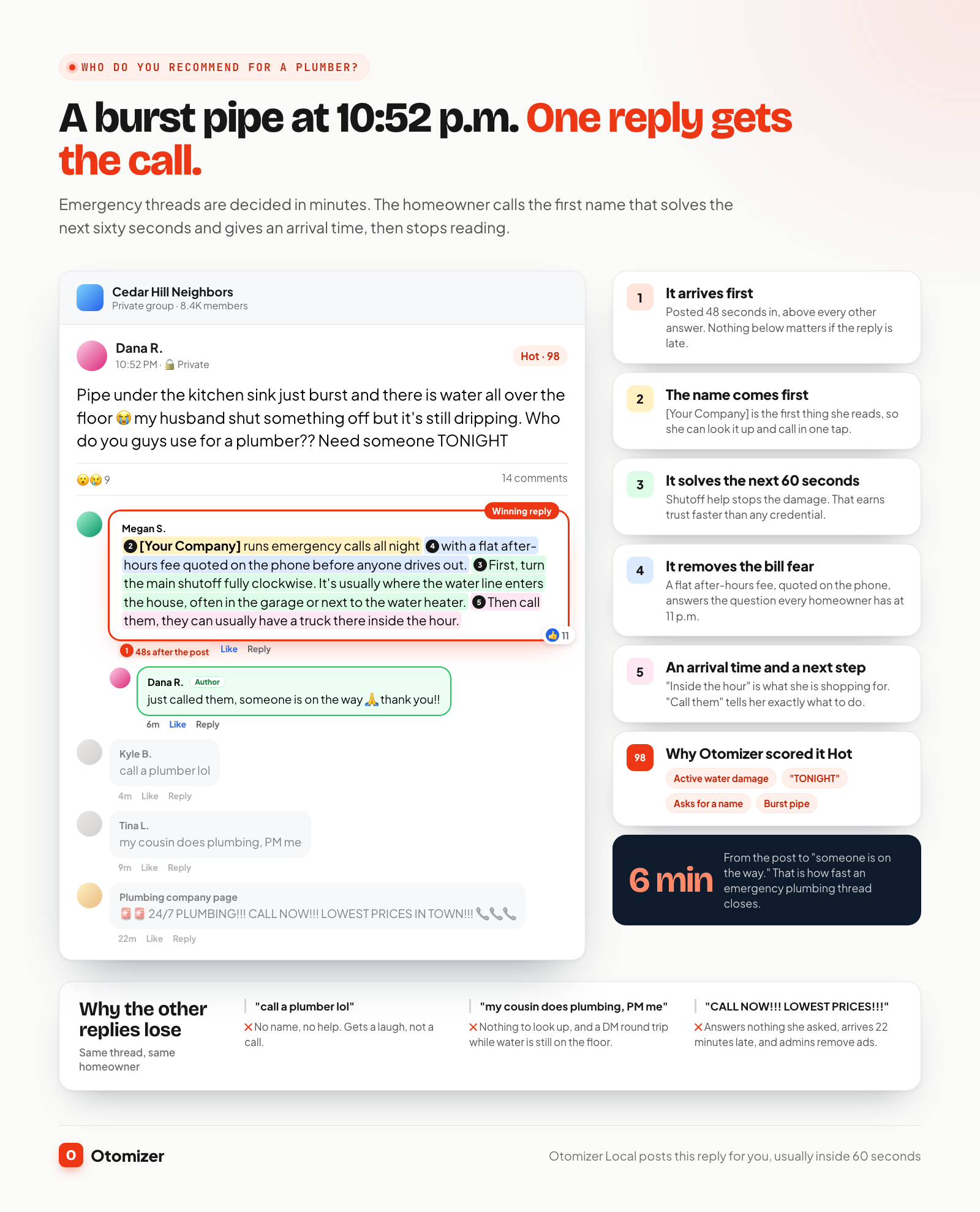
Winning reply: “[Your Company] runs emergency calls all night with a flat after-hours fee quoted on the phone before anyone drives out. First, turn the main shutoff fully clockwise. It is usually where the water line enters the house, often in the garage or next to the water heater. Then call [Your Company] at the number on their page and they can usually have a truck there inside the hour.”
Six minutes later, Dana answers under it: “just called them, someone is on the way 🙏“
Why that reply wins
- It names the company first. The homeowner can look it up and call in one tap.
- It solves the next sixty seconds. Shutoff help stops the damage. That builds trust faster than any credential.
- It removes the fear of an open-ended bill. A flat after-hours fee, quoted on the phone, answers the question every homeowner has at 11 p.m.
- It gives an arrival time. “Inside the hour” is the thing the homeowner is shopping for.
- It arrives first. Every part above only matters if the reply is at the top of the thread. Otomizer Local posts it usually inside 60 seconds.
Reply templates for the four plumbing threads you will see every week
Copy these, put your company name in the brackets, and adjust the details to how you actually work. Otomizer drafts replies in this structure for every Hot post it finds.
The water heater is out
Jess M.: “Water heater is leaking from the bottom and we have zero hot water. 2 toddlers. Who can come today and not charge a fortune 😩”
Reply: “[Your Company] keeps 40 and 50 gallon tanks on the truck, so most swaps happen the same day, with a flat-rate price on the phone before anyone shows up and haul-away included. Until they get there, turn the cold supply valve on top of the tank off and switch off the breaker or set the gas to pilot. Call or text them and ask for today’s install slot.”
The sewer backup
Marcus T.: “Basement floor drain is backing up with nasty water every time someone showers. Is this a sewer thing?? Who do you call for this”
Reply: “Stop running water upstairs until the line is cleared. [Your Company] clears main lines the same day, then runs a camera down it and shows you the footage on site, so you see whether it is roots, a sag or a one-time clog before anyone quotes a repair. If the line does need work, they do trenchless repairs that usually leave the yard intact. Ask for the camera inspection.”
The quote check
Kelly W.: “Got quoted $7,400 to repipe our 1978 house (galvanized). Second plumber said $11k. How do you even know who’s right”
Reply: “Two numbers that far apart usually mean two different scopes. [Your Company] does free repipe estimates in writing with PEX or copper, fixture count, wall openings, drywall patching and the permit spelled out line by line, so you can compare them side by side. Send them both quotes and ask for a line-by-line comparison before you sign anything.”
The mystery water bill
Ryan P.: “Water bill went from $60 to $210 and nothing looks wet. Toilets aren’t running. Where is this water going??”
Reply: “Turn every tap off and look at your meter. If the small leak dial is still spinning, water is escaping somewhere. [Your Company] does electronic leak detection, so they find it without opening walls or the slab on a guess, and the detection visit is priced up front. Text them a photo of the meter and they will tell you the next step.”
What to avoid in plumbing replies
- Posting the same pasted reply in every thread. Members notice, admins remove it.
- Quoting a full job price in the comments. Quote the visit or the fee, then talk on the phone.
- Arguing with other plumbers or criticizing the homeowner’s last plumber.
- Replying to an emergency thread an hour late. Spend that reply on a planned-work thread instead.
The freeze-night response playbook, hour by hour
The first hard freeze is the plumbing equivalent of a hailstorm. Burst-pipe requests arrive in a wave, and a large share of them land the morning after, when frozen lines thaw and start leaking. The companies that win that week planned it before the forecast dropped.
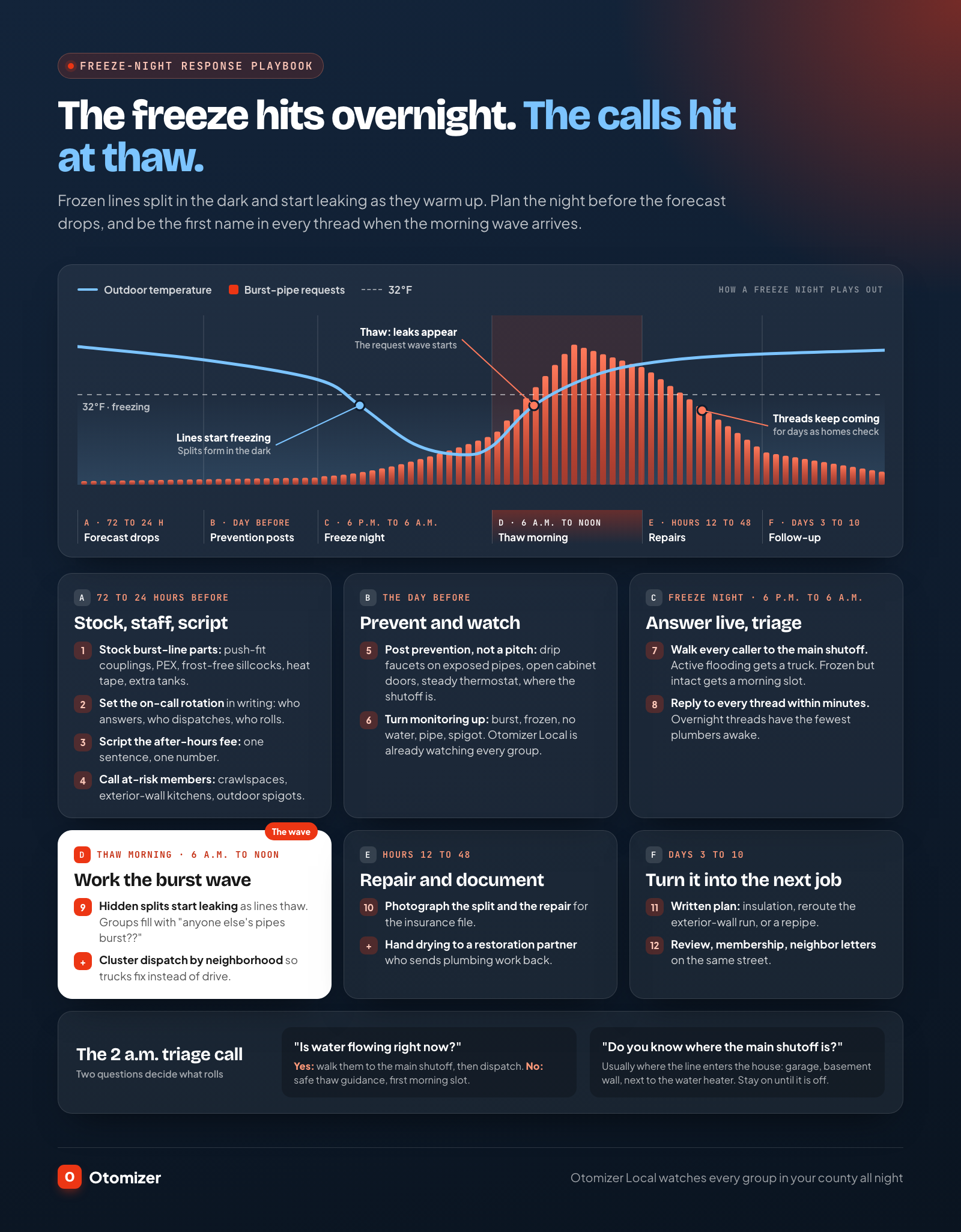
72 to 24 hours before the freeze
- Stock the trucks for burst lines. Push-fit couplings, PEX and copper repair parts, frost-free sillcocks, heat tape, and extra water heater tanks.
- Set the on-call rotation. Who answers at 2 a.m., who dispatches, who rolls first. In writing.
- Script the after-hours fee. One sentence, one number, said before anyone drives out.
- Call the at-risk customers. Members with crawlspaces, exterior-wall kitchens, and outdoor spigots that were never winterized.
The day before
- Post prevention, not a pitch. On your Facebook Page and Google Business Profile, share the basics the American Red Cross recommends for frozen pipes: let cold water drip from faucets served by exposed pipes, open kitchen and bathroom cabinet doors, and keep the thermostat at the same temperature day and night. Add one line: where the main shutoff usually is, and your 24/7 number.
- Turn monitoring all the way up. With Otomizer, add freeze keywords: “burst”, “frozen”, “no water”, “pipe”, “spigot”. On Otomizer Local, our team is already watching every group in your county through the night.
Freeze night: 6 p.m. to 6 a.m.
- Answer live and triage. Ask two questions: is water flowing right now, and do you know where the main shutoff is? Walk every caller to the shutoff. Active flooding gets a truck. A frozen line that has not burst gets safe thaw guidance and a morning slot.
- Reply to every thread within minutes. Use the burst-pipe reply above. Overnight threads have the fewest competing plumbers awake.
Thaw morning: 6 a.m. to noon
- Work the wave. As lines thaw, hidden splits start leaking and the group fills with “anyone else’s pipes burst??” posts. Cluster dispatch by neighborhood.
Hours 12 to 48
- Repair, document and hand off. Photograph the damaged section and the repair for the homeowner’s insurance file, and pass drying work to a water restoration partner who sends plumbing work back.
Days 3 to 10
- Follow up with a written plan. Insulation, rerouting the exterior-wall run, a frost-free sillcock, or a repipe if the old material keeps failing.
- Ask for the review and the membership. “Mention the freeze night” gets you reviews that sell the next emergency. Leave neighbor letters on the same street: same builder, same vulnerable run.
When do plumbing leads spike? The plumbing demand calendar
Plumbing demand runs all year, with predictable surges. Plan crews, inventory and campaigns around them instead of reacting.
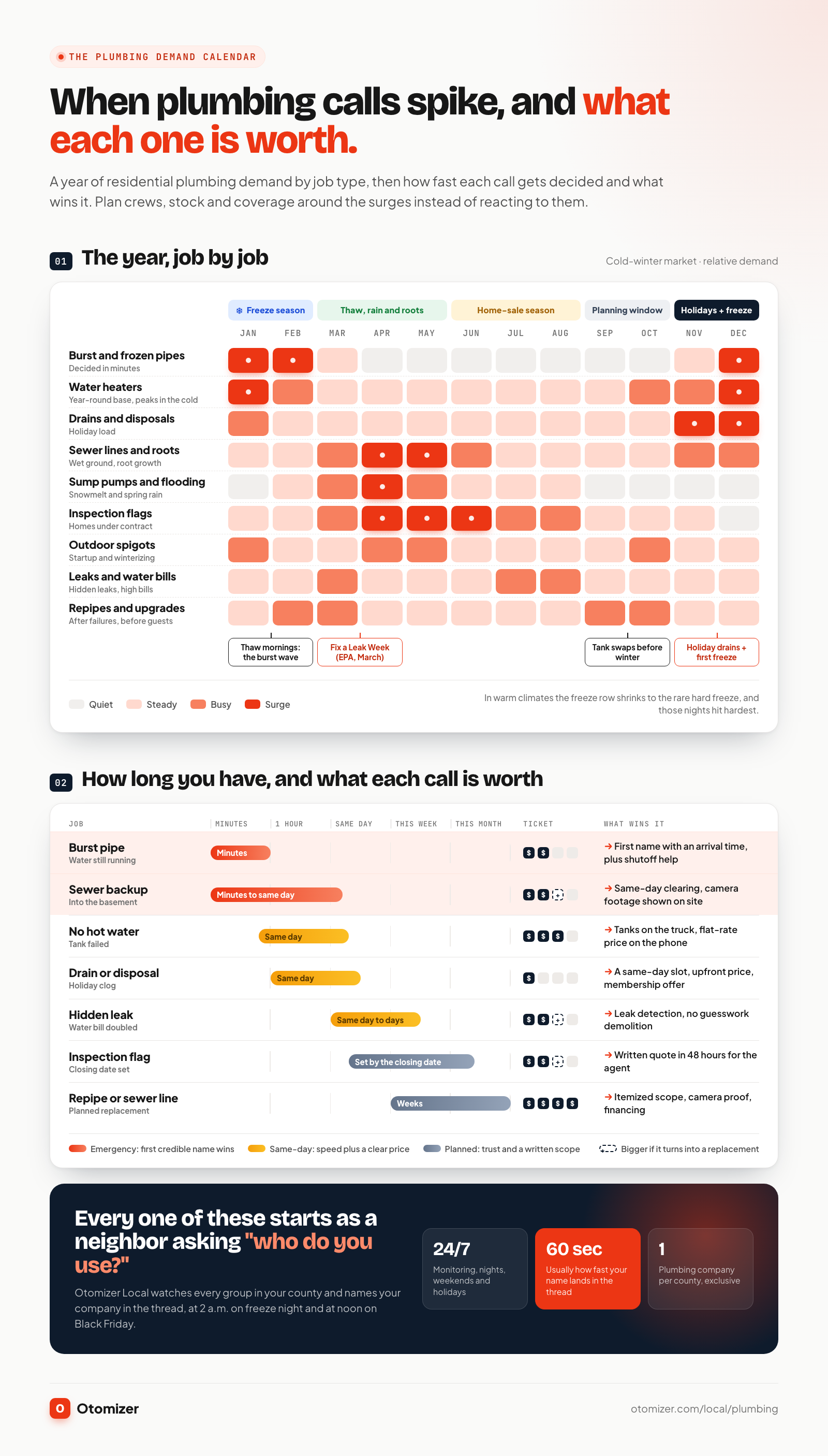
- December to February: freeze season. Burst and frozen pipes, frozen spigots, and water heaters working hardest against the coldest incoming water. Your highest emergency volume.
- Thanksgiving to New Year: holiday drains. Full houses, grease, peels and extra showers. The days after Thanksgiving are known across the trade as one of the busiest stretches for kitchen drains, disposals and main line backups.
- March to May: thaw, rain and roots. Saturated ground and root growth push sewer backups and sump pump failures. The EPA runs Fix a Leak Week every March and estimates the average household’s leaks can waste more than 9,300 gallons a year, which makes March the natural month for leak detection and fixture offers.
- Spring through summer: home-sale season. More closings mean more inspection flags: old tanks, polybutylene, galvanized lines, sewer scope findings.
- September to October: the planning window. Water heater replacements before winter, hose bib winterizing, membership renewals, and repipes homeowners want done before guests arrive.
Water heaters and clogged drains never stop. They are your year-round base.
How do plumbing memberships turn one emergency into years of work?
The cheapest booked job is the one you never have to market for again. A membership converts an emergency customer into a scheduled relationship.
A plumbing membership that sells well includes:
- An annual whole-home plumbing inspection with photos: water heater age and condition, shutoff valves, supply lines, visible leaks, pressure.
- A yearly water heater flush.
- Main shutoff tagged and shown to the homeowner, with your sticker on it. On freeze night, that tag is your phone number.
- Priority dispatch and a reduced after-hours fee.
- A repair discount on everything else.
How to sell it:
- Offer it on every emergency call, after the repair is done, while the homeowner is grateful.
- Bill monthly. A small monthly number is an easier yes than a lump sum.
- Use the inspection to find the next job, documented with photos: the tank near the end of its life, the supply line about to fail.
Track your membership attach rate on emergency calls. It turns today’s lead cost into a lifetime acquisition cost.
Water heaters and sewer lines: the high-ticket plumbing leads
These two job types carry the biggest tickets in residential service plumbing, and both reward preparation.
Water heaters. The winning offer: tanks on the truck, same-day install, flat-rate price on the phone, haul-away included. On every visit, check the tank’s age from the rating plate and leave a written note when it is near the end of its life. That note becomes a planned fall replacement instead of a January emergency. For tankless questions, give a clear side-by-side with financing.
Sewer lines. Lead with the camera. Clear the line, run the camera, and show the footage on site before quoting. Homeowners fear “dig up the entire yard,” so explain trenchless options plainly when they fit. Offer pre-listing and pre-purchase sewer scopes to realtors and inspectors, because a sewer finding during a sale is a five-figure job with a closing deadline attached.
How do plumbers get referrals from realtors, inspectors and property managers?
Partners send exclusive, repeat work, and each one needs something specific from a plumber.
| Partner | What they need | What you offer | How to open the door |
|---|---|---|---|
| Realtors | Inspection repair items fixed before closing | Written quotes within 48 hours and a completion letter for the file | A one-page inspection repair sheet dropped at their office meeting |
| Home inspectors | A name to give when they flag a tank, polybutylene, galvanized or a sewer issue | Sewer scopes on short notice, footage sent to buyer and agent | Offer to scope a line for one of their clients this week |
| Property managers | A plumber who answers at 2 a.m. and invoices cleanly | After-hours line, photo-documented tickets, an approval threshold per unit | Ask for one test work order |
| Water restoration companies | Someone to stop the source on every water loss | Fast source repair and documentation for the claim | Swap after-hours numbers before freeze season |
Partners are a slow build, and one missed closing deadline takes you off the list. Run them alongside group coverage so your calendar never depends on who closes this month.
How Otomizer gets plumbing companies booked jobs from Facebook groups
You can run the group channel yourself, or have our team run it for you.
Run it yourself with Otomizer. Join the neighborhood, town and subdivision groups in your service area and connect them through the Otomizer Chrome extension. Otomizer monitors them 24/7 across 218,000+ groups already on the platform, scores every plumbing post by buyer intent, and drafts a reply in your voice. You approve and post from your phone. See Otomizer pricing for the Pro plan.
Have it done for you with Otomizer Local. Otomizer Local for plumbers is built for owners who are under a sink when the burst-pipe post goes up. We map and join every group in your county, private ones included, monitor around the clock, and post a recommendation naming your company in every matching thread, usually inside 60 seconds. You get a text the moment a homeowner engages and a dashboard of every thread.
Three plans, all exclusive by county (full pricing):
- Local Leads: $1,197 a month plus $1,497 setup. The group engine: monitoring, recommendations, alerts, a named account manager and a weekly summary.
- Local Presence: $1,497 a month plus $1,797 setup. Everything in Leads, plus a brand kit, 20 designed posts and 4 reels a month across groups, your Facebook Page, Instagram and Google Business Profile, seasonal campaigns built around freezes and holiday drain season, and review requests to every closed job.
- Local Dominance: $1,997 a month plus $2,997 setup. Everything in Presence, plus a premium website rebuild, local SEO for your Google Business Profile, citations, service and city pages, and AEO so ChatGPT and Google AI Overviews name you when homeowners ask who to call. Six-month minimum. You own the website.
Every plan is backed by the guarantee: 20 qualified conversations in your first 90 days, or we keep working at no charge until you get them. And one plumbing company per county means no competitor can buy into your territory at any price. Check the county demand report to see the plumbing requests your county produces, then claim it before another plumber does.
Your 90-day plumbing lead generation plan
Start this week and your 90 days run straight through holiday drain season, the first hard freeze and the January water heater run.
Days 1 to 30: coverage and freeze prep
- Tag every call by source and type. Emergency or planned, and where it came from. A spreadsheet is enough.
- Turn on group coverage. Apply for Otomizer Local or connect your groups to Otomizer and load the four reply templates above.
- Fix your Google Business Profile. Categories, real hours, truck and tank photos, a same-day review text on every job.
- Prep for holiday drains. Post disposal and grease tips the week before Thanksgiving, open extra same-day slots, and stock drain machines and cameras.
- Write your freeze-night playbook. On-call rotation, after-hours fee script, freeze parts on every truck.
Days 31 to 60: freeze season and memberships
- Run the freeze playbook the first time the forecast drops hard.
- Launch the membership on every emergency call, with tagged shutoffs and stickers.
- Visit five realtors, three inspectors, two property managers and one restoration company with your partner sheet.
- Follow up every freeze customer with a written prevention or repipe plan.
Days 61 to 90: measure and reallocate
- Calculate cost per booked job by channel, split into emergency and planned.
- Cut the most expensive channel, usually shared marketplace leads, and move that budget to exclusive coverage.
- Plan spring now: sewer and sump season, inspection-flag partners, and a March leak detection offer.
Running more than one trade? HVAC runs on heat waves and cold snaps (how to get HVAC leads), roofing runs on storms (how to get roofing leads), and the home service marketing guide covers the full channel mix.
The bottom line
Plumbing leads are expensive when you share them and cheap when the homeowner hears one name. The emergency half of your revenue goes to the first credible plumber in the thread. The high-ticket half goes to the plumber who earned trust during the emergency.
Otomizer puts you first in those threads in every group in your county, every hour of the night. Stock the trucks before the freeze. Quote the after-hours fee on the phone. Sell the membership while the floor is still drying. And track cost per booked job until the numbers tell you where every dollar belongs.

Stop racing for shared leads. Get recommended in your county.
Otomizer Local covers one trade in one county exclusively. Our team monitors neighborhood groups and posts a recommendation naming your company when homeowners ask who to hire.
Apply for Otomizer LocalOne company per trade per county · Three-month initial term
FAQ
Frequently asked questions
01What is the best way to get plumbing leads?
02How much do plumbing leads cost?
03What are exclusive plumbing leads?
04How do plumbers get more emergency calls?
05Are Angi and HomeAdvisor leads worth it for plumbers?
06Do Google Local Services Ads work for plumbers?
07How do plumbers get leads from Facebook groups?
08How long does it take to get more plumbing customers?
Keep reading
Related articles
How to Get HVAC Leads in 2026: Every Channel Ranked by Cost Per Booked Job
October 30, 2026
ContractorsHow to Get Roofing Leads in 2026 (Without Paying for Shared Leads)
October 30, 2026
ContractorsHow to Get Contractor Leads Without Angi or HomeAdvisor in 2026
August 26, 2026
ContractorsThumbtack Alternatives for Contractors That End the Bidding War
August 26, 2026