Contractor Website Cost in 2027: What a Premium Site Includes
Contractor website cost in 2027: typical prices for DIY, freelancer and agency builds, what a site that books jobs includes, and how to get a premium rebuild.

Key takeaways
- 01 Typical contractor website costs run from $0 to $500 for a DIY template, $2,000 to $8,000 for a freelancer, and $10,000 to $40,000 or more for a custom agency build, with SEO billed separately.
- 02 Price is the wrong measure. The right one is whether the site books jobs: fast load times, an instant estimate calculator, a page for every service in every city, structured data, answer-ready FAQs and lead forms on every page.
- 03 A redesign without 301 redirects can wipe out rankings you spent years earning. Every old URL needs to point to its new home on launch day.
- 04 Local Dominance includes a premium website rebuild in the $2,997 setup, live within 30 days of kickoff, with local SEO, AEO, hosting and updates every month. You own the site.
- 05 Every Local Dominance build ships with a fast mobile site, a page for every service and city, an instant estimate calculator, structured data and every old URL redirected so your rankings carry over.
The short answer: a contractor website typically costs $0 to $500 as a DIY template, $2,000 to $8,000 from a freelancer, and $10,000 to $40,000 or more as a custom agency build, with SEO, hosting and updates usually billed on top. What matters more is whether the site books jobs.
A premium contractor site loads instantly, gives visitors a price on the spot, has a page for every service in every city you work, and carries your existing rankings over on launch day.
This guide breaks down what each type of website typically costs, what separates a site that books work from one that just sits there, what a premium build looks like using one of our latest projects as the example, and how Local Dominance includes a complete rebuild in its setup fee.
How much does a contractor website cost?
Here is what roofers, HVAC companies, plumbers, electricians, painters, landscapers and other local contractors typically pay, by type of build. These are common market ranges; page count and features move any single quote up or down.
| DIY template | Freelancer | Agency custom build | Local Dominance | |
|---|---|---|---|---|
| Typical upfront cost | $0 to $500 | $2,000 to $8,000 | $10,000 to $40,000+ | Included in the $2,997 setup |
| Typical monthly cost | $20 to $60 platform fee | $50 to $200 hosting and care | $200 to $1,000+ care plan | Included in $1,997/mo |
| Service and city pages | A handful, written by you | Usually 5 to 15 pages | Depends on scope | Every service and every city you serve |
| Instant estimate calculator | Rarely | Sometimes, as an add-on | Sometimes, as an add-on | Included |
| Structured data and llms.txt | Basic or none | Often basic | Varies | On every page |
| Old URLs redirected | Up to you | Sometimes | Usually | Every one, on launch day |
| Local SEO and AEO | Not included | Usually extra | Separate retainer | Included every month |
| Time to launch | Depends on your evenings | 1 to 3 months | 2 to 4 months | Live within 30 days of kickoff |
| Who owns it | You, on their platform | Usually you | Usually you | You |
DIY templates and website builders
Builders like Wix, Squarespace and GoDaddy let you put a site up in a weekend for the price of a monthly subscription. You get a clean template and a few pages.
What you also get is every remaining job: writing the copy, taking the photos, building service pages, setting up the Google Business Profile connection, adding structured data and keeping it all current. Most owners launch the site, mean to come back to it, and never do. A DIY site is a fine business card. It rarely ranks for “[your trade] in [your town],” and it almost never shows up in AI answers.
Freelancers
A good freelancer builds a custom-looking site on WordPress or a similar platform, often in the $2,000 to $8,000 range. You get a more polished design and someone to call when something breaks.
The limit is scope. A freelancer typically builds 5 to 15 pages, handles basic on-page SEO and hands the site over. The work that makes a contractor site rank (dozens of service and city pages, structured data, citations, monthly content) is usually outside the quote.
Agency custom builds
Custom agency builds commonly run $10,000 to $40,000 or more. That buys strategy, a dedicated designer, copywriting, development and project management. Done well, it is a strong site.
For most contractors, the bigger number comes after launch. Hosting and care plans are commonly billed monthly, and local SEO is usually a separate retainer, often $1,000 to $3,000 a month on its own. The first-year cost of a “$15,000 website” frequently lands far higher once SEO and maintenance are added.
Why is price the wrong way to compare contractor websites?
A contractor website has one job: turn the people who find it into booked estimates. A $500 site that never ranks and a $30,000 site that loads slowly and hides the phone number both fail at that job.
So compare on outcomes. Does it show up when someone in your service area searches for your trade? Does it load instantly on a phone in a driveway? Does it give a visitor enough confidence (and enough of a price) to call you instead of the next name? Does it get named when someone asks ChatGPT who to hire?
It also decides how hard every other channel has to work. Paid placements like Google Local Services Ads rent you visibility one lead at a time. A website that ranks is an asset you own, and it makes every referral, group recommendation and review land harder, because the homeowner who checks you out finds a business that looks like the obvious choice. Our home service marketing guide shows how the website fits with every other channel.
Those outcomes come from a specific set of features. Here they are.
What should a contractor website include?
Eight features separate a contractor website that books jobs from one that just sits there. Here they are on one page, then one by one.
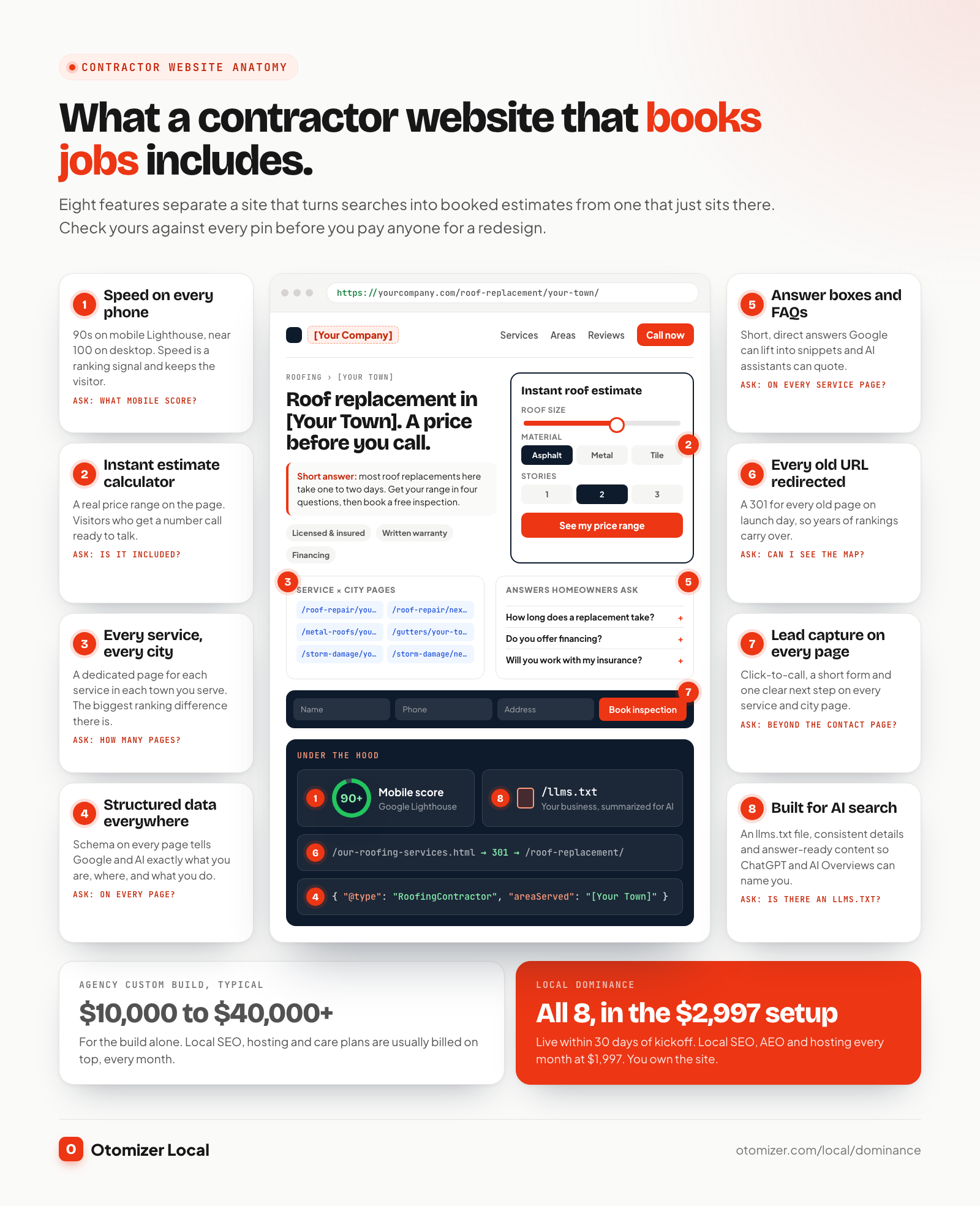
1. Speed that passes on every phone
Most local searches happen on a phone, often in the moment: a leak in the ceiling, an AC that quit, a fence that blew down. A site that takes several seconds to load loses visitors before they see your name.
Google measures this, and so can you. Run your site through Google’s Lighthouse or PageSpeed Insights. A premium contractor site scores in the 90s on mobile and near 100 on desktop. Speed is also a ranking signal, so a fast site gets found more often and converts more of the people who find it.
2. An instant estimate calculator
The number one question every visitor has is “roughly what will this cost?” A site that answers with “contact us for a free quote” sends them back to search.
An instant estimate calculator gives a real range on the page: roof size and material, system size and type, square footage and finish. Visitors who get a number stay longer, trust you more, and call ready to talk. The calculator also captures the details you need before the first conversation.
3. A page for every service in every city
This is the single biggest difference between a contractor site that ranks and one that does not. Someone searching “metal roof replacement in [Town]” is far more likely to find a page about exactly that than a generic “Services” page.
A premium build has a dedicated page for each service you offer and each city or town you serve, each with useful, specific content about that service in that place. This is also exactly the kind of page AI assistants quote when they recommend a local business, and it works hand in hand with your Google Business Profile. Our guide on how to rank higher on Google Maps shows how service and city pages feed your map pack position.
4. Structured data on every page
Structured data (schema markup) is code that tells search engines and AI systems exactly what each page is: a roofing contractor, this service area, these services, these reviews, these FAQs. Google documents exactly how LocalBusiness structured data works: it powers rich results in Search and Maps and makes your business far easier for AI assistants to understand and recommend. On a premium build, it is on every page, not just the homepage.
5. Answer boxes and FAQs
Short, direct answers to the questions homeowners ask (“How long does a roof replacement take?” “Do you offer financing?” “Is a heat pump worth it here?”) help in three ways. Visitors get answers instantly. Google can pull them into featured snippets. And AI assistants can quote them. Our guide to AEO for local businesses explains why this matters more every year.
6. Redirects that keep your rankings
This is where redesigns quietly destroy businesses. Your old site has pages Google already ranks, and other sites link to them. Launch a new site with different URLs and no redirects, and every one of those pages becomes a dead link. Rankings you spent years earning can disappear in weeks.
The fix is a 301 redirect for every old URL, mapped to its matching new page, live on launch day. Google’s own site move guide recommends exactly this: permanent server-side redirects from every old URL to its new home. It is tedious work, and it is non-negotiable on a premium build.
7. Lead capture on every page
Click-to-call buttons, short lead forms and clear calls to action on every service and city page, not just a contact page. Every page should make the next step obvious.
8. Built for AI search
An llms.txt file (a plain-text summary of your business for AI systems), consistent business details, structured data, answer-ready content and a steady flow of fresh reviews together put your site in position to be named when someone asks ChatGPT, Google AI Overviews, Perplexity or Gemini who to hire. Reviews matter more than most owners think here, so read how to get more Google reviews alongside this guide.
What does a premium contractor website look like?
This is the standard every Local Dominance website is built to in 2027:
- Top Google Lighthouse scores on mobile and desktop. Fast everywhere, including on a phone in the driveway.
- A page for every service and every city you serve. A dedicated page for each job and each place you work.
- An instant cost calculator for your trade. Visitors get a real price range on the page.
- Interactive tools that pre-sell the job, like a color or material picker, so homeowners arrive ready to choose.
- Structured data on every page and an llms.txt file. Built for Google and AI search from day one.
- Every blog post migrated and every old URL 301-redirected. Every piece of content and every ranking you have already earned carries over to the new site.
The site is only half of the project. The brand kit covers feed ads, stories, short videos, carousels, a Facebook cover, a seasonal post series, and print pieces: business card, door hanger, yard sign and postcard. One visual identity, from the website to the yard sign.
The same team built the Otomizer software that monitors 218,000+ Facebook groups, PilotPoster, our own publishing system, and the website and brand stack every build runs on. We are builders and operators, and every Dominance client gets that stack. See Local Dominance.
What should you ask before hiring a website builder?
Whoever you hire, these questions separate a site that books jobs from a site that just looks nice:
- What Lighthouse performance score will the site hit on mobile and desktop?
- How many service pages and city pages are included?
- Is there an instant estimate calculator, or is every visitor sent to a contact form?
- Is structured data on every page? Is there an llms.txt file?
- How many of my current URLs will be redirected, and can I see the map?
- Who handles local SEO and new content after launch, and what does that cost per month?
- Who hosts, secures and updates the site, and what does that cost?
- Do I own the site, the domain and the content?
- When will it be live?
Add up every answer that comes back as “extra” and you have the real cost of the website.
How does Local Dominance include a website rebuild?
Local Dominance is the top tier of Otomizer Local, our done-for-you growth team for local businesses. It includes a complete premium website rebuild as part of the $2,997 setup, and every feature above comes standard:
- Live within 30 days of kickoff.
- Custom design in your brand.
- Every service page and every city page for the area you serve.
- An instant estimate calculator built for your trade.
- Lead forms on every page.
- Built for speed, with structured data on every page and an llms.txt file.
- Every old URL redirected so your rankings carry over.
- You own the website.
Then the monthly plan, $1,997 a month on a 6-month minimum, keeps it growing: local SEO (Google Business Profile optimization, citations, service-by-city pages, monthly content, technical SEO, schema), AEO so AI assistants name you, hosting, security and updates, and a monthly visibility report with your Google rankings and an AI mention check. The Dominance setup is waived entirely with a 12-month commitment.
And the website is only one part of it. Dominance also includes everything in Local Leads and Local Presence: our team recommending you in your county’s Facebook groups (including private ones) usually inside 60 seconds of a neighbor asking, a brand kit, 20 designed posts and 4 short-form videos every month across Facebook, Instagram and Google Business Profile, review-request sequences, seasonal campaigns and a named account manager. It is exclusive: one company per trade, per county. See how that engine works for roofers, HVAC companies and plumbers.
Compare that with an agency quote of $10,000 to $40,000 for the build alone, plus a separate SEO retainer, plus hosting. Our tier comparison lays out the full math, and the pricing page has every tier side by side.
So what should a contractor website cost?
A contractor website typically costs anywhere from a few hundred dollars to $40,000 or more. The price tag matters far less than what the site does: load instantly, give a real price on the spot, rank for every service in every town you work, carry your existing rankings over, and get named in AI answers.
That is what a premium build includes, and it is what Local Dominance delivers at setup, live within 30 days, owned by you, with a team keeping it growing every month.
A premium website, included. Live in 30 days. Yours to own.
Local Dominance rebuilds your site in the $2,997 setup, then runs local SEO, AEO, content and hosting every month. One company per trade, per county.
See Local DominanceFAQ
Frequently asked questions
01How much does a contractor website cost?
02Why do agency websites for contractors cost so much?
03Will a new website hurt my Google rankings?
04How long does it take to build a contractor website?
05Do I own my website with Otomizer Local?
06What makes a contractor website rank in Google and AI search?
07What should a contractor website include?
08Can the Local Dominance setup fee be waived?
Keep reading
Related articles
Google Local Services Ads Cost in 2026: Real Cost Per Booked Job
November 13, 2026
ContractorsHow to Get Plumbing Leads in 2026: 12 Channels Ranked by Cost
November 13, 2026
MarketingHow to Rank Higher on Google Maps: The Contractor Playbook
November 13, 2026
MarketingWhat Is AEO? How Local Businesses Get Named by ChatGPT and Google AI
November 1, 2026