How to Get HVAC Leads in 2026: Every Channel Ranked by Cost Per Booked Job
How to get HVAC leads in 2026: 13 channels ranked by cost per booked job, speed, and exclusivity, plus worked math, seasonality, and a 90-day HVAC lead plan.

Key takeaways
- 01 Judge every HVAC lead source by cost per booked job, not cost per lead. A cheap lead you share with four competitors is often the most expensive job you book.
- 02 Local Facebook group threads are the highest-intent, most exclusive HVAC lead source available in 2026. Otomizer Local covers them for you, one HVAC company per county, and wins on cost per booked job.
- 03 HVAC demand arrives in spikes: the first heat wave and the first hard freeze. The shops that win those weeks prepared their channels and phone coverage in the shoulder season.
- 04 Speed to response decides more HVAC jobs than price. An emergency post answered in five minutes beats a better company that calls back in three hours.
- 05 Maintenance agreements turn one emergency call into years of revenue, so the true value of an HVAC lead is far higher than the first ticket.
Quick answer: The best way to get HVAC leads in 2026 is to own the local Facebook group threads where homeowners ask “who do you use for AC repair?” Those requests are urgent, exclusive, and free of lead fees. Otomizer monitors every group around the clock and Otomizer Local responds for you, then back it up with a strong Google Business Profile and maintenance agreements.
That is the short version. The long version is below: thirteen HVAC lead generation channels, what each one really costs, how fast it works, whether you share the lead with competitors, and what quietly kills it. Then a worked example of the math, the seasonal calendar that decides your year, and a 90-day plan you can start this week.
This guide is written for owner-operators and small to mid-size residential HVAC companies. If you run three trucks and answer the phone yourself, every section applies. If you run thirty trucks with a call center, skip to the ranking table and the seasonality section.
The only HVAC lead metric that matters: cost per booked job
Every lead seller will quote you a cost per lead. It is the least useful number in HVAC marketing.
A $40 lead that four other companies also received, and that you close 12 percent of the time, costs you about $333 per booked job. A $90 lead that only you received, and that you close 45 percent of the time, costs you $200. The “expensive” lead is the cheaper job.
So before you compare channels, get three numbers from your own business:
- Average gross profit per job. Separate service calls from replacements if you can, because a $350 repair and a $12,000 system install cannot share one average.
- Close rate by source. Booked jobs divided by leads received, per channel. If you do not track source today, start by asking every caller “How did you hear about us?” and logging the answer.
- Total monthly spend per source. Include software, agency fees, and the hours somebody spends working the channel.
Divide spend by booked jobs and you have the number that decides whether a channel deserves more money, less money, or none.
How do you get HVAC leads? 13 channels, ranked
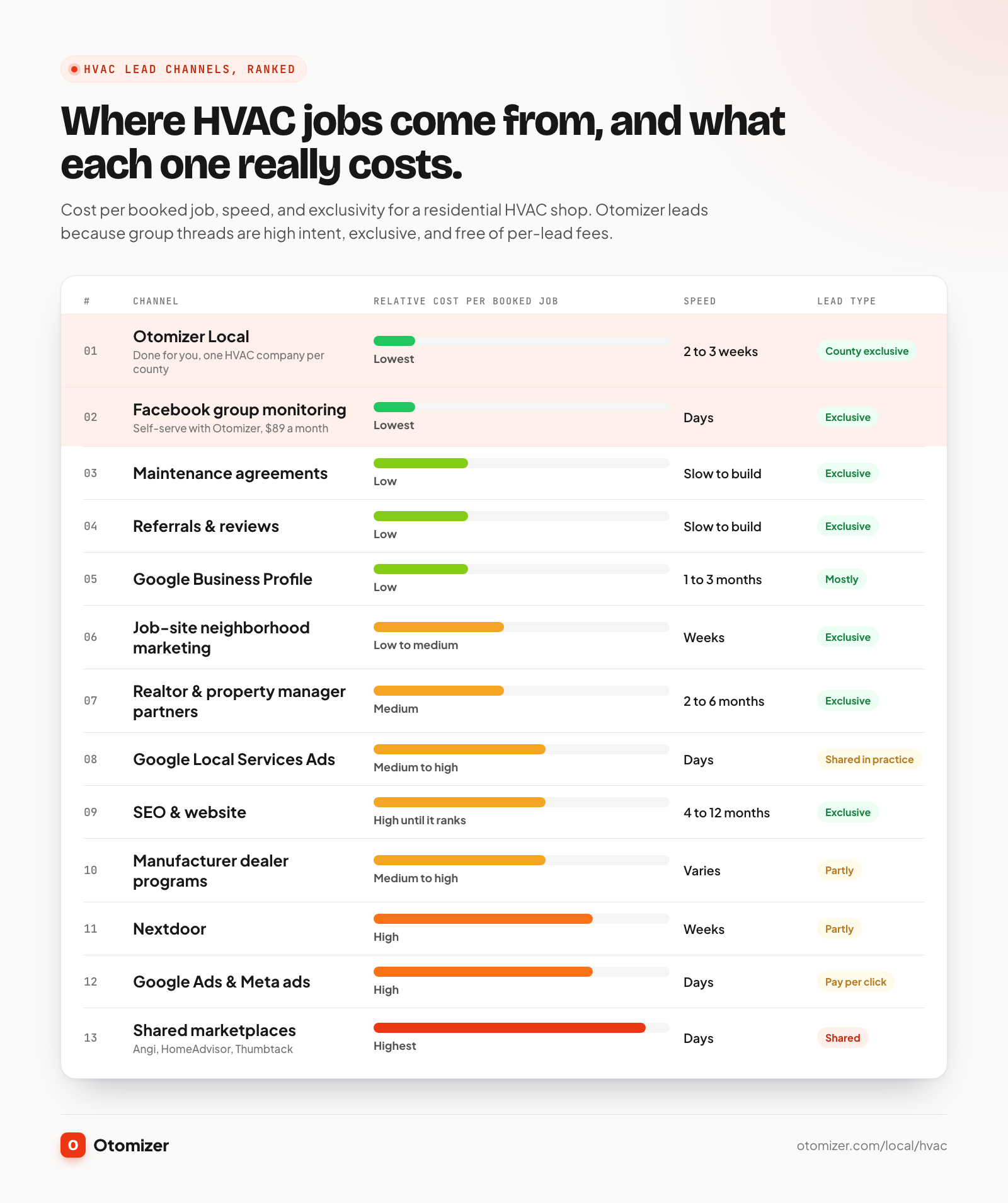
Here is the master table. “Exclusive” means the homeowner contacted you and only you. Otomizer Local and Facebook group monitoring top the list because they combine the three things that decide HVAC jobs: high intent, exclusivity, and speed.
| Rank | Channel | Typical cost model | Speed to first lead | Exclusive? | Cost per booked job |
|---|---|---|---|---|---|
| 1 | Otomizer Local (done for you) | Flat monthly retainer | 2 to 3 weeks | Yes, one HVAC company per county | Lowest |
| 2 | Facebook group monitoring with Otomizer (self-serve) | $89 a month plus reply time | Days | Yes | Lowest |
| 3 | Maintenance agreements | Discounted tune-ups, admin time | Slow to build | Yes | Low |
| 4 | Referrals and reviews | Your time, small referral rewards | Slow to build | Yes | Low |
| 5 | Google Business Profile | Free, plus time | 1 to 3 months | Mostly | Low |
| 6 | Job-site neighborhood marketing | Print and labor | Weeks | Yes | Low to medium |
| 7 | Realtor and property manager partners | Relationship time | 2 to 6 months | Yes | Medium |
| 8 | Google Local Services Ads | Pay per lead | Days | No, homeowners call several listings | Medium to high |
| 9 | SEO and website | Agency retainer or your time | 4 to 12 months | Yes | High until it ranks |
| 10 | Manufacturer dealer programs | Dealer requirements, co-op | Varies | Shared with nearby dealers | Medium to high |
| 11 | Nextdoor | Free posting, paid ads | Weeks | Partly | High |
| 12 | Google Ads (search PPC) | Pay per click | Days | Yes | High |
| 13 | Facebook and Instagram ads | Pay per impression or click | Days | Yes, but low intent | High |
| 14 | Shared marketplaces (Angi, HomeAdvisor, Thumbtack) | Pay per lead or per contact | Days | No, shared | Highest |
Now each channel in detail.
1. Otomizer Local (done-for-you Facebook group coverage)
How it works. Homeowners post in neighborhood, town, and community groups asking who to call. Instead of joining those groups and watching them yourself, you have our team cover your county for you. We find and join the active local groups, monitor them around the clock including nights and weekends, respond in matching threads naming your company, and send you an alert so you can call and book.
Typical cost. $1,197 a month plus a $1,497 setup fee, with a three-month initial term. Local Presence at $1,497 a month adds a brand kit, 20 designed posts and 4 reels a month, seasonal campaigns and review requests. Local Dominance at $1,997 a month adds a new website, local SEO and AI search.
Speed. Two to three weeks from kickoff to live coverage across your county.
Exclusivity. One HVAC company per county. If you are in, your competitors are not.
Why it wins. It is the only channel on this list where a team works the highest-intent local conversations for you, around the clock, and locks your competitors out of your county. You get the alert, you call, you book.
Who it is for. Busy HVAC owners who know the demand is in local groups but cannot watch fifty feeds from a crawlspace. Details on the Otomizer Local HVAC page, and the full operations walkthrough is on how Otomizer Local works.
2. Facebook group monitoring with Otomizer (the channel most HVAC shops miss)
How it works. Homeowners post in neighborhood, town, and community groups asking for recommendations. “AC stopped cooling, who do you use?” The first helpful, specific reply often gets the call.
Typical cost. Free to participate. The cost is attention: you have to see the post while it is fresh. A monitoring tool like Otomizer (the Pro plan is $89 a month) watches the groups around the clock and flags the posts worth answering.
Speed. Days. Most shops see Hot posts in their dashboard within the first week.
Exclusivity. Yes. There is no lead seller. The homeowner asked their neighbors, and you answered.
Why it wins. The homeowner asked a specific question, nobody sold the request, and Otomizer puts the post on your phone within minutes so you answer first. That is why Edge Mechanical added $6,800 in booked work in three weeks. Covered in depth below.
3. Maintenance agreements (the lead source that keeps paying)
How it works. Customers pay monthly or yearly for two tune-ups, priority service, and a repair discount.
Typical cost. The discount and the admin time to schedule visits.
Speed. Slow to build, then compounding.
Exclusivity. Completely. These are your customers.
What kills it. Selling the plan once and never following up. A plan member who never gets a reminder call does not renew.
Why it matters. A tune-up visit is a scheduled chance to find failing parts, recommend repairs, and be the obvious company to call when the system needs replacing. Every emergency call you book from any channel on this list should end with a maintenance agreement offer.
4. Referrals and reviews
How it works. Happy customers recommend you to friends, family, and the neighborhood group. Reviews make strangers trust you.
Typical cost. Your time, plus any referral reward you offer.
Speed. Slow at first, then one of the lowest costs per booked job you will see.
Exclusivity. Yes.
What kills it. Never asking. Most happy customers will leave a review or refer a friend if you make it easy and ask at the right moment, which is when the house is comfortable again and the technician is still standing in the kitchen.
How to speed it up. Send a review link by text the same day and ask for a referral at the second tune-up. Otomizer Local Presence runs review request sequences to closed jobs for you.
5. Google Business Profile
How it works. Your free listing in Google Maps and the local pack. When someone searches “AC repair near me,” the three map results get a large share of the calls.
Typical cost. Free. The real cost is the time to fill it out completely, post weekly, upload real job photos, and earn a steady stream of reviews.
Speed. One to three months to move up meaningfully, faster if your profile is currently thin. Our Google Maps ranking playbook has the full checklist, and how to get more Google reviews covers the ask system and templates.
Exclusivity. Mostly exclusive. The caller chose you from a short list.
What kills it. Incomplete categories and services, a service area that does not match where you actually work, stale photos, and a review count that stopped growing two years ago. Reviews that mention the service and the town (“fixed our heat pump in Doylestown same day”) help more than five-word reviews.
Where it falls short. A profile only catches people who search. The homeowner who asks the neighborhood group never sees it, and that is where Otomizer puts your name in front of them.
6. Realtor, property manager, and home inspector partnerships
How it works. Agents need fast HVAC inspections and repairs before closing. Property managers need a reliable vendor. Home inspectors flag aging systems every day.
Typical cost. Relationship time, fast turnaround, and fair pricing.
Speed. Two to six months to build trust.
Exclusivity. Yes, once you are their go-to vendor.
What kills it. Slow response on a closing deadline. Miss one and you are off the list.
Where it falls short. It takes months to earn the relationship and the volume is limited to closings. Use it alongside group coverage, not instead of it.
7. Google Local Services Ads
How it works. The “Google Verified” ads at the very top of results (the badge that replaced Google Guaranteed in October 2025). You pay per lead, not per click, after passing background and license checks. Our Google Local Services Ads cost breakdown runs the full math.
Typical cost. Lead prices vary widely by market and job type, commonly from tens of dollars for a service call to well over a hundred in competitive metros. You can dispute leads that are clearly invalid.
Speed. Days once you are approved.
Exclusivity. Not in practice. Homeowners routinely call two or three LSA listings back to back, so you are still racing competitors on every lead.
What kills it. Missed calls. LSA ranking leans heavily on responsiveness and reviews, so a shop that lets calls roll to voicemail slides down the list and pays for leads it never converts.
Where it falls short. You pay for every lead, including the ones that also called your competitors, and lead prices climb every peak season. In an Otomizer group thread the homeowner gets your name from their neighbors, and there is no per-lead fee.
8. SEO and your website
How it works. Service pages and town pages that rank organically for searches in your area, supported by your Google Business Profile.
Typical cost. Either your time or an agency retainer. Good local SEO is a steady monthly investment rather than a one-time project.
Speed. Slow. Four to twelve months for competitive terms.
Exclusivity. Yes.
What kills it. Thin, generic pages (“We offer quality HVAC services”) and no reason for Google to believe you work in the towns you list. Real photos, real job write-ups, and specific answers to local questions win.
Where it falls short. It takes months to rank and only reaches people who search. Otomizer reaches homeowners in the conversations where they ask before they search, starting in weeks.
9. Nextdoor
How it works. A business page plus recommendations from neighbors, and optional paid ads.
Typical cost. Free business page. Paid placements vary.
Speed. Weeks.
Exclusivity. Partly.
Where it falls short. Recommendation volume is thin in most markets, and nobody is watching for new requests at 9pm. Facebook groups carry the bulk of local recommendation traffic, which is exactly where Otomizer works.
10. Google Ads (search PPC)
How it works. You bid on keywords like “furnace repair [city]” and pay for every click.
Typical cost. HVAC clicks are among the more expensive in home services, and in competitive metros a single click on emergency terms can cost tens of dollars. A campaign usually needs a meaningful monthly budget before the data is useful.
Speed. Days.
Exclusivity. Yes. The visitor came to your site.
What kills it. Broad match keywords bleeding budget on “how to fix my AC myself,” landing pages without a click-to-call button, and nobody listening to call recordings to see which ads produce booked jobs.
Where it falls short. Every click costs money whether it books or not, and the calls stop the day the budget does. Group coverage with Otomizer keeps producing exclusive requests without a meter running on every click.
11. Facebook and Instagram ads
How it works. Paid ads shown to homeowners in your service area, usually promoting a tune-up offer, a financing deal, or a replacement rebate.
Typical cost. Pay per impression or click. Cheap to start, expensive to do well.
Speed. Days to launch, weeks to optimize.
Exclusivity. Yes, but intent is lower. Most people scrolling were not looking for HVAC at that moment.
What kills it. Generic stock creative, no follow-up on form leads within minutes, and offers that attract price shoppers.
Where it falls short. You are interrupting people who were not looking for HVAC, so you pay to create demand. Otomizer finds the people who already need you. If you run ads anyway, promote content people already engage with: see our HVAC social media post ideas.
12. Manufacturer dealer programs and job-site neighborhood marketing
Dealer programs. Brands like Carrier, Trane, Lennox, and others run dealer locators, co-op advertising funds, and financing programs. They come with requirements and you share the locator with other dealers nearby, so the leads are rarely yours alone.
Job-site neighborhood marketing. When you finish a job, leave door hangers on the five houses on either side: “We just serviced your neighbor’s system. Here is a tune-up offer for the street.” Neighbors in the same development often have systems the same age and brand. It is cheap, exclusive, and pairs well with a post in that neighborhood’s Facebook group.
13. Shared marketplaces: Angi, HomeAdvisor, Thumbtack
How it works. Homeowners submit a request and the platform sells or routes it to several pros.
Typical cost. Per lead or per contact, with prices varying by job type and market.
Speed. Fast. Leads can arrive the day you sign up.
Exclusivity. No. Typically three to five companies receive the same request. That is structural, because selling one request several times is how the model makes money.
What kills it. Being the third caller. Close rates on shared leads track speed of response more than any other factor, so the shops that do well have someone whose whole job is calling back in under five minutes.
Where it falls short. You pay to compete. The same homeowner is sold to several companies, so close rates fall and cost per booked job climbs. We broke down the full math in are Angi leads worth it, and Thumbtack alternatives for contractors and how to get leads without Angi show how HVAC shops replace marketplace spend with exclusive group coverage.
The math: what does one booked HVAC job really cost?
Here’s the math for a typical residential HVAC shop:
| Channel | Monthly spend | Leads or conversations | Close rate | Booked jobs | Cost per booked job |
|---|---|---|---|---|---|
| Otomizer self-serve group monitoring | $89 plus reply time | 10 conversations | 40% | 4 | $22 plus your time |
| Otomizer Local, after month 3 | $1,197 | 15 conversations | 40% | 6 | about $200 |
| Otomizer Local, first 3 months | $1,696 ($1,197 plus setup spread over 3 months) | 15 conversations | 40% | 6 | about $283 |
| Local Services Ads | $2,160 | 24 leads at $90 | 25% | 6 | $360 |
| Shared marketplace leads | $2,400 | 40 leads at $60 | 15% | 6 | $400 |
| Google Ads search | $3,000 | 100 clicks at $30, 12 calls | 50% of calls | 6 | $500 |
Three things jump out.
Otomizer wins on cost per booked job. Group threads are requests nobody sold, from homeowners who asked their neighbors, so they close at a far higher rate than paid leads.
Shared leads look cheap and are not. The $60 lead becomes a $400 job because you are splitting the homeowner with several competitors. LSA has the same problem in practice: the homeowner calls three listings.
Paid channels stop when the budget stops. Every Otomizer conversation that turns into a job also turns into a review, a maintenance agreement, and the next neighbor recommendation. That compounding never shows up in a pay-per-click report.
Why do Facebook groups produce some of the best HVAC leads?
Because this is where homeowners ask before they search.
When an AC dies in July, a lot of people do not open Google first. They open the neighborhood group, because they want a name from somebody who lives nearby and was not ripped off. The post looks like this:
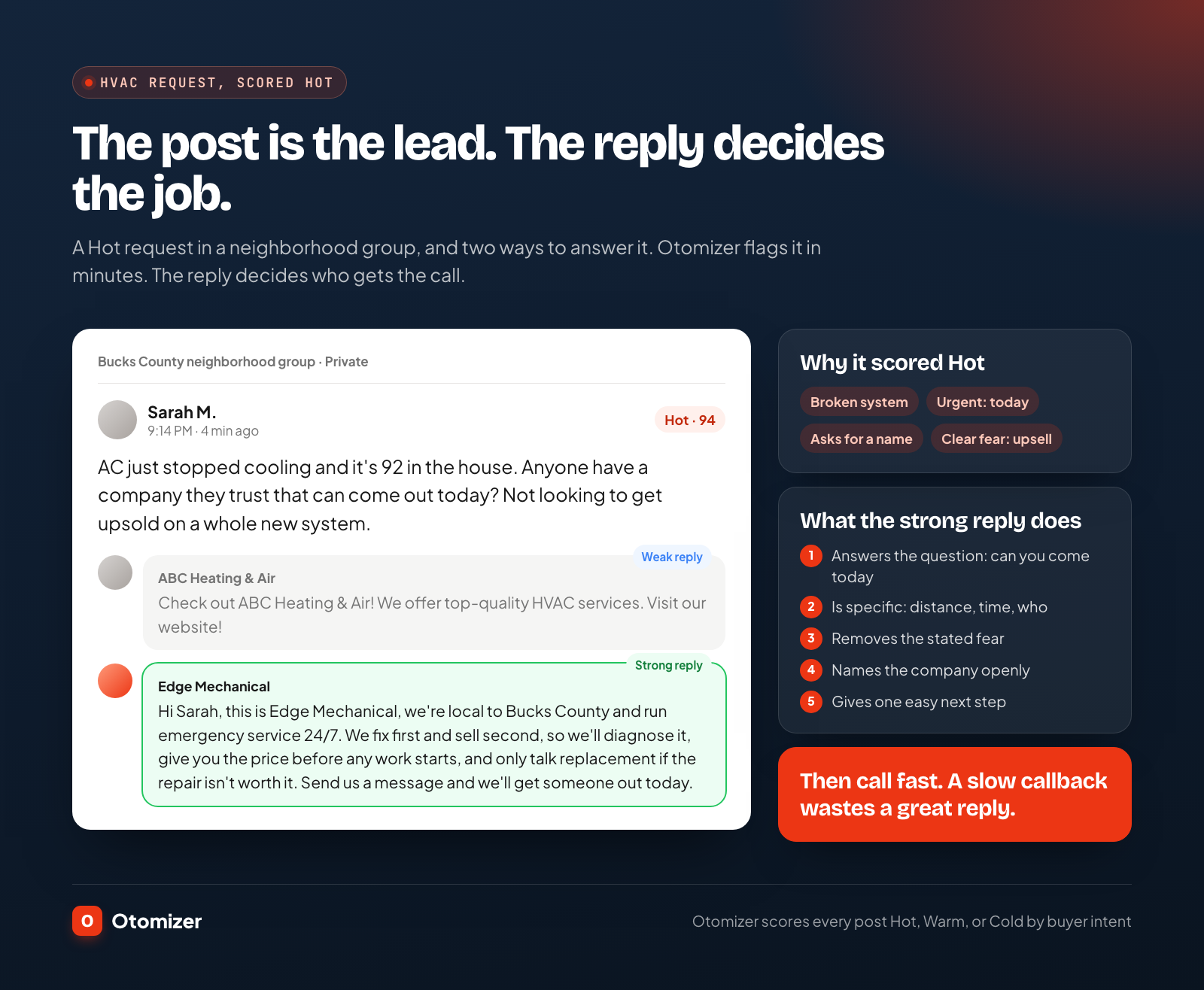
“AC just stopped cooling and it’s 92 in the house. Anyone have a company they trust that can come out today? Not looking to get upsold on a whole new system.”
That post has everything you want in a lead: a specific broken system, urgency, a request for a name, and a clear buying criterion (no upsell). Within an hour it will have twenty replies. Within three hours the homeowner has already called someone.
Here are the post types that show up again and again in HVAC:
- The emergency. “No heat and it’s 18 degrees tonight. Who does emergency furnace calls in [town]?” Highest urgency, converts to whoever answers first.
- The second opinion. “Company told me my compressor is shot and I need a new system for $14k. Is that right? Who gives a straight second opinion?” Trust is the whole purchase.
- The replacement research. “Getting quotes for a new heat pump. Who did yours and were you happy?” Five-figure ticket, comparison shopping.
- The water heater. “Water heater leaking in the basement. Who do you use?” Often lands with HVAC shops that also do plumbing.
- The new homeowner. “Just moved in. Looking for a company to service the furnace before winter.” Low urgency, high lifetime value.
How to reply to an HVAC request in a Facebook group
The reply decides whether the post becomes a phone call. The rules are simple and most companies break them.
- Answer the actual question. They asked who can come today. Say whether you can.
- Be specific. “We have a tech in Warminster this afternoon and can usually get there by 4” beats “We offer fast, reliable service.”
- Address their fear. If they said “not looking to get upsold,” say you diagnose and repair first and only talk replacement if the repair does not make sense.
- Lead with the name and the nearest truck. “[Your Company] has a tech 10 minutes from you this afternoon” gets the call before anyone else has finished typing.
- Give one easy next step. A phone number or “send me a message and I’ll call you in five minutes.”
- Then call fast. If they reply or message, call. A slow callback after a good comment is the most expensive mistake on this list.
Here is a weak reply and the kind of reply Edge Mechanical sends:
Weak: “Check out ABC Heating & Air! We offer top-quality HVAC services. Visit our website!”
Strong: “Hi Sarah, this is Edge Mechanical, we’re local to Bucks County and run emergency service 24/7. We fix first and sell second, so we’ll diagnose it, give you the price before any work starts, and only talk replacement if the repair isn’t worth it. Send us a message and we’ll get someone out today.”
The strong reply answers the question, removes the fear, and gives a next step. The weak reply is an ad, and admins remove ads.
The real problem: watching the groups
Most HVAC owners agree with all of this and still miss the posts. You are on a call. The post goes up at 9pm. By morning it has forty replies.
This is the coverage problem that tools solve. Otomizer watches your groups around the clock, scores each post Hot, Warm, or Cold by buyer intent, and drafts a reply for you to send, so you see the emergency AC post on your phone while it is still fresh. The full setup is in our guide to how to monitor Facebook groups for leads, or start at Otomizer, the tool to monitor Facebook groups for leads.
Edge Mechanical, a family-owned HVAC company serving Philadelphia, Eastern Montgomery County, and Bucks County, joined the neighborhood groups in their service area, connected them to Otomizer, and replied fast to Hot posts. They added $6,800 in booked HVAC work in three weeks, and their calendar roughly doubled.
If you do not want to join groups and watch them yourself, Otomizer Local covers your county for you, exclusively, and our county demand report shows how many HVAC requests appear in your area.
HVAC seasonality: the two days that decide your year
HVAC demand does not arrive evenly. It comes in spikes, and the companies that win the spikes prepared for them weeks earlier.
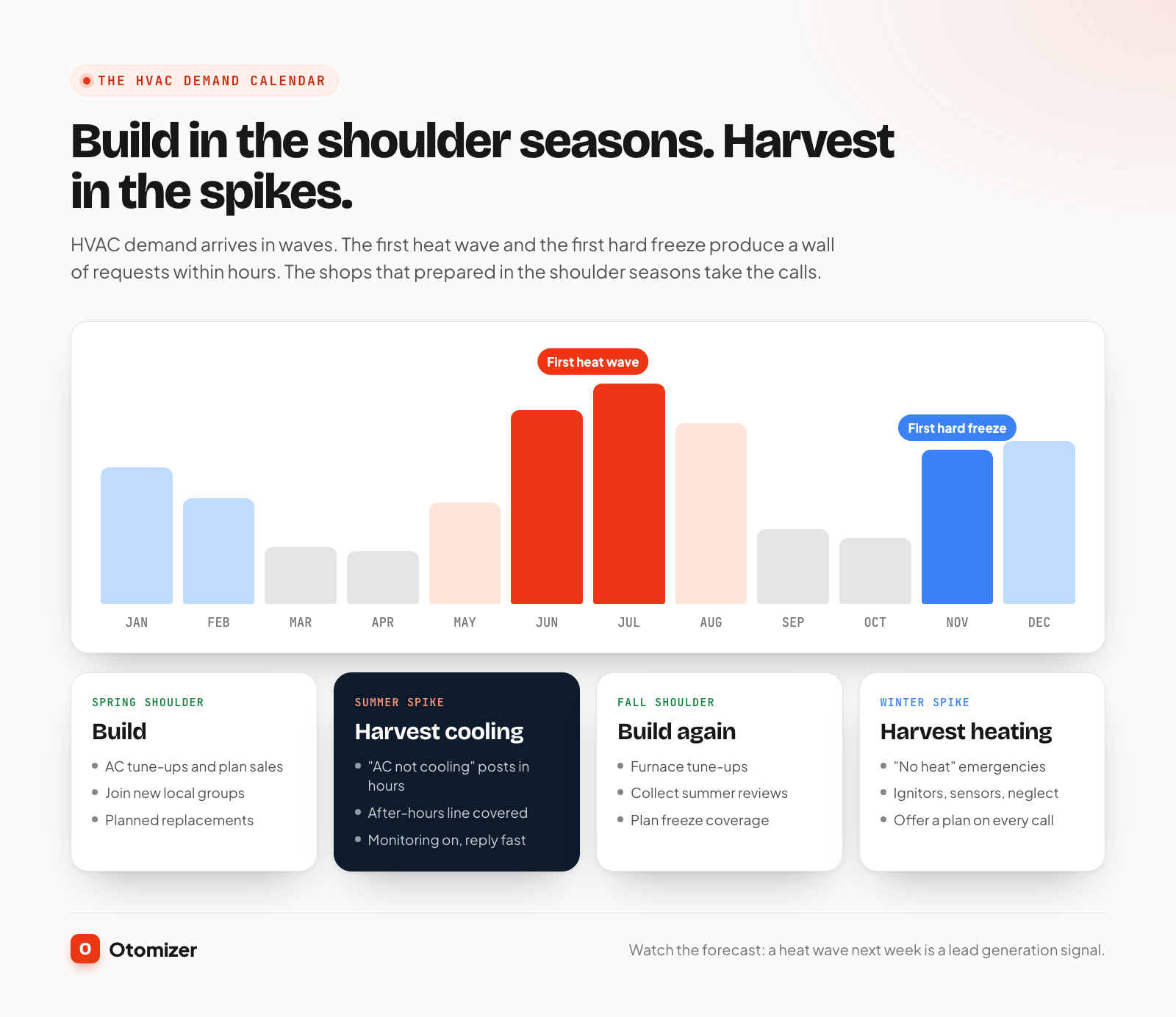
The first real heat wave. The first genuinely hot week of the year produces a wall of “AC not cooling” posts and calls within hours. Systems that sat all spring fail on the first hard day.
The first hard freeze. Same pattern for furnaces and heat pumps. Ignitors, flame sensors, and neglected systems fail the first cold night.
The shoulder seasons (spring and fall). Demand is calmer, crews have capacity, and homeowners are more willing to plan. This is when you:
- Sell maintenance agreements and schedule tune-ups.
- Collect reviews from the busy season.
- Join new local groups and build a presence before you need it.
- Run replacement campaigns, because planned replacements happen in mild weather.
- Plan phone coverage for the spike: who answers at 9pm in July?
The weather forecast is a lead generation tool. When a heat wave is forecast for next week, make sure your monitoring is on, your after-hours line is covered, and your techs know overtime is coming.
Speed to lead: why the phone process decides everything
Every channel in this guide fails without fast response. It is the single biggest predictor of whether an HVAC lead becomes a job.
The reason is simple. Someone with a broken AC calls or messages several companies. The first credible company that answers and gives a time window usually gets the job. Price comes second. Brand comes third.
What fast response looks like in practice:
- Answer live during business hours. If your office manager is out, forward to a cell.
- Cover after-hours. An answering service, an on-call rotation, or a tech who returns missed calls within the hour. A large share of emergency posts and calls happen in the evening and on weekends.
- Text back missed calls automatically. “Sorry we missed you, this is [Your Company]. What’s going on with your system?” saves a large share of missed calls.
- Track time to first response. If you do not measure it, it drifts.
Otomizer Local is built around this: you get an instant SMS and email the moment a homeowner engages, so you are always the first call.
Maintenance agreements: the lead that keeps paying
The true value of an HVAC lead is not the first ticket. It is everything after.
A homeowner who found you through an emergency AC call can become a maintenance agreement member, then a system replacement customer a few years later, then the person who recommends you in the neighborhood group the next time someone asks. None of that shows up when you calculate cost per lead on the first job.
That is why every channel’s cost per booked job looks better when you attach a maintenance offer to every call:
- Offer the plan on every service call. The technician explains it in the kitchen, while the customer is grateful.
- Make it easy. Monthly billing, two visits, priority service, and a repair discount.
- Schedule visits before the season. Spring AC tune-ups, fall furnace tune-ups.
- Use tune-ups to build trust. Find real problems early, document them with photos, and quote fairly.
- Ask for reviews and referrals at every visit. Members are your happiest customers.
A 90-day HVAC lead generation plan
Here is the plan we recommend for a small to mid-size HVAC company.
Days 1 to 30: foundations
- Start tracking source on every call. One column in your CRM or a spreadsheet. Without this, nothing below can be measured.
- Fix your Google Business Profile. Every service, every town, real photos, weekly posts.
- Start asking for reviews on every job. Text a link the same day.
- Set up after-hours coverage and missed-call text back.
- Join 15 to 30 active local Facebook groups across your service area: neighborhood, town, subdivision, and community groups. Participate as yourself before you ever mention work.
Days 31 to 60: exclusive channels
- Turn on Facebook group monitoring. With Otomizer, connect your groups, set HVAC keywords (AC, furnace, heat pump, no heat, water heater, plus recommendation phrases like “anyone recommend”), and reply to Hot posts first. Or apply for Otomizer Local and let our team cover your county.
- Launch a maintenance agreement offer on every service call.
- Reach out to five realtors and two property managers with a fast-turnaround inspection offer.
- Start job-site door hangers on every completed job.
- Keep paid search small and only where it beats your group channel on cost per booked job.
Days 61 to 90: measure and scale
- Calculate cost per booked job by source.
- Cut or reduce the worst channel. For many shops, that is shared marketplace leads.
- Add budget to the best exclusive channel.
- Plan for the next seasonal spike: phone coverage, crew capacity, and monitoring.
- Repeat monthly. Marketing is not a one-time setup.
Common HVAC lead generation mistakes
- Buying leads before fixing the phone. Every lead source fails when calls go to voicemail.
- Measuring cost per lead instead of cost per booked job. The cheapest leads are often the most expensive jobs.
- Relying on one channel. A Google algorithm change or a marketplace price increase should not be able to empty your calendar.
- Selling hard in community spaces. Groups reward help, not ads. Reply as a person who knows the trade.
- Ignoring the shoulder seasons. The heat wave is too late to start building.
- Not offering maintenance agreements. The single best way to lower your lifetime acquisition cost.
Which HVAC lead sources should you start with?
If you are just starting out or rebuilding, prioritize in this order:
- Local Facebook group coverage with Otomizer. Exclusive, high-intent requests at the lowest cost per booked job, either self-serve or done for you with Otomizer Local.
- Fast phone response and after-hours coverage. The multiplier for everything else.
- Google Business Profile and reviews. Free and essential.
- Maintenance agreements. Turn every job into recurring revenue.
- Referrals and partnerships. Slow to build, then very cheap.
- Paid search, only where it beats the above.
Shared marketplaces and broad paid ads make you one of five names on a list. Build on channels where the homeowner chose you.
If you run more than HVAC, or want the bigger picture for plumbing, electrical, and other trades, read our home service marketing guide. And if you want to see everything a done-for-you team can handle, from monitoring and responding to content and posting, read what Otomizer Local does every day.
The bottom line
Getting HVAC leads in 2026 comes down to being first in the conversations where homeowners ask for help. Otomizer puts you there around the clock, Otomizer Local does it for you with your county locked to your company, and maintenance agreements keep every customer you win.
The homeowners are already asking. Every week, in every county, people post “who do you use for AC repair?” in their neighborhood groups. The only question is whether your name is in the thread while the post is still fresh.

Stop racing for shared leads. Get recommended in your county.
Otomizer Local covers one trade in one county exclusively. Our team monitors neighborhood groups and posts a recommendation naming your company when homeowners ask who to hire.
Apply for Otomizer LocalOne company per trade per county · Three-month initial term
FAQ
Frequently asked questions
01How do I get HVAC leads fast?
02What is the best lead source for HVAC companies?
03How much should an HVAC company pay per lead?
04Are Angi and HomeAdvisor leads worth it for HVAC?
05Can HVAC companies get leads from Facebook groups?
06What is the difference between Otomizer and Otomizer Local for HVAC?
07When is the best time to market an HVAC business?
08How long does HVAC lead generation take to work?
Keep reading
Related articles
Edge Mechanical: $6,800 of HVAC Leads From Facebook Groups in 3 Weeks
September 8, 2026
ContractorsHow to Get Plumbing Leads in 2026: 12 Channels Ranked by Cost
November 13, 2026
ContractorsHow to Get Roofing Leads in 2026 (Without Paying for Shared Leads)
October 30, 2026
ContractorsHow to Get Contractor Leads Without Angi or HomeAdvisor in 2026
August 26, 2026