75 HVAC Social Media Post Ideas (Plus a Ready-to-Use 30-Day Content Calendar)
75 HVAC social media post ideas with written hooks, 10 ready-to-publish example posts, a seasonal content map, and a 30-day calendar any HVAC company can run.

Key takeaways
- 01 The best HVAC social media post ideas answer the questions homeowners in your county are already asking. Seasonal timing beats clever design almost every time.
- 02 Run seven content pillars: seasonal education, proof, local community, team, offers, myth-busting, and answers to real group questions. Rotate them so no week reads like an ad.
- 03 Write the hook first. A post that opens with "Your furnace is about to tell you something" earns the scroll; one that opens with your logo does not.
- 04 Post on your own page on a schedule, and answer questions inside community groups when they come up. Groups reward help and remove promotion.
- 05 Monitoring local Facebook groups tells you what to post next. Otomizer shows you the questions; Otomizer Local Presence writes and publishes daily value posts for you.
The best HVAC social media post ideas are seasonal, local, and useful: maintenance reminders timed to your weather, before and after job photos, technician introductions, myth-busting posts, membership offers, and plain answers to the questions homeowners in your county ask in Facebook groups. Rotate those pillars three to five times a week and you will never run out of HVAC content ideas.
That is the short answer. The rest of this guide is the long one: a strategy, 75 post ideas with the hook already written, ten posts you can copy almost word for word, a seasonal map for the whole year, and a 30-day calendar.
To keep it concrete, this is the content plan we’d run for Edge Mechanical, the Philadelphia-area HVAC company from our case study.
Why most HVAC social media posts get ignored
Scroll the business page of almost any HVAC company and you will see the same three posts on repeat: a stock photo of a smiling technician, a coupon, and “Call us today!”
None of that is wrong. It is just invisible. Homeowners do not follow HVAC companies for entertainment. They pay attention to HVAC content in two moments:
- When the weather turns. The first 90 degree week and the first frost are when people think about their systems at all.
- When something is wrong. A noise, a smell, a bill that doubled, a room that will not cool.
Good HVAC marketing ideas meet people in those two moments. Bad ones assume people are waiting to hear from you on a random Tuesday.
There is a third moment most companies miss entirely: when a neighbor asks a question in a local Facebook group. “Is it normal for my heat pump to blow cool air?” “Who do you use for AC maintenance in Doylestown?” Those threads are the best content brief you will ever get. More on that below.
The 7 content pillars for an HVAC company
A content pillar is a category you return to every week. Pillars stop you staring at a blank screen, and they keep the page from turning into a wall of offers.
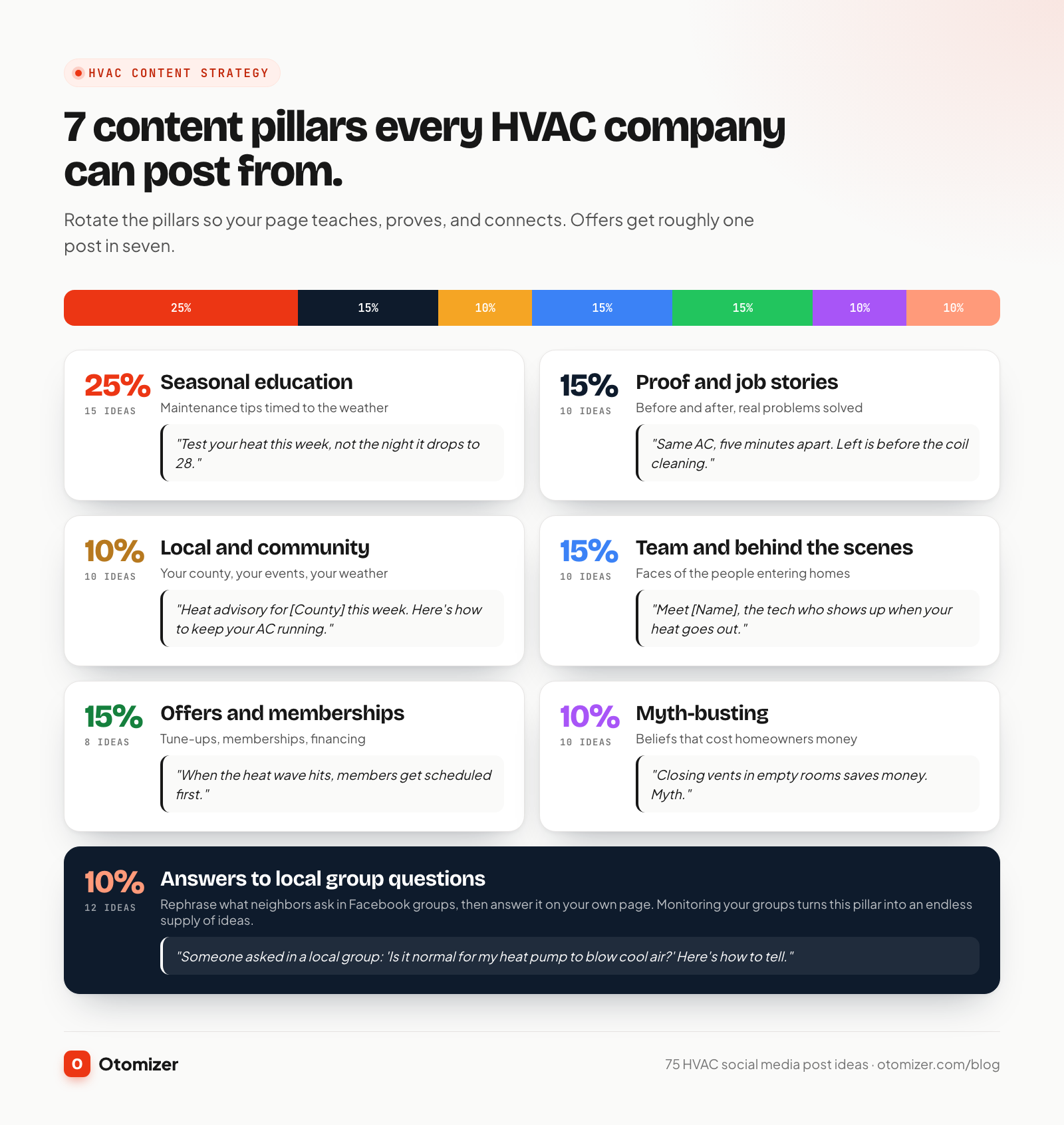
Here is the mix we would run for Edge Mechanical:
| Pillar | What it is | Share of posts | Job it does |
|---|---|---|---|
| 1. Seasonal education | Maintenance tips timed to the weather | 25% | Earns attention and saves homeowners money |
| 2. Proof and job stories | Before and after, real problems solved | 15% | Shows competence without bragging |
| 3. Local and community | Your county, your events, your weather | 10% | Makes you the local name, not a brand |
| 4. Team and behind the scenes | Technicians, trucks, training | 15% | Puts faces to the company people let into their homes |
| 5. Offers and memberships | Tune-ups, maintenance plans, financing | 15% | Converts attention into booked work |
| 6. Myth-busting | Common beliefs that cost money | 10% | Positions you as the expert in the room |
| 7. Answers to group questions | Real questions from local Facebook groups | 10% | Proves you know what your county is dealing with |
Offers get about one post in seven. That ratio matters. A page that is mostly offers trains people to scroll past you, and the one offer that would have landed gets ignored with the rest.
75 HVAC social media post ideas, with the hook written for you
Each idea below includes the opening line. The hook is the hardest part of any post, so we wrote it. Adjust the details to your climate and your equipment.
Pillar 1: Seasonal education and maintenance (15 ideas)
- Filter check. “Pull your furnace filter out right now and hold it up to a light. If you can’t see through it, this post is for you.”
- Turn the heat on early. “Test your heat this week, not the night it drops to 28. Here’s the 5-minute check.”
- First furnace smell. “That burning dust smell when the heat kicks on for the first time? Usually normal. Here’s when it isn’t.”
- AC startup before summer. “Don’t let the first 90 degree day be the first time your AC runs this year.”
- Outdoor unit clearance. “Your outdoor unit needs about two feet of breathing room. Here’s what’s usually crowding it.”
- Carbon monoxide detectors. “Heating season is CO season. When did you last test your detector?”
- Thermostat settings while away. “Leaving for the holidays? Here’s what to set your thermostat to (and what not to).”
- Condensate line in summer. “Water around your indoor unit isn’t a mystery. It’s usually one small pipe.”
- Heat pump in shoulder season. “Mild days, cold nights. Here’s how to set a heat pump so it isn’t working against itself.”
- Frozen pipes and heat. “Going away during a cold snap? Never turn the heat all the way off. Here’s why.”
- Vents and furniture. “That cold bedroom might just be a dresser sitting on the vent.”
- Humidity in winter. “Static shocks, dry skin, cracking wood floors. Your home’s humidity is too low.”
- Spring allergies. “If your allergies feel worse indoors, check these three things in your HVAC system.”
- Storm prep. “Big storm coming? Three things to do with your HVAC system before the power flickers.”
- Ductwork in the attic. “If your upstairs is always hotter, the problem might be above your head.”
Pillar 2: Proof and job stories (10 ideas)
- Before and after filter. “This filter came out of a house this morning. It had been in there [X] months.”
- The repair, not the replacement. “We were called in for a second opinion on a ‘you need a new system’ quote. Here’s what we found.”
- Late-night call. “[Time] on a [day]: no heat, two kids, 31 degrees outside. Here’s how the night went.”
- Dirty coil reveal. “Same AC, five minutes apart. Left is before the coil cleaning, right is after.”
- Install timelapse. “A full system swap in [X] hours, sped up to 30 seconds.”
- Problem of the week. “Problem of the week: a tiny part that caused a big no-cool call.”
- Clean install standards. “Here’s what a clean install looks like underneath. Most people never see this part.”
- Old equipment retirement. “We pulled out a furnace today that was installed in [year]. Here’s what’s changed since.”
- Customer handoff (template). “Walking a homeowner through their new thermostat before we leave. [Photo with permission]”
- Review spotlight (real reviews only). “We don’t post every review, but this one made the whole team’s week.” Share a genuine review, with the customer’s permission.
Pillar 3: Local and community (10 ideas)
- Local weather alert. “Heat advisory for Bucks County this week. Here’s how to keep your AC from quitting on day three.”
- Hometown pride. “We’ve been working in Bucks County basements since 2014. Here’s what Bucks County houses have in common.”
- Local event sponsorship. “Our crew will be at the [Event] on Saturday. Come say hi, we’ll have water and filter sizing charts.”
- School or team support. “Proud to support the [High School] [Team] this season.”
- Neighborhood housing stock. “If you live in a [decade]-built home in [Subdivision], your ductwork probably looks like this.”
- Community cooling or warming centers. “Know someone without heat this week? Bucks County warming centers are open. Share this.”
- Local business shoutout. “Lunch today is from [Local Spot]. Our crew’s official fuel.”
- Seasonal local landmark. “First frost on the [Landmark] this morning. Time to make sure your heat works.”
- Elderly neighbor check-in. “Heat wave tip: call your older neighbors. Ask if their AC is actually cooling.”
- Anniversary in the county. “We ran our first service call in 2014. Thank you, Philadelphia, Montgomery County, and Bucks County.”
Pillar 4: Team and behind the scenes (10 ideas)
- Meet the tech. “Meet [Name]. [X] years in the trade, the guy who’ll show up when your heat goes out.”
- Truck stock tour. “What’s on an Edge Mechanical truck so we can fix it on the first visit.”
- Training day. “Every [month], the whole team trains on [topic]. Here’s what we learned today.”
- Apprentice journey. “[Name] started as an apprentice [X] months ago. Today they ran their first solo tune-up.”
- Day in the life. “A day on the schedule in mid-July, from the 7am dispatch to the last call.”
- Office team. “The voice on the phone when you call us: meet [Name].”
- Tools explained. “This is a manometer. Here’s why we use it on every furnace tune-up.”
- Shoe covers. “We wear shoe covers in every house. Every one.”
- Hiring post. “We’re hiring an HVAC technician. Here’s what working here is actually like.”
- Owner’s note. “Why Evan started Edge Mechanical in 2014, and the one rule we haven’t broken since: fix it first, sell second.”
Pillar 5: Offers and memberships (8 ideas)
- Tune-up season. “Fall tune-up slots are open. Book now and skip the first-cold-snap wait.”
- Maintenance plan value. “What an Edge Mechanical maintenance plan covers in a year, laid out on one page.”
- Priority service. “When the heat wave hits, members get scheduled first. Here’s why that matters in July.”
- Financing explained. “A new system shouldn’t need your whole savings account. Here’s how our financing works.”
- Rebates and incentives (general). “There may be rebates or tax incentives for high-efficiency equipment. We’ll help you check what applies before you buy.”
- Free second opinion. “Got a replacement quote that felt rushed? We’ll give you a second opinion.”
- Referral thank-you. “Sent a neighbor our way? Here’s how we say thanks.”
- Seasonal bundle. “Furnace tune-up plus CO detector check plus filter, one visit.”
Pillar 6: Myth-busting (10 ideas)
- Closing vents. “Closing vents in empty rooms saves money. Myth. Here’s what it actually does.”
- Thermostat cranking. “Setting the thermostat to 60 doesn’t cool the house faster.”
- Bigger is better. “A bigger AC isn’t better. An oversized system can leave your house clammy.”
- Heat pumps in the cold. “Heat pumps don’t work in winter. Myth, mostly. Here’s the real story.”
- Filters last a year. “That filter box says 12 months. Your house might say 2.”
- New system fixes everything. “A new system on old ductwork is a sports car on a dirt road.”
- Maintenance is a scam. “Is an annual tune-up actually worth it? Here’s what we check and what it prevents.”
- Fan on all day. “Running your fan on ON instead of AUTO: what it really costs and when it helps.”
- DIY refrigerant. “Topping up your own refrigerant isn’t a fix. Here’s why it keeps running low.”
- Duct cleaning every year. “You probably don’t need your ducts cleaned every year. Here’s when you do.”
Pillar 7: Answers to questions from local groups (12 ideas)
These come straight from the kinds of questions homeowners post in neighborhood groups. Never screenshot or name the person who asked. Rephrase the question and answer it on your own page.
- “Someone asked in a local group: ‘Is it normal for my heat pump to blow cool air?’ Short answer: sometimes. Here’s how to tell.”
- “‘My AC is running but the house won’t go below 78.’ Asked in a [Town] group this week. Here’s what we’d check first.”
- “‘Why is my electric bill double this month?’ Five HVAC causes worth ruling out.”
- “‘There’s ice on my AC line.’ Turn it off first. Then read this.”
- “‘Furnace keeps clicking on and off.’ That’s called short cycling. Here’s what causes it.”
- “‘How much should a new AC cost?’ We can’t quote a house we haven’t seen, but here’s what changes the price.”
- “‘Is it worth repairing a 15-year-old system?’ Here’s how to decide.”
- “‘Water heater making popping noises.’ That’s sediment. Here’s what to do.”
- “‘What size generator do I need to run my furnace?’ Good question for this storm season.”
- “‘Do I need a permit to replace my AC?’ In most places, yes. Here’s why it protects you.”
- “‘What does SEER mean on a quote?’ Plain English in 60 seconds.”
- “‘Who do you use for AC maintenance?’ We’ll let our reviews speak, but here’s what any good tune-up should include.”
Where the best HVAC content ideas actually come from
The 75 ideas above will carry you for months. But the strongest posts you will ever write are ones you could not have guessed.
They come from your county.
Every week, in neighborhood groups, subdivision pages, and town boards, homeowners describe their HVAC problems in their own words. They ask about a specific noise. They complain about a local utility rate change. They ask whether a rebate they heard about is real. They ask who to call.
Those threads give you three things no content calendar can:
- The exact language your customers use. Nobody posts “my system is short cycling.” They post “furnace keeps turning on and off every two minutes.”
- What is happening this week. A cold snap, a utility outage, a run of frozen coils after a humid stretch.
- Proof of demand. If six people in your county asked about heat pump noise this month, a heat pump noise post will land.
The problem is watching all those groups. A busy HVAC crew does not have someone who can read thirty neighborhood groups a day. That is the job Otomizer does: it lets you monitor Facebook groups around the clock, scores every matching post Hot, Warm, or Cold by buyer intent, and puts the questions in one dashboard. The Hot posts are jobs to call back on. The Warm and curious ones are next week’s content.
Edge Mechanical already proved it. With Otomizer watching their groups, they added $6,800 of booked HVAC work in three weeks and roughly doubled their calendar. Their posts in groups were replies, not ads. The full mechanics are in our guide to monitoring Facebook groups for leads.
10 ready-to-publish posts for Edge Mechanical
Each post is written in Edge Mechanical’s voice: fix it first, sell second, price before the work starts. Where you see [brackets], drop in the real detail from the job. Never invent a customer quote or a review.
Example 1: Seasonal education (fall)
Visual: Close-up photo of a technician’s hand holding a clogged filter next to a clean one.
Hold your furnace filter up to a light. Can you see through it?
If not, your furnace is working harder than it needs to, and your first cold night is going to cost more than it should.
Edge Mechanical tip for October: check your filter now, before you need the heat. Most 1-inch filters need changing every 1 to 3 months. Pets, renovations, and allergies push that closer to 1.
Not sure what size you need? It’s printed on the side of the old one. Snap a photo and send it to us and we’ll tell you.
📅 Fall tune-up slots are open: [link]
CTA: Book a tune-up. Why it works: a physical action the reader can do in thirty seconds, then a soft offer.
Example 2: The “test your heat now” post
Visual: Short vertical video, a technician standing at a thermostat, 20 seconds.
Don’t wait for the night it drops to 28 to find out your heat doesn’t work.
Do this today:
- Switch your thermostat to HEAT.
- Set it 5 degrees above the room temperature.
- Wait 10 minutes. Warm air from the vents? You’re good.
- Strange smell that doesn’t fade after an hour, cold air, or nothing at all? Call someone before the cold does.
A little dust smell on the first run is normal. A burning plastic or rotten egg smell is not.
Questions? Comment below and one of our techs will answer.
CTA: Comment a question. Why it works: teaches, invites engagement, and positions your techs as the people who answer.
Example 3: Job story (template)
Visual: Before and after photo of an outdoor condenser coil.
Same AC unit. Twenty minutes apart.
We were called to a [neighborhood] home this week for “AC running but not cooling.” The left photo is why: a coil packed with [cottonwood fluff / grass clippings / dirt].
No parts. No replacement. A proper coil cleaning and the house was cooling again before we packed up.
Not every “my AC is dying” call is a dying AC. Sometimes it just can’t breathe.
CTA: None needed. Why it works: it is “fix it first, sell second” in one photo. That is the post people screenshot and share when a neighbor asks who to call.
Example 4: Meet the tech
Visual: Natural photo of the technician next to their truck. No stock photos.
Meet [Name], one of the techs you might see in your driveway this winter.
[Name] has been doing HVAC for [X] years and has been with Edge Mechanical since [year]. Favorite call: [real answer]. Least favorite: crawlspaces in August.
When [Name] shows up, you’ll get the price before any work starts, shoe covers on, and a plain explanation of what’s wrong.
Say hi if you see the truck around Bucks County 👋
CTA: Soft community engagement. Why it works: people let strangers into their homes. Faces lower that bar.
Example 5: Myth-busting
Visual: Carousel. Slide 1 “MYTH: Closing vents saves money.” Slides 2 to 4 explain.
Closing vents in rooms you don’t use saves money, right?
Usually not. Most systems are designed for a certain amount of airflow. Close too many vents and you raise pressure in the ductwork, which can mean more leaks, a noisier system, and in some cases a frozen coil or an overheated furnace.
Better options: a programmable thermostat schedule, sealing leaky ducts, or a zoning system if you really do have rooms you never use.
Save this for the next family argument about the guest room vent.
CTA: Save the post. Why it works: saves signal value, and the straight answer earns trust.
Example 6: Answering a local group question
Visual: A simple branded graphic with the question in quotes (no names, no screenshots).
“Is it normal for my heat pump to blow cool air?”
This came up in a Bucks County group this week and it’s one of the most common questions we get when temperatures drop.
Short answer: sometimes yes. A heat pump’s air feels cooler than a gas furnace’s air (often in the 90s instead of the 120s) because it heats more gently. Your hand reads that as “cool.”
It’s NOT normal if: • The house temperature keeps falling • The outdoor unit is covered in thick ice for hours • You hear grinding or the unit won’t stop running
If any of those sound familiar, give us a call. If not, your heat pump is probably doing exactly what it’s designed to do.
CTA: Call if symptoms match. Why it works: it answers the question your county is already asking, in their words, and filters out unnecessary calls, which homeowners appreciate.
Example 7: Membership offer
Visual: One clean graphic listing what the maintenance plan includes.
What happens when your AC dies on the hottest day of the year and half of Bucks County calls for help at the same time?
Someone gets scheduled first.
An Edge Mechanical maintenance plan gets your system checked before the season hits, so the hottest day of the year is far less likely to be the day it quits. And when you do need us, you are already a customer we know.
What the plan includes: [plan benefits]
Details: edgemechpros.com
CTA: Join the plan. Why it works: sells the moment of need, not the membership.
Example 8: Local weather alert
Visual: Simple graphic: “Heat advisory: [dates].”
Heat advisory for Bucks County starting [day]. Three things to do today so your AC doesn’t quit on day three:
- Change your filter.
- Hose off the outdoor unit gently (power off first).
- Close blinds on south and west windows in the afternoon.
And please check on older neighbors. Heat is hardest on them.
If your system is already struggling, call early. Schedules fill fast in a heat wave.
CTA: Call early. Why it works: timely, helpful, and community-minded. It also gets shared into neighborhood groups by readers, which is the kind of reach you cannot buy.
Example 9: Behind the scenes training
Visual: Photo of the team around a furnace on a training bench.
Why is half our team standing around a furnace in the shop on a Thursday?
Training day. Today: [topic, for example combustion analysis, the test that shows whether a furnace is burning fuel safely and efficiently].
It’s the part of the job most homeowners never see. We think you should know it happens.
CTA: None. Why it works: quietly explains why your tune-up is worth more than a cheaper one.
Example 10: Owner’s note
Visual: Photo of the owner, in a work shirt, not a suit.
I started Edge Mechanical in 2014 with one rule: fix it first, sell second. Tell people the truth about their system, even when the truth is “you don’t need a new one.”
That rule has cost us some replacement jobs. It has also gotten us invited back into the same homes year after year.
Thank you to every family in Philadelphia, Montgomery County, and Bucks County who has trusted us with their heat and air. We still answer our own phones.
Evan, Edge Mechanical
CTA: None. Why it works: a single human post a year does more for trust than a dozen ads.
The seasonal HVAC content map: what to post each month
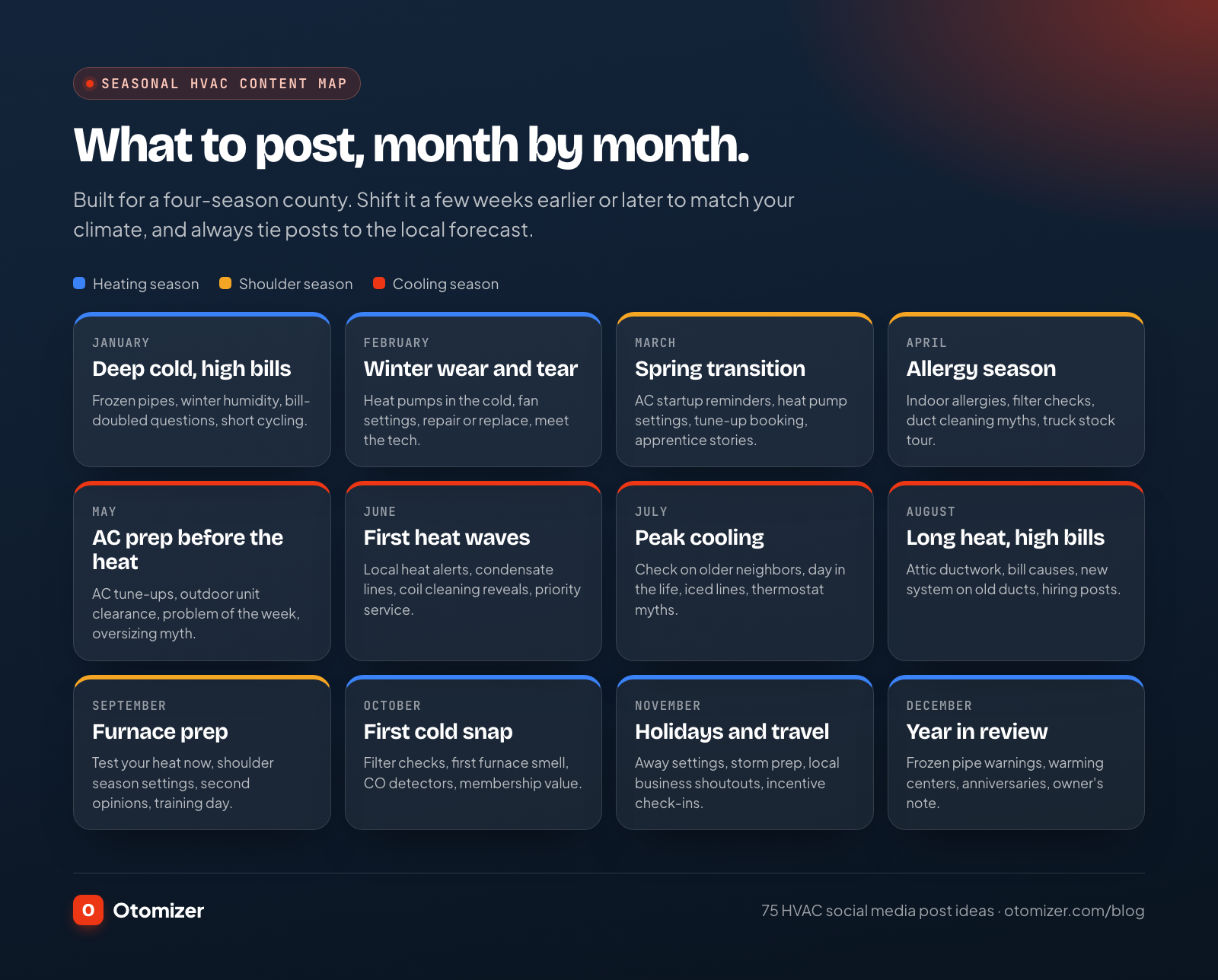
Timing is the cheapest edge in HVAC marketing. Here is the map for a four-season county. Shift it a few weeks for a warmer or colder climate.
| Month | Main theme | Post ideas from the list |
|---|---|---|
| January | Deep cold, high bills | 10, 12, 66, 68, 58 |
| February | Bills, winter wear and tear | 57, 61, 70, 36, 47 |
| March | Spring transition, AC prep | 4, 9, 46, 39, 22 |
| April | Allergy season | 13, 1, 63, 37, 53 |
| May | AC tune-ups before heat | 4, 5, 46, 21, 56 |
| June | First heat waves | 26, 8, 19, 65, 48 |
| July | Peak cooling, emergencies | 34, 40, 18, 67, 55 |
| August | Long heat, high bills | 15, 66, 59, 62, 44 |
| September | Furnace prep, shoulder season | 2, 9, 46, 51, 38 |
| October | First cold snap | 1, 3, 6, 64, 47 |
| November | Holidays and travel | 7, 14, 32, 52, 50 |
| December | Holidays, year in review | 10, 31, 35, 45, 25 |
A note on incentives: rebate and tax credit rules change, vary by location, and depend on the equipment. Post about them as “we’ll help you check what applies,” never as a promise. Link to your utility or official sources rather than restating rules that might be out of date by spring.
A 30-day HVAC content calendar you can start Monday
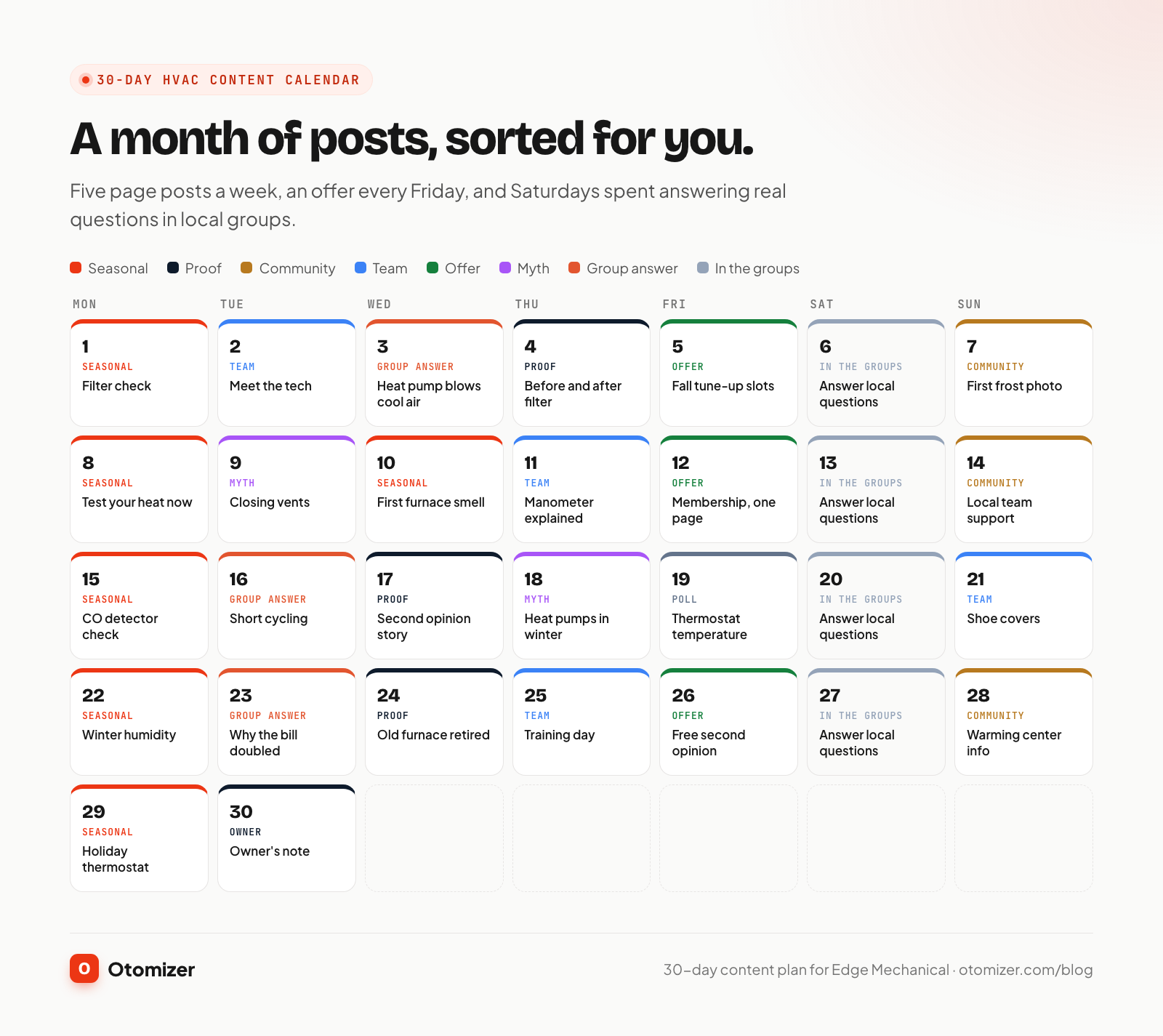
This calendar assumes you are starting in October, the busiest content month of the year for heating. It runs five posts a week on your page, with weekends reserved for answering group questions and engaging with comments. Numbers refer to the 75 ideas above.
| Day | Pillar | Post | Format |
|---|---|---|---|
| 1 (Mon) | Seasonal | #1 Filter check | Photo |
| 2 (Tue) | Team | #36 Meet the tech | Photo |
| 3 (Wed) | Group answer | #64 Heat pump cool air | Graphic |
| 4 (Thu) | Proof | #16 Before and after filter | Photo |
| 5 (Fri) | Offer | #46 Fall tune-up slots | Graphic |
| 6 (Sat) | Groups | Answer questions in local groups | Comments |
| 7 (Sun) | Community | #33 First frost photo | Photo |
| 8 (Mon) | Seasonal | #2 Test your heat now | Short video |
| 9 (Tue) | Myth | #54 Closing vents | Carousel |
| 10 (Wed) | Seasonal | #3 First furnace smell | Short video |
| 11 (Thu) | Team | #42 Manometer explained | Short video |
| 12 (Fri) | Offer | #47 Maintenance plan, one page | Graphic |
| 13 (Sat) | Groups | Answer questions in local groups | Comments |
| 14 (Sun) | Community | #29 Local team support | Photo |
| 15 (Mon) | Seasonal | #6 CO detector check | Graphic |
| 16 (Tue) | Group answer | #68 Short cycling | Short video |
| 17 (Wed) | Proof | #17 Second opinion story | Photo |
| 18 (Thu) | Myth | #57 Heat pumps in winter | Carousel |
| 19 (Fri) | Engagement | Poll: “What temperature is your thermostat on right now?” | Poll |
| 20 (Sat) | Groups | Answer questions in local groups | Comments |
| 21 (Sun) | Team | #43 Shoe covers | Photo |
| 22 (Mon) | Seasonal | #12 Winter humidity | Graphic |
| 23 (Tue) | Group answer | #66 Bill doubled | Carousel |
| 24 (Wed) | Proof | #23 Old furnace retired | Photo |
| 25 (Thu) | Team | #38 Training day | Photo |
| 26 (Fri) | Offer | #51 Free second opinion | Graphic |
| 27 (Sat) | Groups | Answer questions in local groups | Comments |
| 28 (Sun) | Community | #31 Warming center info | Graphic |
| 29 (Mon) | Seasonal | #7 Holiday thermostat settings | Graphic |
| 30 (Tue) | Owner | #45 Owner’s note | Photo |
Which post formats work best for HVAC?
Different ideas suit different formats. Here is the quick guide:
| Format | Best for | Effort | Tip |
|---|---|---|---|
| Short vertical video (15 to 45 seconds) | How-tos, tool explainers, tech intros | Medium | Film on the job with a phone. Natural light beats editing. |
| Before and after photo | Coil cleanings, installs, filters | Low | Same angle, same framing, both photos. |
| Carousel | Myth-busting, step-by-step, membership value | Medium | One idea per slide. Big text. |
| Poll | Engagement, thermostat habits | Very low | Ask something people have an opinion on. |
| Plain text post | Owner’s notes, community alerts | Low | Short paragraphs. No hashtags wall. |
| Answer in a group thread | Real questions from neighbors | Low | Help first, mention your company openly, one reply per thread. |
The single biggest upgrade most HVAC pages can make is replacing stock photos with phone photos from real jobs. Ask your techs to take two pictures on every interesting call. Get the homeowner’s permission before anything identifiable (their face, their house number, their street) goes online.
How to post in local Facebook groups without getting removed
Your business page is where you publish. Local groups are where your customers talk. They are not the same thing, and treating a neighborhood group like your page is the fastest way to get banned.
Follow these rules:
- Read the rules of every group. Many ban business posts entirely. Some allow them on one day a week, often in a pinned promotion thread.
- Never drop an ad uninvited. A coupon in a neighborhood group is the post admins remove first.
- Answer questions when people ask them. “Who do you recommend for AC repair?” or “Is this noise normal?” is an invitation. Reply helpfully and say plainly who you are.
- Lead with the answer, not the pitch. “That’s usually a frozen coil. Turn the system off for a few hours to let it thaw, and check your filter. If it happens again, it’s worth a call.” Then: “I’m [Name] with Edge Mechanical, happy to help if you need us.”
- One reply per thread. Don’t bump. Don’t reply to every comment. Don’t have coworkers pile on.
- Never pretend to be a customer. Recommendations from your own team must say they are from your company. Undisclosed self-promotion breaks group rules and, in many cases, advertising law.
- Be there at night and on weekends. That’s when “no heat” posts appear. A helpful answer at 9pm on a Sunday is worth more than a polished post on Tuesday.
That last rule is where most shops fail. Their content is fine. They just are not in the thread when it matters. Recommendation threads collect most of their replies in the first hour.
This is the exact gap Otomizer Local fills. Our team monitors the groups across your county around the clock, replies in matching threads naming your company, and alerts you by SMS and email the moment a homeowner engages. It is one trade per county, exclusively, so you are never competing with another client in the same thread. For HVAC specifically, see Otomizer Local for HVAC companies, and the full operating detail on how Otomizer Local works.
How to measure whether your HVAC content is working
Likes are the least useful number on the page. Track these instead:
| Metric | What it tells you | Check |
|---|---|---|
| Calls or messages mentioning a post | Content directly producing work | Ask “how did you hear about us?” on every call |
| Saves and shares | Content people find genuinely useful | Weekly |
| Comments with questions | Topics to write more about | Weekly |
| Group threads where your name is recommended | Word of mouth growing | Monthly |
| Booked jobs from group replies | The highest-intent channel | Monthly |
| Membership signups after offer posts | Offer posts that work | Monthly |
Two habits make measurement reliable:
- Ask every caller how they found you, and write it down in your CRM or field service software. “Facebook” is not specific enough. “Saw your post about the heat pump” is.
- Review once a month. Which pillar got saves? Which got calls? Do more of those next month and drop what got nothing.
If you want to know what HVAC demand looks like in your county before you invest in content, the county demand report shows request volume in local groups by trade.
Doing it yourself vs having it done for you
There are three ways to run this plan. One of them keeps running in July and January.
| Option | What you do | What it costs | Best for |
|---|---|---|---|
| DIY posting | Write, shoot, post, and answer groups yourself | Your time (and it stops in peak season) | Owner-operators with evenings free |
| Self-serve Otomizer | Otomizer watches your groups and drafts replies; you post content and reply | $89 a month (Otomizer Pro) | Shops with someone who can reply fast |
| Otomizer Local Presence | Our team monitors, replies, publishes 20 designed posts and 4 reels a month, plans seasonal campaigns, and runs review requests | $1,497 a month plus $1,797 setup | Best results. HVAC companies that want content and group replies running every day, in peak season too |
DIY content breaks on seasonality. The months when content matters most (the first heat wave, the first cold snap) are the months nobody in the building has a free minute. Posting stops exactly when it should peak.
That is why Otomizer Local Presence is the best way to run this plan. It is the only option that covers both halves of HVAC social media at once: the content on your page and the conversations in your county’s groups, every day, including the weeks your crew is slammed. It includes everything in Local Leads (exclusive county coverage, round-the-clock monitoring, replies in matching threads, a named account manager, a weekly summary) plus 20 designed posts and 4 short videos a month across your groups, Facebook Page, Instagram and Google Business Profile, a brand kit, seasonal campaign planning around storms, freezes, and incentive deadlines, review request sequences sent to closed jobs, and a monthly performance call. The guarantee is 20 qualified conversations in your first 90 days, or we keep working at no charge until you get them. Terms are three months to start, then month to month.
If you are weighing this against paid leads, run your own numbers with the Angi cost breakdown and the comparison of Otomizer Local and Angi leads. And if content is only half the problem, our guide on how to get HVAC leads ranks every channel by cost per booked job.
Start with the next seven days
You do not need all 75 ideas this week. You need seven.
- Pick the pillar that matches this week’s weather.
- Write five page posts from the list. Use the hooks as written.
- Take two real photos on every interesting call.
- Join five active neighborhood groups in your service area, read their rules, and answer one genuine question a day.
- Ask every caller how they heard about you.
- At the end of the week, write down which post got a save, a share, or a call.
- Do more of that next week.
The companies that win on social media in HVAC are not the ones with the best designers. They are the ones who post consistently, answer when neighbors ask, and show up in the thread before anyone else does.
If you want a team to do all of it, from watching the groups to publishing the posts, that is exactly what Otomizer Local does.

Stop racing for shared leads. Get recommended in your county.
Otomizer Local covers one trade in one county exclusively. Our team monitors neighborhood groups and posts a recommendation naming your company when homeowners ask who to hire.
Apply for Otomizer LocalOne company per trade per county · Three-month initial term
FAQ
Frequently asked questions
01What should an HVAC company post on social media?
02How often should an HVAC company post on Facebook?
03What are good HVAC Facebook post ideas for the fall?
04Can HVAC companies post in local Facebook groups?
05How do I find out what homeowners in my area want to know about HVAC?
06What kind of HVAC content gets the most engagement?
07Should HVAC companies hire someone to manage social media?
Keep reading
Related articles
Home Service Marketing: The 2026 Playbook for Plumbers, Electricians, and Local Trades
October 30, 2026
ContractorsHow to Get HVAC Leads in 2026: Every Channel Ranked by Cost Per Booked Job
October 30, 2026
Case StudyEdge Mechanical: $6,800 of HVAC Leads From Facebook Groups in 3 Weeks
September 8, 2026
MarketingHow to Get More Google Reviews: 22 Templates and a 72-Hour System
November 13, 2026