What Is AEO? How Local Businesses Get Named by ChatGPT and Google AI
AEO explained for local business owners: how ChatGPT, Google AI Overviews, Perplexity and Gemini pick the businesses they name, and how to become one of them.

Key takeaways
- 01 AEO (answer engine optimization) is the work of getting your business named when someone asks an AI assistant who to hire. SEO earns you a spot in a list of links. AEO earns you a place inside the answer.
- 02 AI assistants usually name two or three local businesses. They pick the ones whose information is clear, consistent and backed up across the web: your website, your Google Business Profile, directories, reviews and local mentions.
- 03 The fundamentals are concrete: answer-ready service and city pages, FAQ sections with structured data, an llms.txt file, identical business details everywhere, and a steady flow of recent reviews.
- 04 AEO works best as one system with your website and local SEO, which is why Local Dominance runs all three every month and reports on AI recommendations alongside your Google rankings.
- 05 Your AEO baseline takes five minutes: ask ChatGPT, Perplexity and Gemini who they recommend for your trade in your town, and write down who gets named. Local Dominance re-runs that check every month.
The short answer: AEO (answer engine optimization) is the work of getting your local business named when someone asks an AI assistant like ChatGPT or Google AI Overviews who to hire. Assistants name the two or three businesses they are most confident about. Answer-ready pages, structured data, identical business details everywhere and recent reviews build that confidence.
When a homeowner types “who’s the best roofer near me?” into ChatGPT, or sees a Google AI Overview at the top of their search, the assistant does not hand them ten blue links. It names two or three businesses and explains why. AEO is how you become one of those names.
If you run a roofing company, an HVAC shop, a plumbing business, a real estate team, a landscaping crew or any other local business, this guide is for you. No jargon required. We will cover what changed, how AI assistants decide who to recommend, what you can do about it, and what our team does every month for Local Dominance clients to put their name in the answer.
Why are customers asking AI who to hire?
For twenty years, finding a local business worked the same way. You typed “plumber near me” into Google, scanned the map pack, clicked a few websites, maybe read some reviews, and called someone.
That habit is shifting. More people now ask the question the way they would ask a friend:
- “Who’s the best roofer in my town for hail damage?”
- “My AC is blowing warm air. Who should I call near me that does same-day repairs?”
- “Which real estate agent knows the neighborhoods around here best?”
- “Recommend a landscaper who does drainage work and has good reviews.”
They ask ChatGPT, Perplexity or Gemini. They read the AI Overview Google now shows above the regular results. And the answer they get is short: a few names, a sentence or two about each, sometimes a link.
That shifts the math for local businesses in one important way. On a search results page, being sixth still gets you some calls. In an AI answer, if you are not one of the two or three names, you are invisible. The answer is the shortlist, and the shortlist is the first call.
The good news: AI assistants are not random. They follow patterns, and those patterns reward businesses that do a specific, learnable set of things well.
What is the difference between SEO and AEO?
SEO (search engine optimization) is the work of ranking your website in Google’s results. AEO is the work of being named in an AI assistant’s answer. They overlap heavily, and AEO builds on top of good SEO. Here is the difference side by side.
| SEO | AEO | |
|---|---|---|
| The goal | Rank your website high in a list of links | Get your business named inside the answer |
| Where it shows up | Google search results and the map pack | ChatGPT, Google AI Overviews, Perplexity, Gemini |
| What the customer sees | Ten or more options to compare | Two or three recommended names |
| What wins | Relevant pages, links, Google Business Profile, reviews | Clear answers, consistent business details everywhere, structured data, reviews, local mentions |
| How content is written | Pages built around search keywords | Pages that answer real questions in plain sentences an assistant can quote |
| How you measure it | Rankings, traffic, calls from search | Whether AI assistants name you when asked your money questions |
| Who does it for you | Most SEO agencies | Local Dominance, every month, reported alongside your rankings |
The short version: SEO gets you found. AEO gets you recommended. A local business wants both, and the same foundations power each one. Google’s own guidance on AI features and your website points site owners back to the same search fundamentals, which is why a business with strong local SEO starts the AEO race ahead.
How do AI assistants choose which local businesses to name?
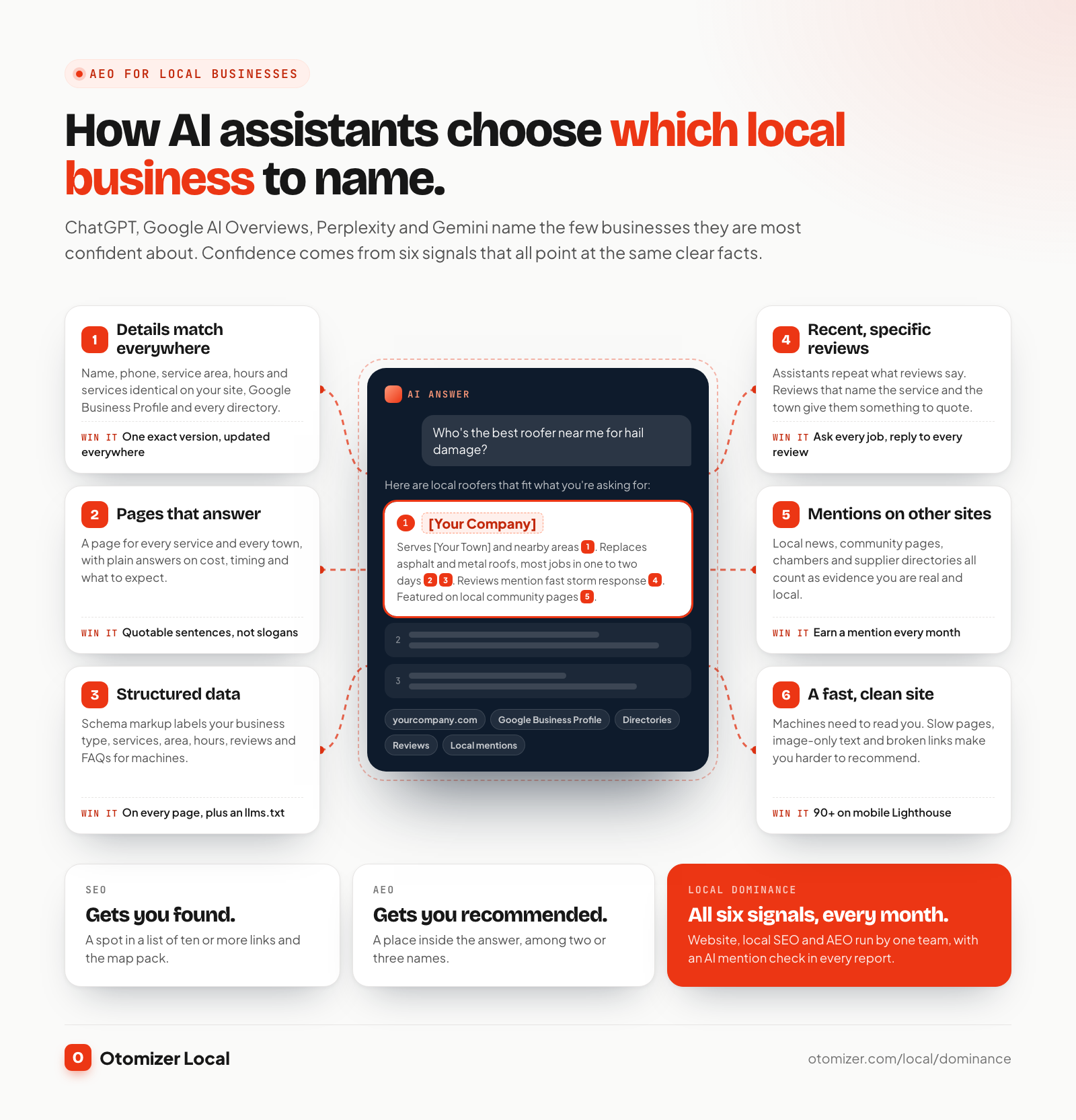
When someone asks an AI assistant for a local recommendation, the assistant pulls together what it can find about businesses that match: from the web, from business listings, from review platforms and from its own training. Then it picks the few it is most confident about.
“Confident” is the key word. An assistant does not want to recommend a business that might be closed, might not serve that town, or might not do that kind of work. So it leans toward businesses where the evidence is clear and agrees with itself. Here are the six signals that matter most.
1. Your business details match everywhere
Your business name, address or service area, phone number, hours and list of services should be identical on your website, your Google Business Profile, Facebook, Yelp, the Better Business Bureau, industry directories and every other listing.
When those details disagree (an old phone number on one directory, a different business name on another), the assistant has a reason to doubt. When they match across dozens of sources, it has a reason to trust.
2. Your website answers questions directly
AI assistants love pages that answer a question in a clear sentence. “We replace asphalt shingle roofs in [Your City], and most replacements take one to two days” is quotable. A page that says “Quality you can trust, service you deserve” says nothing an assistant can use.
The businesses that get named tend to have a page for every service they offer, a page for every city or area they serve, and plain-language answers to the questions customers actually ask: cost ranges, timelines, what is included, what to expect.
3. Structured data tells machines exactly what you are
Structured data (also called schema markup) is code on your website that labels information for machines: this is a roofing contractor, this is the service area, these are the services, these are the hours, this is an FAQ and here are the answers. Visitors never see it. Search engines and AI systems read it directly.
It removes guesswork. Instead of inferring what your business does from paragraphs of text, an AI system can read it in a format built for exactly that purpose. Google publishes the exact format for local business structured data, including hours, services and reviews.
4. Reviews are recent, frequent and specific
Assistants often summarize reviews when they recommend a business: “known for fast response times” or “customers mention clean job sites.” They can only say that if your reviews say it. A steady stream of recent, detailed reviews, plus your own replies that name the service and the town, gives an assistant something concrete to repeat. Google’s own local ranking guidance says more reviews and positive ratings can help your local ranking too. Our guide on how to get more Google reviews covers the ask, the timing and the follow-up.
5. Other sites mention you
Local news, community pages, supplier and manufacturer directories, chamber of commerce listings and neighborhood conversations all count. Every credible mention of your business in connection with your trade and your area is another piece of evidence that you are a real, established local option.
6. Your site is fast, clean and easy to read
AI systems and search engines both need to read your website. A slow site, a site built entirely of images, or a site with broken pages and missing information makes that harder. A fast, well-structured site with clean code is easier to understand, which makes it easier to recommend.
How do you start AEO for a local business?
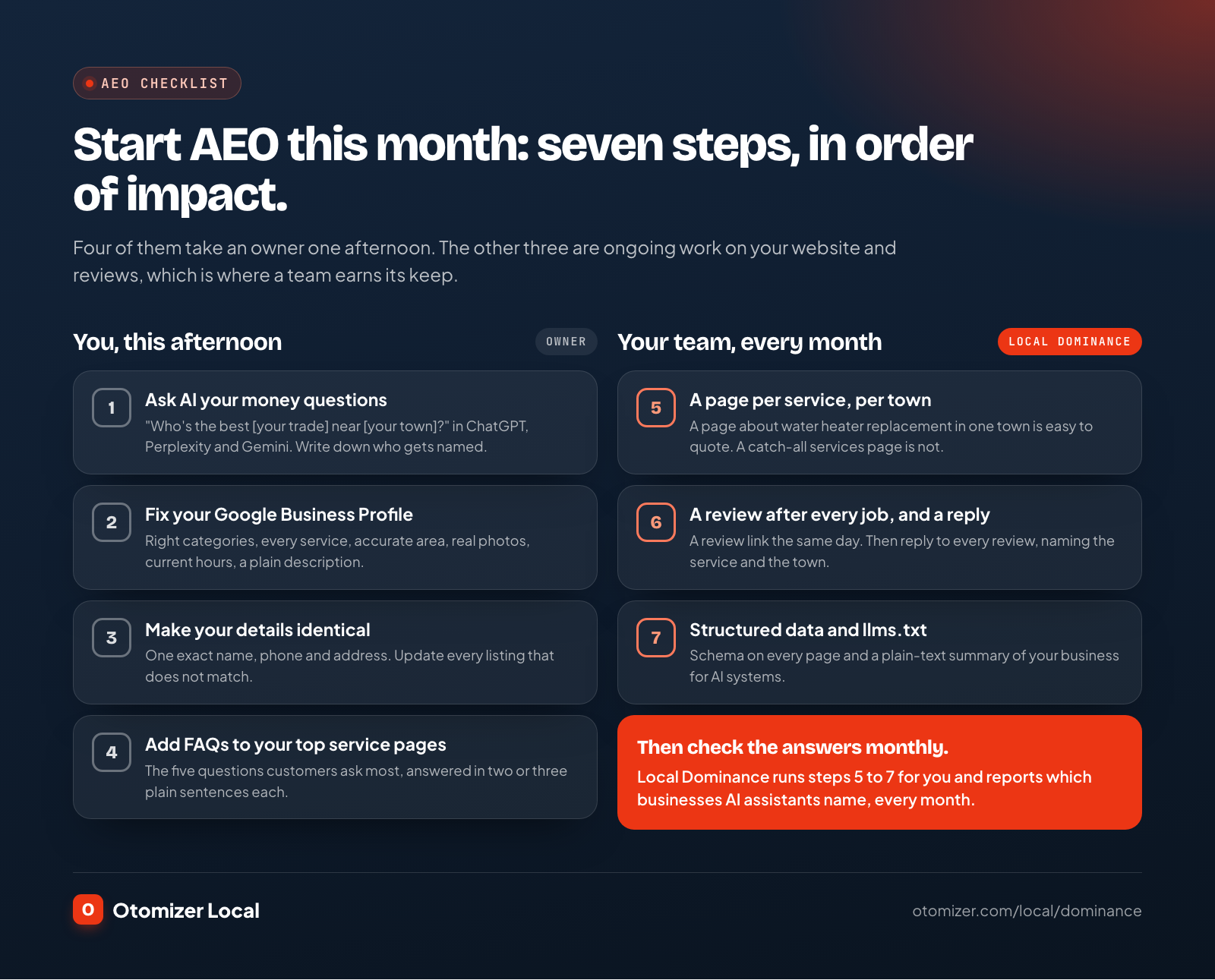
You can start on AEO today with the tools you already have. Here is a practical checklist, in order of impact.
- Ask an AI assistant your money questions. Open ChatGPT, Perplexity and Gemini and ask “who’s the best [your trade] near [your town]?” and two or three variations. Write down who gets named. That is your starting point.
- Fix your Google Business Profile. Correct categories, every service listed, accurate service area, real photos, current hours, and a description that states plainly what you do and where. The same work lifts your map pack position; see how to rank higher on Google Maps.
- Make your details identical everywhere. Pick one exact version of your business name, phone number and address, then update every listing that does not match.
- Add an FAQ section to your main service pages. Answer the five questions customers ask most, in two or three sentences each. Plain words, real numbers where you can give them.
- Build a page for each service and each main town you serve. One page that tries to cover everything is hard to quote. A page about water heater replacement in one specific town is easy to quote.
- Ask every customer for a review, then reply to each one. Send a direct review link the same day you finish the job, so leaving one takes a minute. Let customers write in their own words: Google’s contribution policy does not allow asking for specific content. Then reply to every review yourself and name the service and the town in your reply (“Thanks for trusting us with your water heater replacement in [Your Town]”). Our guide on how to get more Google reviews has the full playbook.
- Add structured data and an llms.txt file. These are technical, but any competent web developer can add them. An llms.txt file is a plain-text summary of your business at the root of your site, written for AI systems to read.
Steps one through four are things an owner can do in an afternoon. Steps five through seven are ongoing work: five and seven touch the website itself, and six only works as a habit after every job. That is where most local businesses bring in a team.
Why does AEO work best as one system?
AEO is not a single task you finish. It is the result of your website, your Google Business Profile, your listings and your reviews all saying the same clear thing, consistently, month after month.
That is why it is hard to do in pieces. A web designer builds a beautiful site but leaves out structured data. An SEO agency builds citations but never touches the review flow. Someone else handles social media with a different version of your business name. Each piece is fine on its own, and none of them adds up to a business an AI assistant feels sure about.
The businesses that win in AI answers have one team running every piece in the same direction. That is the idea behind Local Dominance.
What does Local Dominance do for AEO every month?
Local Dominance is the top tier of Otomizer Local, our done-for-you growth team for local businesses. It includes everything in Local Leads and Local Presence, plus a complete premium website rebuild, local SEO and AEO, handled by our team every month. Here is the AEO work specifically.
Answer-ready pages. Every service and every city you serve gets its own page, written to answer real customer questions in sentences an assistant can quote. We build these at setup and keep adding them through monthly content.
FAQ sections with structured data. The questions your customers ask most, answered plainly on the pages where they belong, and marked up with structured data so AI systems and Google can read them directly.
Structured data on every page. Your business type, services, service area, hours, reviews and FAQs, labeled in the format search engines and AI systems are built to read.
An llms.txt file. A clean, current summary of your business written for AI systems, kept up to date as your services and service area change.
Consistent business details across the web. We audit your listings and citations and bring them into line, so every source an assistant checks says the same thing about you.
A review strategy. Review-request sequences go to customers after closed jobs (this is part of Local Presence, which Dominance includes), so your reviews stay recent, frequent and specific.
A monthly visibility report. This is the part owners love. Every month we report your Google rankings, and we run an AI mention check: we ask ChatGPT, Google AI Overviews, Perplexity and Gemini the money questions for your trade and town, and show you exactly who they recommend. You see where you started, and you watch your name move into the answers.
What does an AI-ready website look like?
Here is what “AI-ready” means in practice on every Local Dominance build:
- A page for every service and every city you serve, each answering a specific question for a specific place.
- Structured data on every page, so machines know exactly what each page is about.
- An llms.txt file that summarizes the business for AI systems.
- Every blog post migrated and every old URL redirected, so the content and rankings you already earned carry over to the new site.
- Top Google Lighthouse scores on mobile and desktop, so the site is fast for customers and easy for search engines and AI systems to read.
- An instant cost calculator and interactive tools for your trade, which give visitors real answers on the page instead of a “contact us for a quote” dead end.
That is the foundation Local Dominance builds for every client at setup. Our breakdown of what a contractor website should cost shows what that build runs when you buy it from an agency. Then the monthly SEO, AEO and content work keeps it growing. See Local Dominance.
How does AEO fit with the rest of your marketing?
AEO is the newest way customers find local businesses, and it sits alongside the ones that already work:
- Neighbors asking in Facebook groups. Every Otomizer Local tier covers this. Our aged local accounts are in your county’s Facebook groups, including private ones, and we recommend you in the thread, usually inside 60 seconds of a neighbor asking.
- Your social channels and Google Business Profile. Local Presence adds designed posts and short-form videos every month across Facebook, Instagram and Google Business Profile, plus review requests.
- Google search and AI answers. Local Dominance adds the website, local SEO and AEO. Paid placements like Google Local Services Ads rent you a spot one lead at a time. AEO builds a position you keep.
Each layer feeds the others. A neighbor sees you recommended in a group, looks you up, finds a fast site with clear answers and fresh reviews, and asks ChatGPT for a second opinion. The assistant names you too. That is a county where your business is the obvious choice. The tier comparison breaks down what each one includes.
The bottom line
AI assistants are becoming the new front door for local businesses. When someone asks who to hire, the assistant names a few companies it is sure about, and that shortlist gets the first call.
Getting on it comes down to fundamentals: clear pages that answer real questions, structured data, an llms.txt file, identical business details everywhere, and a steady flow of reviews. You can start on the basics this week. And when you want a team building and running the full system for you, every month, with an AI mention check in your report so you can see the results, that is exactly what Local Dominance does.
Get named when your county asks AI who to hire.
Local Dominance rebuilds your website, runs local SEO and AEO every month, and reports who ChatGPT, Google AI, Perplexity and Gemini recommend. One company per trade, per county.
See Local DominanceReady to claim your county? Apply for your territory
FAQ
Frequently asked questions
01What does AEO stand for?
02Is AEO replacing SEO?
03How do ChatGPT and Google AI decide which local businesses to recommend?
04What is an llms.txt file?
05How long does AEO take to work?
06Does Otomizer Local include AEO?
07Do Google reviews affect AI recommendations?
08Can I do AEO for my local business myself?
Keep reading
Related articles
How to Rank Higher on Google Maps: The Contractor Playbook
November 13, 2026
MarketingHow to Get More Google Reviews: 22 Templates and a 72-Hour System
November 13, 2026
MarketingHome Service Marketing: The 2026 Playbook for Plumbers, Electricians, and Local Trades
October 30, 2026
ContractorsContractor Website Cost in 2027: What a Premium Site Includes
November 1, 2026